Fourteen Black Paintings

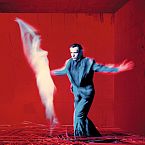
Album: Us (1992)
Play Video
  • From the pain come the dream
    From the dream come the vision
    From the vision come the people
    From the people come the power
    From this power come the change Writer/s: PETER GABRIEL
    Publisher: Sony/ATV Music Publishing LLC
    Lyrics licensed and provided by LyricFind

Comments: 2

  • Catlin from Oakland, CaThe instrument used in the beginning of the song is an Armenian Duduk. This isn't the only Peter Gabriel song where a duduk is used either ;]
  • AnonymousMark Rothko was born Marcus Rothkowitz on September 25, 1903, in Dvinsk, Russia. In 1913, he left Russia and settled with the rest of his family in Portland, Oregon. Rothko attended Yale University, New Haven, on a scholarship from 1921 to 1923. That year, he left Yale without receiving a degree and moved to New York. In 1925, he studied under Max Weber at the Art Students League. He participated in his first group exhibition at the Opportunity Galleries, New York, in 1928. During the early 1930s, Rothko became a close friend of Milton Avery and Adolph Gottlieb. His first solo show took place at the Portland Art Museum in 1933.
    Rothko's first solo exhibition in New York was held at the Contemporary Arts Gallery in 1933. In 1935, he was a founding member of the Ten, a group of artists sympathetic to abstraction and Expressionism [more]. He executed easel paintings for the WPA Federal Art Project from 1936 to 1937. By 1936, Rothko knew Barnett Newman. In the early 1940s, he worked closely with Gottlieb, developing a painting style with mythological content, simple flat shapes, and imagery inspired by primitive art. By mid-decade, his work incorporated Surrealist techniques and images. Peggy Guggenheim gave Rothko a solo show at Art of This Century in New York in 1945.
    In 1947 and 1949, Rothko taught at the California School of Fine Arts, San Francisco, where Clyfford Still was a fellow instructor. With William Baziotes, David Hare, and Robert Motherwell, Rothko founded the short-lived Subjects of the Artist school in New York in 1948. The late 1940s and early 1950s saw the emergence of Rothko's mature style, in which frontal, luminous rectangles seem to hover on the canvas surface. In 1958, the artist began his first commission, monumental paintings for the Four Seasons Restaurant in New York. The Museum of Modern Art, New York, gave Rothko an important solo exhibition in 1961. He completed murals for Harvard University in 1962 and in 1964 accepted a mural commission for an interdenominational chapel in Houston. Rothko took his own life February 25, 1970, in his New York studio. A year later, the Rothko Chapel in Houston was dedicated.
see more comments

Editor's Picks

Little Big Town

Little Big TownSongwriter Interviews

"When seeds that you sow grow by the wicked moon/Be sure your sins will find you out/Your past will hunt you down and turn to tell on you."

Millie Jackson

Millie JacksonSongwriter Interviews

Outrageously gifted and just plain outrageous, Millie is an R&B and Rap innovator.

Don Dokken

Don DokkenSongwriter Interviews

Dokken frontman Don Dokken explains what broke up the band at the height of their success in the late '80s, and talks about the botched surgery that paralyzed his right arm.

Martyn Ware of Heaven 17

Martyn Ware of Heaven 17Songwriter Interviews

Martyn talks about producing Tina Turner, some Heaven 17 hits, and his work with the British Electric Foundation.

Sending Out An SOS - Distress Signals In Songs

Sending Out An SOS - Distress Signals In SongsSong Writing

Songs where something goes horribly wrong (literally or metaphorically), and help is needed right away.

John Lee Hooker

John Lee HookerSongwriter Interviews

Into the vaults for Bruce Pollock's 1984 conversation with the esteemed bluesman. Hooker talks about transforming a Tony Bennett classic and why you don't have to be sad and lonely to write the blues.