Liverpool I left you
said goodbye to Madryn Street
I always followed my heart
and I never missed a beat
"Liverpool is the 'pool of life' " – C.G. Jung, Memories, Dreams, Reflections, 1928
Ringo Starr, best known as the drummer for The Beatles, released this song, "Liverpool 8," in 2008 on his album of the same name. It is an autobiographical song of his life, with emphasis placed on his time with The Beatles, and is named after the area of Toxteth, a postal district in Liverpool where he was born; more specifically, 9 Madryn Street in Dingle, Liverpool, which falls into the inner city area of Liverpool 8. The area is known for its humble working class background and is made up primarily of old terraced houses and social housing. The Liverpool 8 Uprising, or "Toxteth Riots" of 1981 saw many people injured and 81 buildings reduced to cinders when the powerless residents revolted against years of police brutality.
 The Cavern Club in 2015. The original club closed 1973; it was reopened in 1984.
Photo: David Dixon, Geograph Project, CC 2.0By then, however, the Starkey family was long gone.
When Ringo was a child, his family moved him to 10 Admiral Grove, located close by Dingle, where he lived until after he hit the big time, which earned it a mention in this autobiographical song. It also mentions Butlin’s Camp, an English holiday camp, where Richard Starkey first tried on the stage name of Ringo Starr, and where Paul McCartney and John Lennon met him and offered him a place in their band, after having just secured a recording contract. At the time, Starr was playing drums for Rory Storm and the Hurricanes. Also part of the lyric, Hamburg, Germany, is where the band had played regularly before Starr joined them, and where they returned again shortly after he became a part of the group. "
But the song is called "Liverpool 8," so in keeping with Starr's theme, that will be our focus.
Liverpool, is one of the main cities in the North West of England. It sits on the coastline of the Irish Sea, with the Mersey Estuary dividing it from Birkenhead, Wallasey, and the Kirby. The Kingsway and Queensway tunnels connect these two areas and run under the Mersey River. The Queensway is often called the Birkenhead Tunnel so as to distinguish it from the Kingsway, and is 2.01 miles long and circular in in shape. In September 2009, scenes from
Harry Potter and the Deathly Hallows – Part 1 were filmed in this tunnel.
The Liverpool waterfront comprises of the Princess Dock, Pier Head, Albert Dock, and Kings Dock, all which boast several museums and places dedicated to its heritage, such as the Albert Dock, which contains the UK’s largest collection of Grade 1 listed buildings, showing its preserved history. There is also a structure called "A Memorial to the Engine Room Heroes of the
Titanic," as Liverpool was the port of registry of the fated ocean liner, which had the words "Titanic, Liverpool" visible on its stern.
The Liverpool One development, which opened in 2008 and involved the most significant changes since the post-War reconstruction, is a shopping, residential and leisure complex spanning over six districts, totaling 42 acres in the Liverpool city centre, and has played a large role in moving the city into the top five retail destinations in the UK. It has also been closed off to motor vehicles, allowing people to safely access and explore the area. This then leads us to Matthew Street; the street dedicated to The Beatles, and is steeped in their history. This street is home to the Cavern Club, a place allowing its visitors to truly step in to a different era and relive the days of The Beatles. The entrance seems fairly ordinary and displays a statue of John Lennon close by. However, stepping in is anything but ordinary, as one begins the long journey downwards and back in time.
The venue was once used as an air raid shelter during the Second World War and has many flights of stairs leading further underground into the cavernous belly of the club. This is the place where The Beatles spent many a night performing and where they first tasted success. It is dark and cosy, with its history written literally on the wall, which boasts hundreds of names, signatures, scribbles, and messages on the bricks, most of which belong to famous musicians and artists. The real beauty of this club lies in the fact that the small stage is still in use, and on almost any given afternoon will see a band performing for the always-bustling club. There are several sections dedicated to The Beatles with memorabilia lining the glass-enclosed walls. But for the most part it is still a functioning and intimate place where one can feel a part of music history.
The song itself was criticized as being simplistic and not particularly engaging. But it had a definite curiosity value and has earned a decent amount of downloads and interest. The main message of the song is that Ringo Starr feels that even though he physically left Liverpool, it has remained a part of him and that he believes his contributions to music have honoured his birthplace.
Karen Blackwell
August 12, 2014
Comments

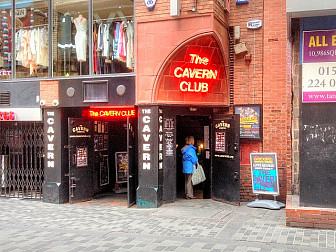 The Cavern Club in 2015. The original club closed 1973; it was reopened in 1984.