Some were spellbound some were hell bound
Some they fell down and some got back up and
Fought against the meltdown
Read full Lyrics
"Walkin' on the Sun" sounds upbeat, but the song is actually about a heavy topic.
Smash Mouth guitarist Greg Camp wrote "Walkin' On The Sun" in 1992 as a way to get out the thoughts and emotions he was having about the Los Angeles Riots (aka the Rodney King Riots) that left 53 dead, nearly 2,400 injured, and close to $1 billion in damages. Camp, who wasn't in Smash Mouth at the time he wrote the song,
told Songfacts the original version sounded very different from the one that would eventually take over the airwaves. The band Camp was in at the time rejected the tune, but he had it still in the back of his mind years later as a member of Smash Mouth.
 A riot barrier in Los Angeles
photo: Mrdoomits"I wrote it on a chintzy little nylon-string guitar that I had," Camp said, "and it sounded to me more like Santana or something. It had bongos and maracas and stuff on the original demo. We took it to Eric Valentine, who produced the record, and we just put this more locomotive driving beat to it. It was already simple, so we just did the little Doors-y style riff in there and that's what happened. The singer [Steven Harwell] brought it out to where it was supposed to be. He had this gravelly voice, but it still has a melody, so it just worked."
Lyrically, the song contends with racial division in the United States, as well as the general atmosphere Camp found himself in back in 1992. "The song was basically a social and racial battle cry," Camp said. "It was a sort of 'Can't we all get along?'"
That "Can't we all get along?" lyric is a reference to the infamous line Rodney King uttered on May 1, 1992, in the midst of the Los Angeles Riots. The riots had kicked off because five police officers were set free, unpunished, after they'd beaten King nearly to death. The whole event was
caught on tape for the world to see, and the events in that tape didn't measure up with the official story the police put forth.
Nearly everyone disagreed with the case's verdict. The city's mayor refused to accept that the outcome was fair or just. President George Bush publicly stated that it was hard to believe the officers were exonerated.
The riots raged for six days, starting April 29, the day of the verdict. "And I'm like,
God," Camp said of his mindset as he watched it all, "what is going on? I don't understand why this is happening. It's like we might as well be walking around a planet on fire."
At the time of the song's release, most people had no idea what it was really about. It didn't matter in terms of sales, as the song was the band's breakout hit and a party favorite in bars and clubs across the country. It initially got a push from alternative station DJ Carson Daly at KOME. Daly then brought the song with him when he went to KROQ in Los Angeles. Daly's work helped create a buzz and made the song viral on other stations, eventually winning Smash Mouth a contract with Interscope.
The song's opening line almost got the band in hot water. The phrase, "It ain't no joke I'd like to buy the world a toke," was a play on Coca-Cola's "I'd like to buy the world a Coke." The company's lawyers contacted the band with complaints, but it never went further than that.
Today "Walkin' On The Sun" is one of the most emblematic, nostalgia-inducing songs for children of the '90s; the social commentary went by largely unnoticed. "Walkin' On The Sun" was a party song, like Smash Mouth's "
All Star." Though, perhaps inducing a world party is the whole point of the song to begin with. Love and fun are the antidotes to hate, after all.
-Jeff Suwak
November 16, 2020
Walkin' On The Sun Songfacts
Browse all Songplaces
Comments


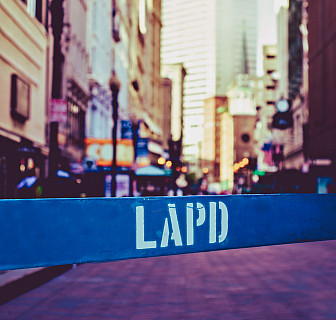 A riot barrier in Los Angeles