Fat cat came to play
Now he can't run fast enough
You'd best stay away
When the pushers come to shove
Read full Lyrics
In the modern age, limitless media outlets compete every moment for our attention. They draw us in with shock and then keep us tuned in through sheer terror, using our own basic instinct for self-preservation to boost their ratings. With this endless proliferation of bad news peddled by murder-and-mayhem mavens, it feels at times that the world is getting progressively scarier and more dangerous. Thankfully, stories like that of the 1943 Zoot Suit Riots in Los Angeles, California, stand to prove to us that the world doesn’t really change much. Things have pretty much always been crazy.
The riots started over fabric. It was 1941, World War II was raging, and the United States issued its first rations for the war effort. This ration attempted to reduce 26 percent of the civilian fabrics usage so that the material could be used for the military. It seems simple enough. But this is the human race we’re talking about. So, of course, it led to a city-wide orgy of violence and rage.
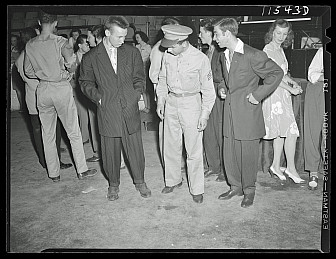
 A Soldier inspecting zoot suiters
Photo: Library of CongressAt the time of the WWII rationing, a Zoot Suit subculture was growing in Los Angeles. This group was predominantly, though not exclusively, made up of Mexican-American and African-American youth. Their trademark attire, the famed zoot suits for which they were known, were big, baggy garments that well exceeded the expectations of fabric usage.
One might think that the fact that their nation was caught in a global conflict with people bent on taking over the world would inspire them to modify their fashion sensibilities, but one would be wrong. The zoot suiters were absolutely devoted to their clothing and would not be so easily dissuaded. They still wanted their trademark suits, and a black market materialized to fulfill that demand. The zoot suits were taken by many to be not only an open mockery of the fabric ration, but also a blatant display of disrespect for the national war effort and the people fighting in it. Tempers rose, as they often do whenever you pack thousands of people inside the confines of a city.
Adding to those tensions were the ones created by the still-fresh memory of the 1942 Sleepy Lagoon murder case, which saw five members of the 38th Street Gang become symbols for many Americans of lawless Mexican youth run amok. Though the five members were eventually set free, their initial imprisonment crystallized the dangerous image of Mexican American youths in the popular American psyche, while simultaneously galvanizing the Mexican-American community itself in response to being persecuted.
Into that pressure-cooker atmosphere went a dozen sailors and soldiers. On shore leave in Los Angeles, they began harassing some women. The event kicked off an altercation with a gang of zoot suiters that saw one of the servicemen take a good beating. Four days later, on June 3, 1943, eleven sailors were jumped and beaten by a gang of zoot suiters after getting into an argument at a bus stop. Those two events would seem innocuous separately, but like so many seemingly innocuous things in modern civilization, together they proved to be violently incendiary, and ended up initiating the Zoot Suit Riots.
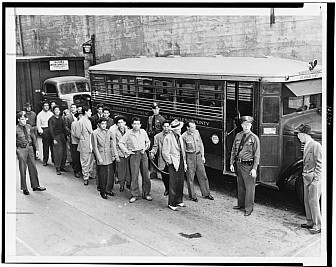
Zoot suiters being taken to jail after the riots
Photo: Library of Congress Two hundred U.S. Navy members taxied into East Los Angeles and began beating anyone they saw wearing a zoot suit. The numbers of servicemen involved soon climbed to thousands. Zoot suiters were pulled off of trolley cars and beaten in the streets, hunted down on their own porches, stripped and pummeled in crowded movie theaters.
When it was all done, over 150 people had been injured, and more than 500 Mexican-Americans arrested. The servicemen were widely lauded for their efforts by police and civilians alike. In the eyes of the masses, physical beatings were apparently seen as a healthy and rational way to cure perceived social ills.
The violence peaked on June 7 when servicemen traveled from as far away as San Diego to get a piece of the action. Incredibly - to modern sensibilities, anyway - taxi drivers gave the men free rides to Los Angeles. By the end, approximately 5,000 civilians and servicemen were involved. Not only Mexican-American zoot suiters, but also African-American zoot suiters became victims.
The attacks finally slowed on June 8, after the military leadership pulled their men from the city and threatened strict punishment for any man going ashore. The wearing of zoot suits was made officially illegal. Fighting continued, but nothing like it had been for the previous days.
The Zoot Suit Riot spread briefly to other California cities, and into Texas and Arizona. There were even some incidents on the far side of the country, in cities like Detroit, New York, and Philadelphia.
Afterwards, Eleanor Roosevelt declared that it had been a race riot, something which Los Angeles media strongly objected to. The debate continues to the modern day, where some feel the conflict was primarily racial/cultural, while others hold that it was truly a matter of patriotism and the war effort rationing.
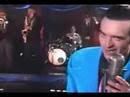
As serious as the Zoot Suit Riots were, there isn’t any need to read too much into the political implications of the Cherry Poppin’ Daddies' 1997 song named after the event. Front man and writer of the tune, Steven Perry, has stated, “I guess it seemed like a Pachuco rallying cry that would double down as a dance anthem for those of us interested in swing music and culture at a time when nobody else was. It was an expression of proud marginalism. That’s not deep, but there you go.”
The lack of a deep-thought political message did little to detract from the song’s mainstream success - as if it ever does. Released on the band’s 1997
Zoot Suit Riot album, "Zoot Suit Riot" was a rare success for the band from Eugene, Oregon. It hit as high as No. 15 on the U.S. Billboard Modern Rock Tracks chart, and help fuel a revival of swing dance culture in the U.S.
It’s unlikely that the swinging supplicants of the revival were thinking too much about American race relations or American war history while flinging each other through the air on the dance floor. Still, the event is not only interesting in itself, but is also a nice window into the history of broader American social and cultural issues. It was a few days of violence that have mostly been forgotten in the shadow of the greater conflict of the era.
Jeff Suwak
June 15, 2016
Zoot Suit Riot Songfacts
Browse all Songplaces
Comments

 A Soldier inspecting zoot suiters
 Zoot suiters being taken to jail after the riots