He went down to Oxford Town
Guns and clubs followed him down
All because his face was brown
Better get away from Oxford Town
On October 1, 1962 a black man, James Meredith, stepped foot onto the campus of the University of Mississippi in Oxford. He was the first African-American to do so as a student. After months of legal battle, NAACP-led lawsuits, and blatantly xenophobic legislation on the part of the state, Meredith, at that time nearly 29 years old, began coursework at the college.
 Meredith being escorted onto campus by John Doar (right)
Photo: Library of CongressMeredith had attended Jackson State University, a historically Black university, for two years prior to application to the University of Mississippi. He was denied admission twice to Ole Miss, but persevered, eventually taking the case to the U.S. Supreme Court. There it was decided that Meredith had the right to be admitted to the school, although local government was not so accepting and quickly acted to put laws into place that might bar Meredith from endeavoring to study at their most prestigious state school.
Not only did Meredith's pursuit of a degree at an all-White school in the Deep South challenge the Kennedy administration to further pursue civil rights agendas, but Meredith's gesture became an hour of decision in the history of our country. As such, Meredith's enrollment to the university sparked controversy and riots throughout Oxford. President John F. Kennedy sent U.S. Marshals to the campus and later, as the riots turned violent, the U.S. Border Patrol, the U.S. Army military police, and the Mississippi National Guard. When the tumult finally settled, hundreds were injured and two were dead.
James Meredith in the Winter Library
Photo: rainchurch, via Flickr, CC 2.0) Just months after this profound and disarming episode,
Broadside magazine, an influential underground publication focusing on folk revival throughout the 1960s, challenged songwriters to compose a ballad about the events that took place in Oxford. It was in response to this invitation that Bob Dylan wrote and recorded "Oxford Town." The lyrics to the song were reproduced in the December 1962 edition of
Broadside and the song appears on Dylan's album
The Freewheelin' Bob Dylan. Without mentioning the university or Meredith by name, Dylan explores this substantial historical moment in spare verse, focusing on race and violence. The song begins with the terse invocation of shame: "Oxford town, Oxford town / Everybody's got their heads bowed down," and continues to dimly chronicle the events of October in Oxford. A year later, in an interview with Studs Terkel, Dylan confirmed the references in the song, yet added, "I wrote that when it happened. I could have written that yesterday. It's still the same." Cryptically adding, "'Why doesn't somebody investigate soon,' that's a verse in the song."
Dylan implies the lasting implication of the events surrounding Meredith's attendance at the University of Mississippi and the continued presence of strife and struggle regarding issues of equality in our country. Despite professing a mere year later that he could have written the song "yesterday," the abiding fact remains that this song could have been written, literally, yesterday, and still carry a telling weight in the mind of the listener. Despite the somber account that will be recorded in history books and streamed through speakers for ages, there are encouraging points of optimism that can be taken away from both accounts, one of them being that James Meredith graduated from the University of Mississippi in 1963 with a degree in political science.
Maggie Grimason
November 11, 2013
Comments

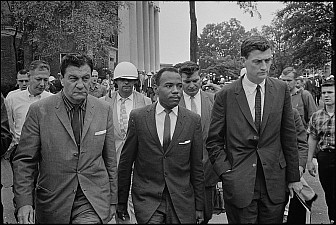 Meredith being escorted onto campus by John Doar (right)
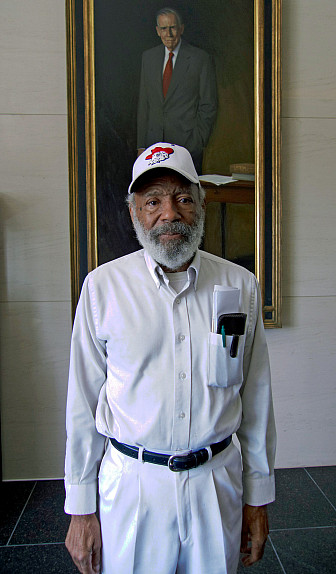 James Meredith in the Winter Library