Antarctica is the most inhospitable continent on Earth. It's a polar desert that hasn't had rain in nearly two million years. The only people who live there are research scientists and the people who provide logistical and administrative support to the scientists. It's a rough, barren place that is unkind to humans.
So, naturally, humans were determined to go to Antarctica pretty much since day one. It's just how we roll.
Humans became particularly driven to conquer Antarctica during a period called the Heroic Age of Antarctic Exploration. This time period fell between 1897 and 1922. Not even World War I (1914–1918) could stop it. The Heroic Age was composed of 17 major expeditions during which 19 people died.
Technology was good enough to get people to Antarctica, but not, by any stretch of the imagination, good enough to make exploration easy or safe. The expeditions took fantastic levels of mental and physical fortitude. That's why they're called "heroic," after all.
Al Stewart's "Antarctica" mentions Heroic Age explorers Sir Ernest Henry Shackleton and Robert Falcon Scott. The two men were at times collaborators and at times rivals, but mostly rivals. They came together when Scott brought Shackleton on as an officer in the crew of his Antarctic expedition, Discovery. There was some initial friction over Scott's authoritarian leadership style, which he learned as a lieutenant in the Royal Navy, but Shackleton accepted his role and things went smoothly - at first.
Shackleton quickly proved very popular among the crew. He was gregarious and good at getting along with people of all backgrounds. He was also apparently effective at his work, because Scott chose him as one of only two men to accompany him on an attempt to reach the South Pole (which is in Antarctica).
 Edward A. Wilson, Robert F. Scott, Edgar Evans, Lawrence Oates, and Henry Robertson Bowers at the South Pole
Photo: Library of CongressThe trio left on November 2, 1902. The march was grueling and grew even worse after all of their sled dogs died from tainted food. They didn't make it to the South Pole, but they did make if farther than anyone in history had made it previously. The trek was so difficult that Shackleton fell apart mentally and physically. He admitted this himself.
He did not, however, admit to Scott's later claims that Shackleton had to be carried on a sledge. Scott then had Shackleton taken home on a ship called
Morning, saying it was for Shackleton's own good. This caused a serious rift between them.
There were other factors at play, as well, though historians disagree on their severity. Some say Scott was jealous of Shackleton's popularity, for instance. Whatever the precise triggering event or events, the two men became determined, some say obsessed, to outdo each other in making it to the South Pole.
In 1907 Shackleton led an expedition named Nimrod that lasted until 1909. Shackleton wanted to get to the South Pole, but he and his men nearly died in the effort and had to turn away. They didn't make their ultimate goal, but they did set a new southern-latitude record.
Scott was determined to outdo Shackleton. He'd already been planning an expedition, but Shackleton's attempt fueled him even more. He set out in 1910, the same year a Norwegian named Roald Amundsen also ventured for the South Pole. They both made it to Antarctica, and both made it to the pole. The similarities in their stories end there.
Amundsen was the first to make it. He returned home to a hero's welcome.
Scott followed 33 days behind. He did make it to the Pole, but he and his four companions all died on the trek back.
Shackleton led two more expeditions, one named Endurance in 1914–1917, the other called Quest in 1921–1922. Quest was the last of the Heroic Age Antarctic expeditions.
Al Stewart and guitarist Peter White wrote and recorded "Antarctica" in 1988 for Stewart's 11th album,
Last Days of the Century. The lyrics are somewhat vague and seem to be occupying the perspective of some other explorer's mind, as the song includes the lines:
The hopeless quest of Shackleton
The dreamlike death of ScottIf Stewart is occupying one of the other Arctic explorer's psyches (there were quite a few besides Scott and Shackleton), he doesn't give us much information to figure it out. Whatever the case, he captures the reckless obsession of Scott and Shackleton's quests beautifully, as he does with the dangerous beauty of Antarctica.
June 15, 2023
-Jeff Suwak
Antarctica Songfacts
Browse all Songplaces
Comments: 3

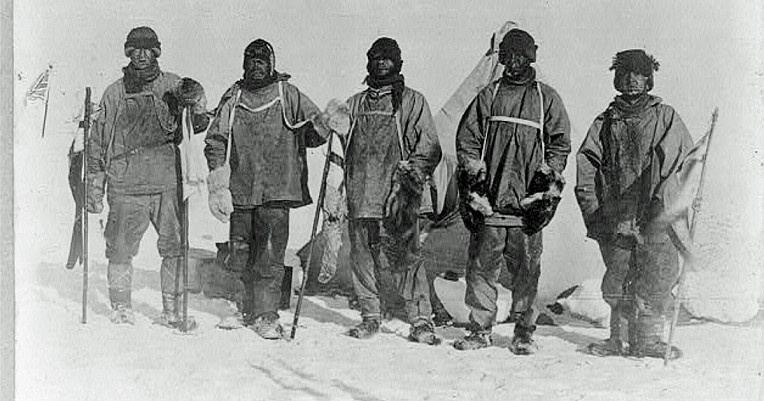 Edward A. Wilson, Robert F. Scott, Edgar Evans, Lawrence Oates, and Henry Robertson Bowers at the South Pole