I remember when we used to sit
In the government yard in Trenchtown
Read full Lyrics
Bob Marley had many musical sides to his personality. He could be a warrior sending out the battle cry one moment, or a social activist bringing attention to substandard living conditions the next. "No Woman No Cry" reveals the singer/songwriter's tender side. This song is like an adult lullaby, as Marley begs a woman not to cry.
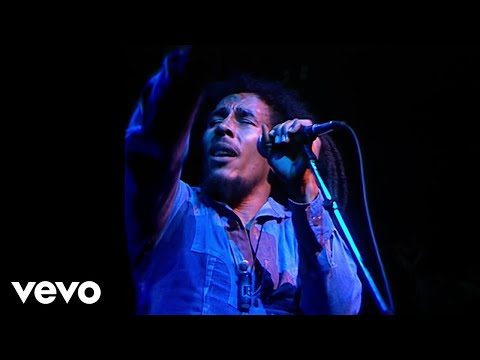
Bob Marley & The Wailers originally released the song on the group's 1974 studio album
Natty Dread. But it was the version from the
Live! album that has become the most popular take on the song. Marley doesn't even have writing credit for the song, although he may actually have penned it. The pretty ballad is credited to "V. Ford." Vincent Ford was one of Marley's friends. Ford ran a soup kitchen in Trench Town, the Kingston, Jamaica ghetto name-dropped in the song.
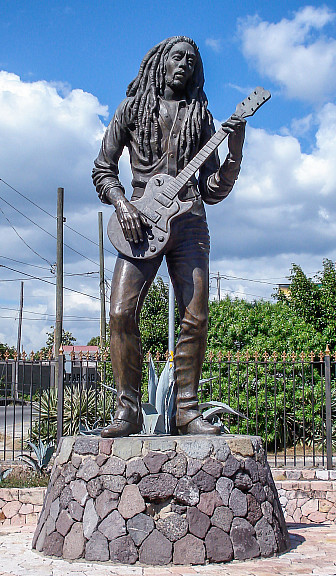
 Bob Marley statue in Kingston
Photo: avda-foto, via Flickr, CC 2.0While reggae fans relate Trench Town to the pivotal birthplace of Bob Marley, its fame is even wider than just being the hometown of reggae music's greatest ambassador. It is also credited as the very birthplace of reggae music itself, as well as rocksteady music.
Some mistakenly believe this region's unique name derives from a large open storm-water drain that cuts through the neighborhood. In truth, the locale was previously referred to as Trench Pen. The "Trench" in its name is taken from Daniel Power Trench, an 18th century Irish immigrant. Although Trench raised livestock on this land, his family gave up the property sometime in the 19th century.
It's likely reggae fans couldn't care less about Trench Town's livestock past. The names of its reggae stars, though, are legendary. In addition to Marley, current and past residents include Toots & the Maytals, Wailing Souls, Delroy Wilson, Joe Higgs, Leroy Sibbles, and Marley's fellow Wailers, Peter Tosh and Bunny Wailer. This is reggae royalty, of the highest order.
The song's lyric is as much a reflection on a life lived as it is about a particular place. Lyrics like
"Good friends we have had, oh good friends we've lost along the way," refer to the people that have come and gone in this person's life. In the ghetto, life expectancy is always shorter than in more well-to-do areas.
When Marley sings,
"In this bright future, you can't forget your past," it seems to apply primarily to the reggae singer's successful career. He may have sung for world leaders and many other important people before he passed on, but he could not – and would not – forget his roots.
The song includes the repeated line of, "Ev'rything's gonna be alright." Although Marley's obviously singing to a grown adult, evidenced by a "woman" being his sole audience for this song, he is also behaving like a father to a child. These are the same kinds of words a dad would use with his small child if, for instance, she imagined a monster under her bed or in the closet. A child may be worried and confused, but dads know there is no such thing as monsters. Ev'rything's gonna be alright, indeed.
It could also be interpreted that Marley wants to stop this woman's tears from falling because seeing her crying may make him cry as well.
"Oh, my little darlin' please don't shed no tears," he pleads. It's as if he knows too well what might happen next, if this woman begins to well up.
Sonically, this song is as much a soul song as it is a reggae tune. The churchy organ part that runs through it, from beginning to end, turns it into something akin to a Saturday night hymn. And Marley, ever the outspoken one, behaves like a preacher.
Who could ever have predicted that one of popular music's greatest lullabies would have its roots in such an economically deprived place as Trench Town in Kingston, Jamaica? Think of this as one of life's little sonic miracles.
Dan MacIntosh
February 9, 2014
No Woman No Cry Songfacts
Browse all Songplaces
Comments

 Bob Marley statue in Kingston