The Guess Who suck
The Jets were lousy anyway
The same route every day
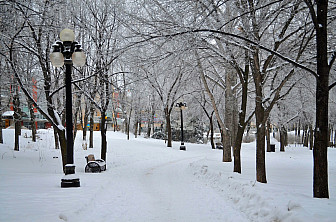
Winnipeg is, by many accounts, one of the coldest places in North America, and the bleakness of a near perpetual winter permeates every facet of the music released by Canadian indie rock band The Weakerthans. Their ode to their home city, where the band remains to this day, "One Great City!" is colored with the isolation of a cold world and evocative of the endless commutes to nowhere in particular, the minutiae of work, and the anger of the modern world, themes that recur time and again in The Weakerthans' catalogue. The simple repeated notes of "One Great City!" let us focus on the cadence of the rhymed lines and singer John K. Samson's loving lyrical destruction of his city as the chorus turns from character to character singing the halted words: "I hate Winnipeg."
 Winnipeg in winter
The song, for all its repetition of the line "I hate Winnipeg," paints an almost nostalgic musical landscape, saying more about the people and the individual's resentment for what they have built rather than the city itself. John K. Samson is practically a master fiction writer in his ability to establish place and cut to the heart of every moment, with characters invented and abandoned in single lines. Each of the three verses of "One Great City!" present the listener with a different character observing the city around them from their unique place within it. A dollar store clerk closes up shop, a man driving a bus, a businessman standing atop his empire accompanied by a wrecking ball that does the talking for him; these are the people whose stories are told in the song and each reaches the same conclusion: "I hate Winnipeg." The song belongs to the characters it invents, not to the city. It is about the veiled sadness that creeps into the edges of our daily lives that is so easily projected onto where we are, rather than what we have allowed ourselves to be and become, and the city seems to echo back our feelings through gas prices, construction, and customers. It is a place and a song built around the lens through which it is seen.
The dollar store clerk observes the city changing colors as an early dusk settles over the landscape - "a darker gray... breaking through a lighter one" - and listens to the same dulled sounds of the traffic through the store, waiting for the customers to leave so he can close up. In six lines, the monotony of working a minimum wage job and the death of another day soaks the simple music and Samson's lulling voice, singing an angry lullaby to the city. Moving out of the dollar store door and into the street in the second verse, we are with a faceless bus driver (and bus drivers are frequently the subject of Samson's work) going through the motions of checking the mirror, changing lanes, watching traffic, and tracking the price of gas. Here the story shifts and allows the city to sing with the characters, the bus driver "hears the price of gas repeat his phrase / I hate Winnipeg." In the last verse the perspective shifts completely, and we are transported to a skyscraper reaching toward the Canadian sky, and a businessman standing atop his empire "watching the north end die / and sing[ing] 'I love this town'" as he destroys it. The only joy in Winnipeg is watching its old self die, and so the agent of its death - the wrecking ball - slowly sings, "I hate Winnipeg." And so the song is arrested in its movement and comes full circle, from the people on the ground to those in the skyscraper, the only saving grace is movement and reinvention for this place, and by virtue of being there, the same is true for the characters.
Maggie Grimason
October 11, 2012
Comments: 5

 Winnipeg in winter