In a foreign field he lay
Lonely soldier, unknown grave
On his dying words he prays:
Tell the world of Paschendale
Read full Lyrics
Following in the footsteps of poets like Wilfred Owen, many of Iron Maiden's songs revolve around deglorifying war and revealing its grotesque and atrocious reality. Some of these refer to specific battles of such horror that they forever stained the land beneath them in blood and misery. This song tells the story of the Battle of Passchendaele Ridge which took place in 1917 as part of the First World War, just outside the Belgian town of Ypres in West Flanders.
Perhaps one of the greatest pioneers of the heavy metal genre, Iron Maiden has become a seminal part of metal head culture and is considered one of the most successful bands in heavy metal history. Formed in 1975 by primary songwriter and legendary bassist Steve Harris, the band has since released a prolific amount of albums and is still composing and touring today. There are many themes explored in Harris's lyrics that keep coming up across all the different albums, such as consciousness, the afterlife, and dreams, prophecy and politics. But one of the things Harris clearly had more than most to say about is the pointless depravity and barbarity of war.
 A cemetery in Ypres where many killed in WWI are buried
Photo: cathallee0, Pixabay"Paschendale" is the eighth track on the album
Dance of Death released in 2003. The album was recorded with the definitive Iron Maiden line-up of Harris on bass and backing vocals, quintessential front man Bruce Dickenson on lead vocals, Nicko McBrain on drums, and the blistering lead guitar trio of Adrian Smith, Dave Murray, and Janick Gers. The world tour for the album led to a live recording released on DVD in 2005 entitled
Death on the Road. During this tour Bruce Dickenson became more theatrical than ever before, bringing the show to life with a series of costume changes, stage props and special effects. When "Paschendale" was being played, he would slump and lay dead over barbed wire while wearing a traditional British infantryman's trench coat and helmet (although he later revealed that the helmet was actually of Hungarian origin). Adrian Smith came up with the haunting intro, which inspired a studio composing session, which eventually grew into the song. Along with other Maiden songs - like "Be Quick or Be Dead," "The Trooper," and several tracks from their more recent war-themed album
A Matter of Life and Death, "Paschendale" constitutes a devastating critique on the sheer sorrowful stupidity of war and its unimaginably horrific consequences.
The battle itself was part of a larger and long lasting campaign, centered on a fight to control the no man's land of Passchendaele Ridge just east of Ypres in West Flanders, Belgium. The terrain of wet and barren muddy silt made waging war especially horrible, as captured in the lyrics: "Many soldiers, eighteen years, drown in mud, no more tears. Surely a war no one can win, killing time about to begin." The battle is historically controversial and often cited as an example of how bad political and military decisions are paid for, not by the blood of those who make them, but by a staggering yet pointless human cost to the armies on both sides. The mud and bad weather put both armies in an ill-supplied stalemate, leaving thousands of soldiers to rot in gruesome conditions that inspired lyrics like "The bodies are ours and our foes, the sea of death it overflows. In no man's land God only knows, into jaws of death we go," and "Blood is falling like the rain, its crimson cloak unveils again. The sound of guns can't hide their shame, and so we die at Paschendale."
Despite Ypres's misfortune at being a valuable strategic location during WWI, it is an ancient town with a rich history. During the middle ages it was a very prosperous Flemish city, and is even mentioned in Chaucer's
Canterbury Tales. The town was largely rebuilt after the war, funded by German reparation payments. It has made great strides since then, and is now a very modernised and beautiful European city. But the devastation of war is not easily forgotten, and the landscape surrounding Ypres contains a vast number of cemeteries and memorial sites to commemorate the soldiers who died there. Ypres also maintains a very close relationship with the city of Hiroshima, as both not only suffered greatly from the collateral damage of poor military decisions, but were also sites for the debut of new technologies of war that brought with them an unprecedented scale of misery (Ypres through the first use of chemical warfare in WWI and Hiroshima through nuclear warfare in WWII). Together the two cities continue to campaign for the abolition of war and its destructive tools.
Harris's lyrics "Cruelty has a human heart, every man does play his part. Terror of the men we kill, the human heart is hungry still," reminds us that despite the hypocrisy in every war between those who order and those who fight and die, each and every participant carries some degree of responsibility. War is the ugliest expression of our darker human nature, but the best way to improve expressions is to understand the nature from which they flow. Before we blame only the politicians and generals while lamenting the poor foot soldiers, we should remember this poem by another of Harris's great influences, William Blake:
Cruelty has a Human Heart
And Jealousy a Human Face
Terror, the Human Form Divine
And Secrecy, the Human Dress
The Human Dress, is Forged Iron
The Human Form a fiery Forge
The Human Face a furnace seal'd
The Human Heart its hungry Gorge.Stefan Smit
April 14, 2014
Paschendale Songfacts
Browse all Songplaces
Comments


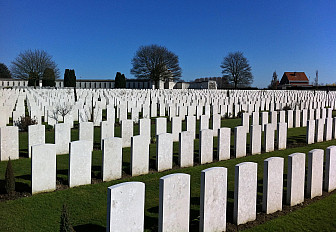 A cemetery in Ypres where many killed in WWI are buried