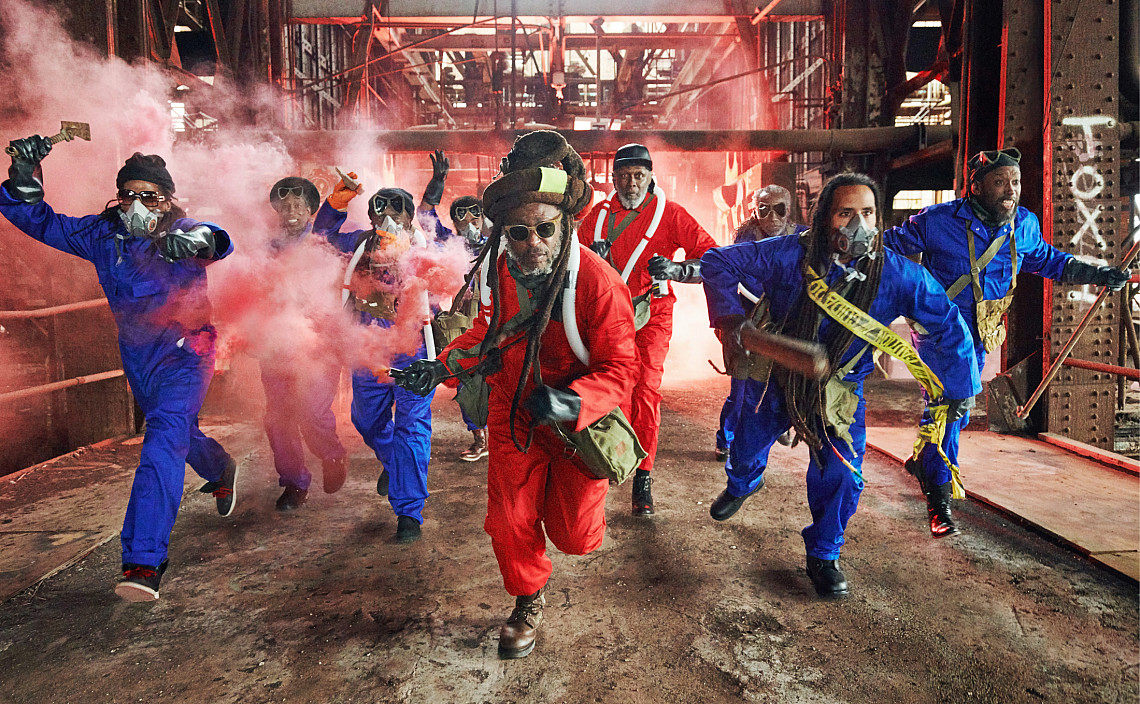
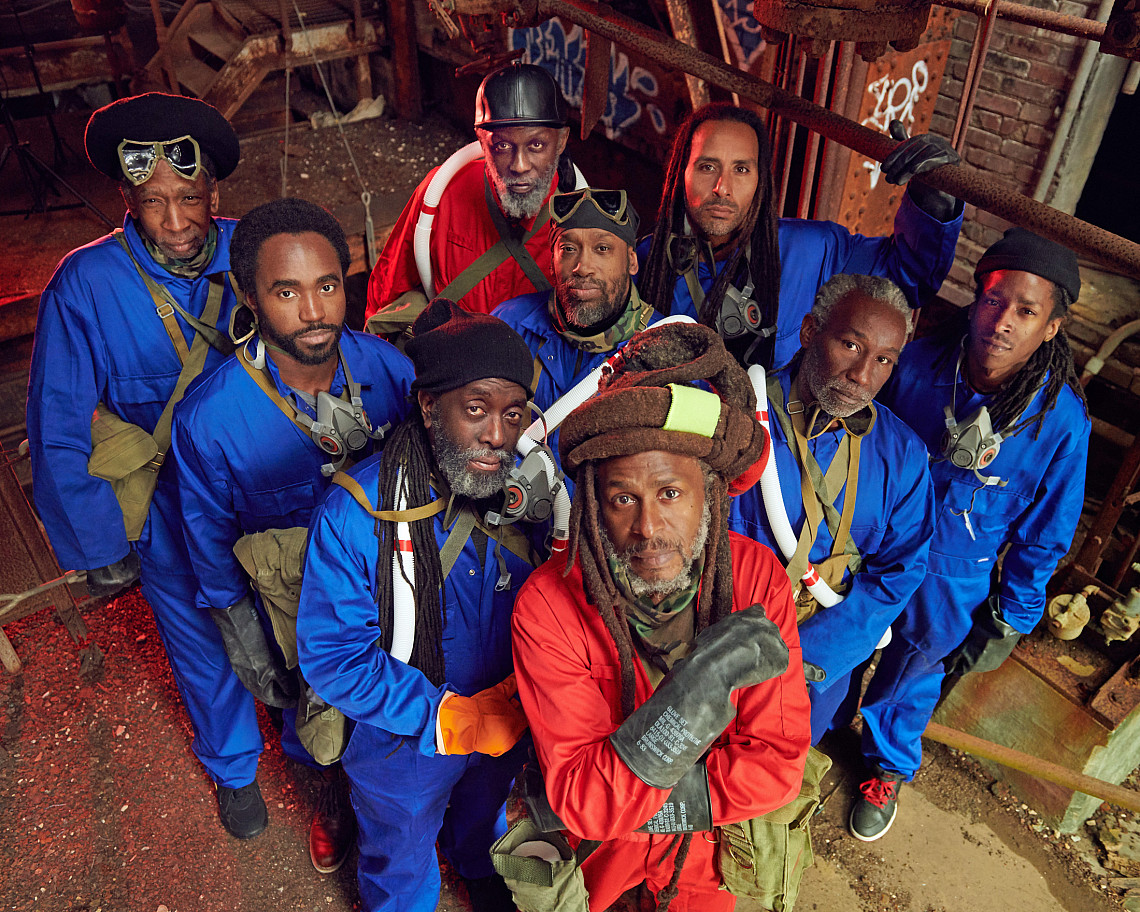
UB40 had the hits, but Steel Pulse is the British reggae band that followed the lead of Bob Marley, stirring up songs about knowing your past to find a better future in a world of injustice. Led by vocalist/guitarist/songwriter David Hinds, Steel Pulse has combined the spirit of Jamaican roots music with the political/social heart of a punk rock band for over 40 years. When the group opened for punk/new wave bands like The Clash, The Police and XTC in the '70s, they fit right in. Early albums, like Handsworth Revolution and True Democracy, were formative first reggae experiences for newer reggae fans in the '70s and '80s.
Like UB40 and The English Beat, Steel Pulse formed in Birmingham, England, at a time when second-generation immigrants from Jamaica were coming of age. Jamaica was a British colony until 1962; after World War II, many from the island were brought to England to rebuild the country, bringing with them a rich musical and cultural heritage. Steel Pulse formed in the Handsworth section of the city. They signed with Island Records in 1978 and released their first album, Handsworth Revolution, that year. This was also the year they participated in a historic Rock Against Racism concert in London, where they joined The Clash and several other acts to oppose the UK neo-Nazi group the National Front, whose slogan was "Keep Britain White." Steel Pulse released two more albums on Island before getting dumped by the label; they signed with Elektra in 1982. While UB40 scored with hit covers of songs by Neil Diamond and Sonny & Cher, Steel Pulse remained revolutionary, making more militant music and asking uncomfortable questions, like why there weren't more black performers at Live Aid.
There was no pop crossover for Steel Pulse, but in 1986 they won the Grammy for Best Reggae Album with Babylon The Bandit, making them the first non-Jamaican act to win that award. In 1993, they became the first reggae act to perform at a presidential inauguration: Bill Clinton's.
The band has gone through many lineup changes over the years, with Hinds and keyboard player Selwyn "Bumbo" Brown the constants. They still have a lot to say: Their 2019 album, Mass Manipulation, doesn't just feed into the outrage, it brings their unique perspective to it.
In this interview, Hinds covers some key tracks in the band's catalog, including one from their debut album that got a lot of attention: "Ku Klux Klan." But we'll start with an uplifting song written during a personal and professional low point.
Like UB40 and The English Beat, Steel Pulse formed in Birmingham, England, at a time when second-generation immigrants from Jamaica were coming of age. Jamaica was a British colony until 1962; after World War II, many from the island were brought to England to rebuild the country, bringing with them a rich musical and cultural heritage. Steel Pulse formed in the Handsworth section of the city. They signed with Island Records in 1978 and released their first album, Handsworth Revolution, that year. This was also the year they participated in a historic Rock Against Racism concert in London, where they joined The Clash and several other acts to oppose the UK neo-Nazi group the National Front, whose slogan was "Keep Britain White." Steel Pulse released two more albums on Island before getting dumped by the label; they signed with Elektra in 1982. While UB40 scored with hit covers of songs by Neil Diamond and Sonny & Cher, Steel Pulse remained revolutionary, making more militant music and asking uncomfortable questions, like why there weren't more black performers at Live Aid.
There was no pop crossover for Steel Pulse, but in 1986 they won the Grammy for Best Reggae Album with Babylon The Bandit, making them the first non-Jamaican act to win that award. In 1993, they became the first reggae act to perform at a presidential inauguration: Bill Clinton's.
The band has gone through many lineup changes over the years, with Hinds and keyboard player Selwyn "Bumbo" Brown the constants. They still have a lot to say: Their 2019 album, Mass Manipulation, doesn't just feed into the outrage, it brings their unique perspective to it.
In this interview, Hinds covers some key tracks in the band's catalog, including one from their debut album that got a lot of attention: "Ku Klux Klan." But we'll start with an uplifting song written during a personal and professional low point.
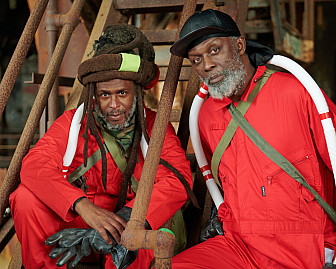 David Hinds and Selwyn Brown
David Hinds: Yes, I do remember writing that song. I was in a single bedroom in someone's house, renting at that time. I was at my lowest ebb. I had broken away from my daughter's mother, and I wasn't able to see my kid. So, with all the other things happening, we'd just gotten kicked off the record label as well. A lot of double whammy things happening at that time.
I penned that song while I was sitting down in the room, actually. Also, we were going through a transition where, as Rastafarians, we were doing a lot of Bible reading and were using a lot of biblical texts when we were putting songs together. So, with all that part and parcel, it triggered "Chant A Psalm."
It was just a way of telling myself, "Don't be down and out because you've got that psalm you can be chanting every day." And at that time, I was reading books, like the sixth and seventh Book of Moses, certain books that were eliminated from the Bible at that time. We were seeking the half that has never been told. With all those kinds of elements floating around in my head, I think that helped me to pen that song at that time.
Songfacts: I can kind of sense that you were trying to encourage yourself. Like you were speaking to yourself.
Hinds: Yeah. All the songs were speaking to myself at that time. That period of the band's life wasn't very pretty, what we were staring at after three albums at Island Records. So, looking back on it in retrospect, those are the things I could immediately bring to mind that could have triggered off that song at that time. Nobody's ever asked that question before. Imagine that.
Songfacts: One of the songs that was really popular around that time was "Ku Klux Klan." Here in the United States, we're still seeing activity by the Klan. Could you have imagined when you wrote that song, that that would still be relevant in 2019?
Hinds: I had no idea or inkling. You know, sometimes people think about the demographics, like who it's going to target and how it's going to affect who it targets. When we did that song, it was just expressing ourselves, sheer imagination. Just like the song said, "Walking along, kicking stones."
That was based on us experiencing a situation similar to that American negativity, the National Front. It was a new political party in Britain that was all about racism, basically, and the head of the Ku Klux Klan was invited over to school them on how to treat immigrants and minorities.
We didn't expect the song to go all the way to the United States and make an impression. When we arrived in the United States, we began to realize how intense it was as a song. Prior to arriving in the United States, my father was always saying to me, "I hope you don't go over there and sing that song." And I said, "Dad, what are you talking about?" He said, "See what they've done to their president? If they did that to their president, what chance do you have?" [United States President John F. Kennedy was assassinated in 1963.]
Funny you should ask that question because during the documentary [Dreadtown], we were trying to find that guy that went on stage and did that. We were asking ourselves, What was the idea of that? Some people will say, "This guy was so disgusted with the Klan, he attacked the whole concept." But we had no idea when we wrote that song that it would have that impact in the United States. And now 40 years later, the Klan is still an integral part of American society.
Songfacts: Unfortunately, we need to stay vigilant, because if we forget about groups like that and the terrible things they've done, they rear their ugly heads again. It's sad that we need to keep pressing the point.
Hinds: What's sad, Dan, is America, United Kingdom, France, Spain, Germany - all these countries with European, Caucasian ancestry, have spent several centuries trying to teach the world or show the world how civilized mankind should be and can be. They did it through politics and religion and through economic means, and what rubbed off is a lot of third world countries have taken up the mantle of what the European and Western world have tried to preach. In third world countries, you read about these places with their streets paved with gold and their lands of milk and honey. If you want a better life, this is the kind of life you need to lead - this kind of country you need to migrate to. Once you start doing that, you wonder what's wrong with you. That's the sad part.
It's very confusing for someone like myself who is a third world descendent, the way we view things. The Western world is trying to teach us things and we're trying to learn what they've taught us: try to strengthen ourselves economically and academically, even take up the religion. They've abandoned their religion, their faiths, their culture, for what has been taught for several centuries as the way to be. It's a bit of a conundrum.
Hinds: First of all, we've all got to realize in this society, this age of technology, that news makes money. Let's say it's Neil Armstrong and it's 1969 and we fast forward five decades now. Fifty years have gone by and we're celebrating 50 years since Neil Armstrong went on the moon. You can bet America's going to be all over that like a cheap suit. Let's say something happens in another part of the world that is not relevant news. So, what's been going on with the slave trade and all these other incidents have been put on the back burner because when it comes to the world of news and media, they do not see that as an important issue.
The song derives from a project I was assigned to do. It actually came from our lead guitar player, David "Cirious" Elecciri, who was putting together a compilation for the benefit of those who have been suffering from human trafficking. I thought it would be a good idea to be part of it, so I wrote the song with the intentions of putting it on a particular album. [The album is Music to Inspire for the United Nations Artists United Against Human Trafficking] I took it as something we need to bring to the forefront.
Songfacts: What's an example of one of your songs that stands the test of time, that you never get tired of performing?
Hinds: There is one particular song that I never get tired of doing it, and it might be perceived as my favorite Steel Pulse song. It's "Soldiers" from the Handsworth Revolution album. I keep asking, "What made you keep having this song in the set?"
"Soldiers" is probably our most-played song outside of "Rally Round The Flag" and "Steppin' Out." I'd lose "Steppin' Out" in a heartbeat if I could, but because of the fans, we keep it in. And "Rally Round," I wouldn't mind losing that, too. I love "Rally Round," but it's run its course. But a lot of people sing it as their national anthem, so we keep it in for that reason and because it's the song that echoes True Democracy. But the song that really comes closest to home to me, is "Soldiers." It's based on a movie I saw with Candice Bergen many years ago called Soldier Blue [1970].
It's an American movie with a woman who was a sex symbol back in the day. It was about her trying to teach a young US calvary soldier the other side of the story when it came to Native American Indians. The film starts when Native American Indians kill some soldiers who come back for revenge and wipe out their entire tribe. And then the soldier reflected on what Candice Bergen's character told him, and he was sickened by what he saw, the way the Native Americans were treated. So, after I saw that, some ideas started running through my head because similar things happened to the African diaspora. I wrote the song with that same kind of sentiment.
[Hinds sings]
When soldiers came
They said they came to make us tame
And from that day until now on
We were jeered and laughed to scorn
Things used to be ire before the soldiers came
Things used to be nice
Our country them did enter, yeah
Troops trodding left right and center
One moment at peace with nature
Now victims of a massacre
We got our spears
We got our shields
But their guns were greater
Prepare for a slaughter
When I'm talking to you now, I'm getting goosebumps. It's a song I sing almost every day on tour. I'm getting goosebumps explaining it to you, so there's something in that song that, to me, says it all when it comes to Steel Pulse.
July 9, 2019
More at steelpulse.com.
Here's our interview with Dave Wakeling of The English Beat, and our interview with Stewart Copeland of The Police.
photos: Patrick Niddrie
More Songwriter Interviews