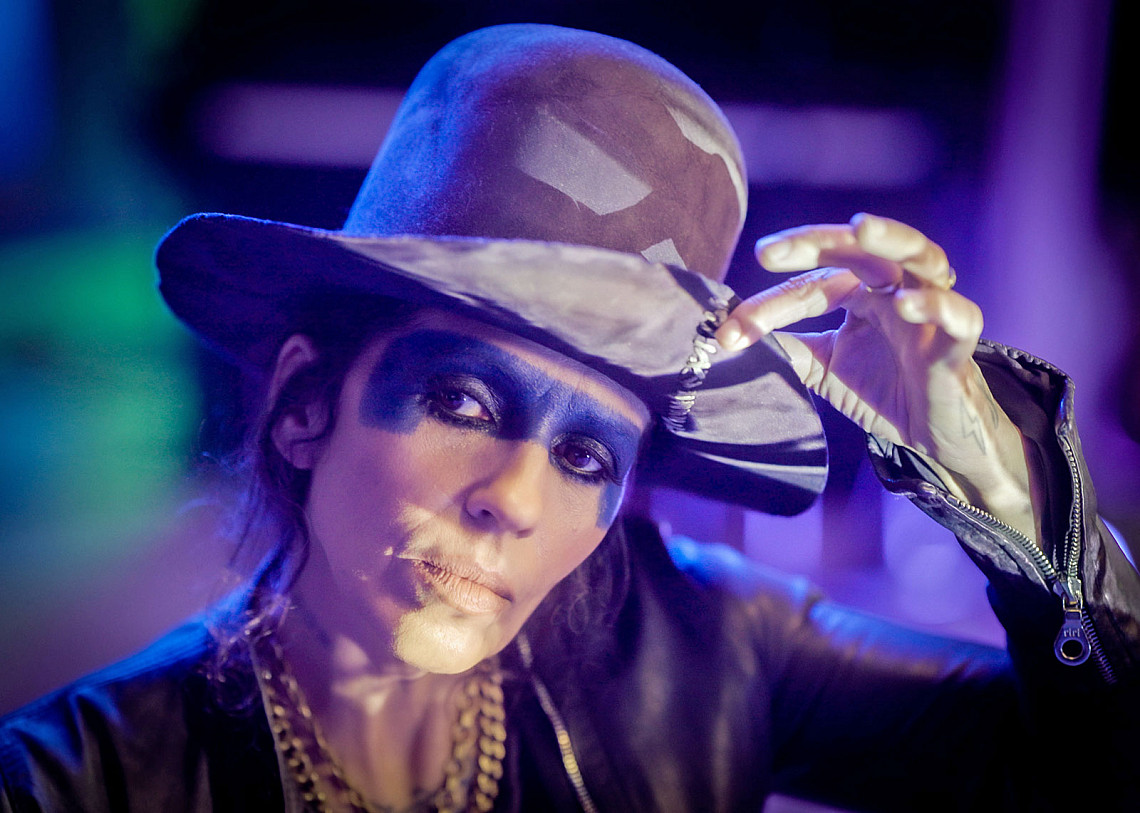
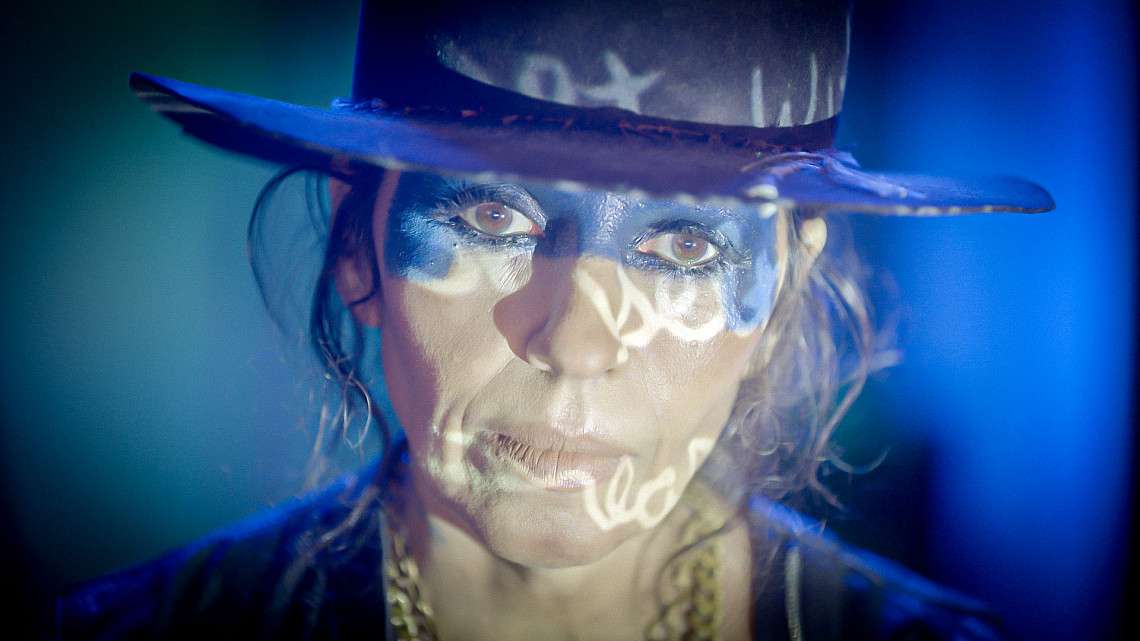
 We caught Linda Perry at a transitional period. She made her mark as the iconoclastic frontwoman of the rock band 4 Non Blondes. Their 1992 Perry-penned "What's Up" has over a billion YouTube views, putting it in league with "Zombie" and "I Will Always Love You" as the top '90s songs on the platform. It was just a modest hit at the time, though, and the band broke up after just one album. In the late '90s, Perry went solo and found herself doing musical odd jobs like opening for Bryan Adams, where she would scream from the top of her lungs, What's going on! as crowds filed in.
In the '00s, she reinvented herself as a songwriter, and a damn good one. Good enough to earn membership into the Songwriters Hall of Fame. Among her hits: "Get The Party Started" for Pink and "Beautiful" for Christina Aguilera.
Now, she's taken her musical talents to the film world. She collaborated with Dolly Parton to write songs for the Netflix film Dumplin', scored the soundtrack for the Hulu documentary Kid 90, and made music for a documentary about Sean Penn's time in Haiti called Citizen Penn. "This is where I'm supposed to be," says Perry. "This is my next chapter."
Linda Perry: Interesting. You know, the thing about that question, when it comes to writing things down, I can find that to be a chore. I have to do that all the time. I have to put down rollouts, I'm constantly sending emails. Even though it's emotional, the action feels like a job. A chore. Something I need to do. Whereas, when you're writing a song, that's something that is an emotion, in a moment. I have my headphones on. I'm sitting quietly. I'm in my zone and I'm expressing myself, and I don't have to answer to anybody. This doesn't have to get out to somebody. This is just an internal creative moment that is for me, whereas the act of writing a letter is beautiful, emotional, but because I have all these other things that tie to writing - letters, emails, songs - I just leave it in my head.
So, the majority of the lyrics, I'm ad-libbing, and I'll do that for a long time. So, I'm not sitting at my piano and writing lyrics down. I'm sitting at the piano expressing myself, and then those expressions get embedded into the song. Then after many takes, I go back and listen to what I was saying because it was ad-libbed.
It was all me that was expressing emotions, and it's not correct. I'm rambling on. Some make no sense, some are beautiful poetry, and then I put it all together and I go, "There's the song."
Songfacts: When you write a letter, you may revise it a few times. A song is more like getting that letter absolutely perfect. Or as perfect as you can get it.
Perry: No, I don't look at it that way at all. For me, there's no comparison between writing a song and writing a letter. It's not from the same brain. It's not from the same creative place, for me.
Here's the difference: Writing a letter takes thought, and it has to be deliberate. There's an agenda. There's an intention. When you sit down and pick up a piece of paper, you're going to write a letter, right? You're going to sit there. "I'm going to write a letter, and this is what it's going to be about." You go in with an intention.
When I write music, there is no intention, there is no agenda, there's nothing. I don't have a line, I don't have a subject matter, I don't have anything. I'm just sitting at the piano or picking up a guitar and I sit there and it's all happening right then at the exact same moment.
Songfacts: So, you're tapping into a different place, and that makes sense to me.
I've noticed a lot of your most recent work has involved film. You just wrote music for Citizen Penn and Kid 90. Tell me more about your involvement in writing for film.
I morph into these characters when I'm writing, so I feel like this is where I'm supposed to be, this is my next chapter. This is where I'm going to reinvent myself again, so basically, you're catching me reinventing myself in a very organic, beautiful segue. A beautiful segue into what I'm supposed to do now.
I love scoring because my relationship is with the characters, the film, and the director, and making sure I am supporting the emotions. I don't have to worry about if this is going to be the right tempo or if it is going to be a hit, or if it's going to be liked on fucking Instagram, or if somebody's going to dance to it on TikTok. I don't give a flying fuck about that shit.
So, when it comes to scoring, that's all I have to answer to. All that matters, is that the director feels I'm creating the support that he or she is feeling needs to be there for this particular scene. And it's emotional, whether it's happy or sad, or a car chase or a small walk. You have to tap into the motion of what's happening and then get to do something really fun that the director doesn't tell you. You get to develop what the sound is for that character. Like Hildur [Guðnadóttir] did for The Joker character. When he transitioned, so did the music and so did the cello playing.
That's the best score I've ever heard in my whole existence of 66 years of life. The Joker soundtrack, that score, was so beautiful, what she did and how simple it was. That is the perfect example of what a composer is supposed to do. Atticus Ross and Trent Reznor did it in The Social Network, too. That was an incredible score, but super simple. It was really a tension that was happening, which was very subtle.
So, that's what I'm looking to do. Kid 90 and Citizen Penn were amazing introductions for me, and I'm so grateful and thankful for Don Hardy, who directed Citizen Penn, and Soleil Moon Frye, who directed Kid 90, for getting me this opportunity. Now, the door is opening and I'm walking in there and I'm going to explore all the possibilities.
Don't look at me...
Heartfelt songs about self-acceptance are common these days, but in 2002 we didn't have hit songs with this kind of sentiment:
I am beautiful no matter what they say
Words can't bring me down
What made it even more unusual was the vessel: the unquestionably beautiful and preternaturally talented Christina Aguilera. But for all her looks and talents, Aguilera was riddled with self-doubt. Singing "Beautiful" was an emotional gut-punch and so hard to get through that she brought a friend into the vocal booth for support while Perry produced. Before her take, Aguilera told her friend, "Don't look at me," which is when Perry knew she was right for the song.
Perry used the first take and included the "don't look at me," which is how the song opens.
Songfacts: Let's talk about a few of your songs. I was reading about the song "Beautiful," which was a hit for Christina Aguilera, that it was actually intended as a solo song for you. Do you have any regrets that you weren't the one to introduce that song to the world?Heartfelt songs about self-acceptance are common these days, but in 2002 we didn't have hit songs with this kind of sentiment:
I am beautiful no matter what they say
Words can't bring me down
What made it even more unusual was the vessel: the unquestionably beautiful and preternaturally talented Christina Aguilera. But for all her looks and talents, Aguilera was riddled with self-doubt. Singing "Beautiful" was an emotional gut-punch and so hard to get through that she brought a friend into the vocal booth for support while Perry produced. Before her take, Aguilera told her friend, "Don't look at me," which is when Perry knew she was right for the song.
Perry used the first take and included the "don't look at me," which is how the song opens.
Perry: No, absolutely not. I am so grateful to the Universe for always taking care of me.
For me at the time, in my mind, being an artist was very one-dimensional. With Christina, that whole concept was, "Let me hear you sing it, and if I like the way you sing it, I'll go that route." And it was very clear as soon as she sang it.
So, right then and there I said she could have the song, and I also made the decision that I would never pursue being an artist ever again. I was going to leave that and just focus on being a producer and a songwriter. And go and do all these other adventures.
 Songfacts: Most of us found out about you with the song "What's Up." How do you feel about that song now?
Perry: I love it! It's a great song. I wrote a really fucking great song, and I write really great songs. I'm really proud of that. That's not an egotistical statement, it's just a proud one. If you can write one great song in your life, that's amazing, and I've written a lot. I'm just so proud of all of them because what a great thing to be able to write a song! And to be able to write a song with really no intention for it to do anything but just be a song that you sing, and it ends up being something that the whole world knows. That after 20-something years, it's still relevant, it's still playing, it's still in karaoke places. People are still covering it.
I just got two big artists that want to sample it. The song's alive and I embrace it, love it, nurture it, care for and respect it. I would never, ever be resentful or discouraged or annoyed with something that beautiful that touched so many people. That would be an insult to the people that it moved, and I am so proud, and I still can't believe it.
Sometimes when I'm in a grocery store and the song starts playing, I'll call my best friend Aubin [Crowell] and I'll go, "Guess what's playing in Whole Foods?" It's still happening to me over and over, that excitement, like the first time you hear it on the radio. It's still there.
Songfacts: That must be gratifying to have a signature song you're that proud of, especially when it's something the audience expects.
I would try to play it different, and I'd have fun with it. A lot of times, I would have people come up on stage and sing it. We'd play to 30 to 80 thousand people, and I'd grab someone out of the audience and put them on stage and let them sing it. I've had people come up and play guitar. When a song gets that big, now it's interactive.
I never felt comfortable singing it all by myself, so I started bringing people on stage to sing it with me. It got big because of their interaction, their embracing the song.
Songfacts: What songs that you've written are you most proud of?
Perry: It doesn't really work that way, and I think I can speak for most artists. It's really hard to look at it that way because I'm proud with everything. I'm just so grateful and thankful that I can get myself into my studio and sit down and write a song. I'm proud of me. I'm not proud of my songs. I'm proud of me.
Songfacts: You wrote songs with Dolly Parton. What was memorable about that experience?
Perry: Holy fuck, it's Dolly Parton, first of all. There is no one like Dolly Parton and never will be. She is so powerful and so smart and funny and a beautiful person. I always say she is operating on a frequency that nobody will ever hear or get to.
I learned a lot from her because she is so open and willing and wanting to give to other people around her and lift them up and lift their spirits no matter who they are. She's always trying to make everybody shine and you can see that. She wants to share the shine with everyone.
[imitating Parton] "I don't need all this sunlight pouring down on me. I wanna share the sun. I want other people to grow and be inspired."
These are the type of things that come out of her mouth. She's super funny. We wrote six songs in three days. We were a phenomenal team together.
June 7, 2021
More interviews:
Dan Wilson
Holly Knight
Bonnie McKee
More Songwriter Interviews