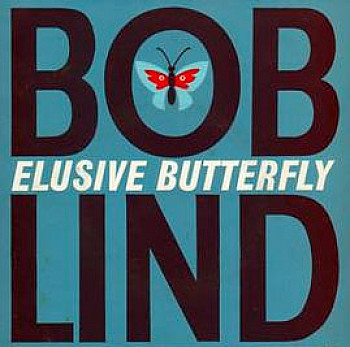
 "Elusive Butterfly"
Artist/Writer: Bob Lind
Album: Don't Be Concerned
Producer: Jack Nitzsche
Year: 1966
Chart Position: #5 US, #5 UK
Label: World Pacific
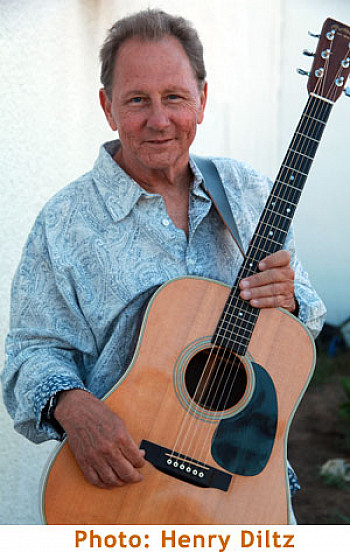 When Bob Lind went in to record his first album for World Pacific with the renowned producer Jack Nitzsche, he didn't have much in the way of a preference for the first single. An acoustic troubadour, big on the Denver folk scene of the early '60s, Lind's only choice was "Anything but 'Elusive Butterfly.'"
 In this instance, his label, distributed by Liberty, was on the same page as the rebellious singer/songwriter just a half step ahead of his time. They put out a rocker called "Cheryl's Goin' Home," with "Elusive Butterfly" safely on the B-side. But befitting the mystic nature of the songwriter's calling, and the changing nature of the times, when "Cheryl" immediately stiffed, a deejay in Orlando, Florida flipped the record over, thus changing Lind's life forever.
"I think I ran into Jack somewhere shortly after that," said Lind. "I remember him saying, 'Listen, "Elusive Butterfly" is starting to get play in about five states. I think we have a hit.' That was so strange, because when we started working together, Jack said to me, 'I don't think there are any hits here. But we're going to make a beautiful album together.'"
Which for someone like Bob Lind would have been well worth the price of admission. Molding himself after the reigning folkies of the time, like Dylan, Phil Ochs, Tom Rush, and Judy Collins, he was seeking an audience whose allegiance was not based on the Top 40. "People would go to hear these artists not to hear a particular song, not to hear a specific rendition of something, but because they were interested in the artist," he said.
Thus, his relationship toward his iconic title is decidedly mixed. "People who have heard me, people who are aware of my newer things, they like 'Elusive Butterfly,' sure. Even I like 'Elusive Butterfly.' But it's not the end all and be all that defines me. Of course, I'm not so ungrateful or foolish as not to value the impact that 'Elusive Butterfly' had. People come to hear me sometimes based on 'Elusive Butterfly,' and they remain to hear my other stuff. I just got an email from a fan who said, 'I always like "Elusive Butterfly," but your new stuff is so much better.' I love hearing that."
Bob notes that there are 200 covers of his songs, not all of them of "Elusive Butterfly." Among others, Cher, Aretha Franklin, Dolly Parton, Eric Clapton, the Four Tops, Nancy Sinatra, and the recently departed Richie Havens have sampled his wares. One of his newest favorites is called "How Dare You Love Me." But Lind refuses to spoil the song by interpreting it, something he can't escape when it comes to "Elusive Butterfly."
"People to this day ask me what it means," he says. "I don't know really anymore than any other observer would know about it. Except that it was written about the thrill of the chase. There's movement in that song. There's motion in it. The motion of reaching for an ideal that's always just a little bit out of reach. The chase itself is what's thrilling. But you can probably ask six or seven or 80 other people what they think and you would get just as accurate a description. I've heard some pretty screwy interpretations along the way, but the point is, I don't know that there are any that are less right than I am."
At that time I had the gush. It's like a 16 year old; man, he can do it four times a day. There's all that sap and passion. And I had a lot of that. But I didn't have a lot of wisdom. I had no sense at all of editing myself. There was a time when I would write 5, 6, 7 songs a day. I would wake up in the morning, I would take some uppers and drink some coffee, and I would sit down at the kitchen table with a stack of papers, and at maybe 5 or 6 o'clock, the table would be strewn with papers, all with writing on it. Now, most of those songs were awful songs. I would be embarrassed to be confronted by them now. It was a learning process. But I didn't know that then. I thought I was pushing Shakespeare right off the map.
At that time I was sort of semifamous in Denver, working the coffeehouse circuit. Then I moved to LA to look for a record deal. World Pacific was the first label I went to. I did some research and found out who the guy to see was and I just walked in. I was prepared to go to all the labels. I knew nothing about the business or how it worked. I brought a horrible tape with me with five songs on it that I had recorded at a little club in Denver called the Analyst. How I ever got signed on the basis of that tape is totally beyond me. But I guess I came at the right time. The guy said, "This sounds interesting. Let me talk to the people at Liberty," and Liberty Records said, "Yeah, well, kind of sounds like Dylan." To me, I didn't sound like Dylan. But I guess I was a niche that satisfied their cravings, so they signed me.
Jack Nitzsche, who died in 2000 at age 63, was one of the most successful producers and arrangers of his time. In the '60s, he worked on many Phil Spector productions, and even had an instrumental hit of his own with "The Lonely Surfer." When he turned his talents to film, he came up with scores to Stand By Me, One Flew Over The Cuckoo's Nest, and Breathless. In 1983, he won an Oscar for co-writing "Up Where We Belong" from the film An Officer And A Gentleman.
They put me with the producer Jack Nitzsche, who I think is at least 50 percent responsible for the success of "Elusive Butterfly." The first thing we did was cut four songs: "Cheryl's Going Home," "Truly Julie's Blues," "You Should Have Seen It," and "Elusive Butterfly." As I said, "Elusive Butterfly" was five verses long. The only real disagreement that I had with Jack - and he turned out to be right about it - was that he wanted me to cut it down. Then Liberty came and asked us, "Which of these four songs do you think should be released as a single?" And I said, "Well, anything but 'Elusive Butterfly.'" The reason I said that was not because I didn't have belief in the song and not because I didn't love the song. It was because there was nothing else like it at the time. And so they said, "Okay. Let's put 'Cheryl's Going Home' out, because it kind of rocks. And so we don't get split play, we'll put this 'Elusive Butterfly' on the B-side." Well, "Cheryl's Going Home" tanked within the first month. But for some reason a disc jockey in Florida turned the record over and started playing the B-side. It started to get a response in Florida and then it moved out to Georgia. And all of a sudden stations all over the United States were playing the B-side and I had a hit.So then I started to tour. But mostly it wasn't touring then. Back then they did these idiot lip synch shows, like Hullabaloo, Shazam!, Shindig, Where the Action Is. To me, I don't know a more idiotic pursuit than lip synching. I have no idea how that got popular. Probably it was some union thing. If you sang on a show they had to pay you, and most of these shows didn't have the budget or said they didn't have the budget. I'll tell you, I was always a little bit at odds with the music business. I didn't trust it. I didn't understand wanting to make somebody who's doing one thing fit into something that doesn't suit their potential or their inclinations.
I realized this when I did a show - it was either Where the Action Is or something like it. Every week they would shoot at a different location and at this time they were shooting in a little place in Hollywood called Jungle Land that was kind of a zoo. And some hotshot director decided it would be really great for me to sing one of my songs called, "Mr. Zero," on a stool with this ocelot sitting by the stool. This trainer guy had brought him over and put him down. I said, "Listen, this is a wild animal. Is this going to hurt me?" He said, "Well, just don't make any real sudden moves." So I'm starting to move my mouth to this song, which is a personal song. It's a love song about a relationship. It's an intimate song. And here I am, I'm moving my mouth to this song that's already been recorded; I've got this jungle cat at my feet, and it hit me, and I said, "What the fuck am I doing here?" And that's really when I started to part company with the whole pop music idea.
Would I have made different decisions? Yes, I would have. I wish I would have had the courage and the knowledge, the overview of my career that I do now. But at that time, drugs and alcohol had a big say in it. I wasn't the most cooperative guy. There was a constant battle between me and my recording company. Jack and I felt that the followup to "Butterfly" should be "I Just Let it Take Me" and the label insisted on putting out "Remember the Rain," backed with "Truly Julie's Blues," which got split play.
I don't know why I had the hit, I don't know why I didn't have another hit. You never know with that stuff. I've seen "Elusive Butterfly" on the list of the 20 best songs of the '60s and I've seen it on the list of the 20 worst songs of the '60s. That stuff is baffling to me. Perhaps I could have been more cooperative. But if I would have been more cooperative with a system that insisted upon me being something other than what I am, what kind of success would that have been? I don't think it's productive at all for me to say I could have been a contender. I don't care about being a contender. My music is not natural for the Hollywood Bowl - which I have played twice, by the way. But eventually I just wanted to get out of there. It was too restrictive. There was a period of time in the early '70s when I didn't perform "Elusive Butterfly" at all. I was mad and drunk and crazy. But I realized that was just spiteful and small. I realized it when I went to see Bobby Freeman playing at some little bar. I said, "Oh, man, 'Do You Wanna Dance' is my favorite song." I went in to hear him and he didn't play "Do You Wanna Dance" and I was angry. Then I realized, look, I'm doing the same thing.
Now I play "Elusive Butterfly" every time I play. It would be too disrespectful to go on stage and not play "Elusive Butterfly." I play "Cheryl's Going Home" every time I play. The point is, I don't shrink from my old material. Music is mysterious. It turns around. It changes. But I don't want to adapt to a changing market. I have no interest in that. What I have interest in is finding a niche audience who likes what I do. I don't need the masses, nor do I want them. Most people record an album and then they go on tour to back the album. I don't do that. My records are just ads to get people in to hear me play. That's what I care about. I've always been interested in writing. I wrote five novels. I wrote several screenplays, one of which won the Florida Screenwriters Competition. I wrote a short play that won the Bronze Halo Award in Los Angeles. I had some stories published in literary magazines. I was a writer with Weekly World News for eight years. But writing is not my favorite thing nor is it necessarily what I'm best at. It always surprises people to hear that since I'm known as a singer/songwriter and I have all these covers of my songs that people would assume that I love writing. No, I love performing. That's what I love. I love being on stage in front of an audience. That's everything to me. I write songs so I have something meaningful and original to play on stage.
July 19, 2013
Get more at boblind.com.
More They're Playing My Song