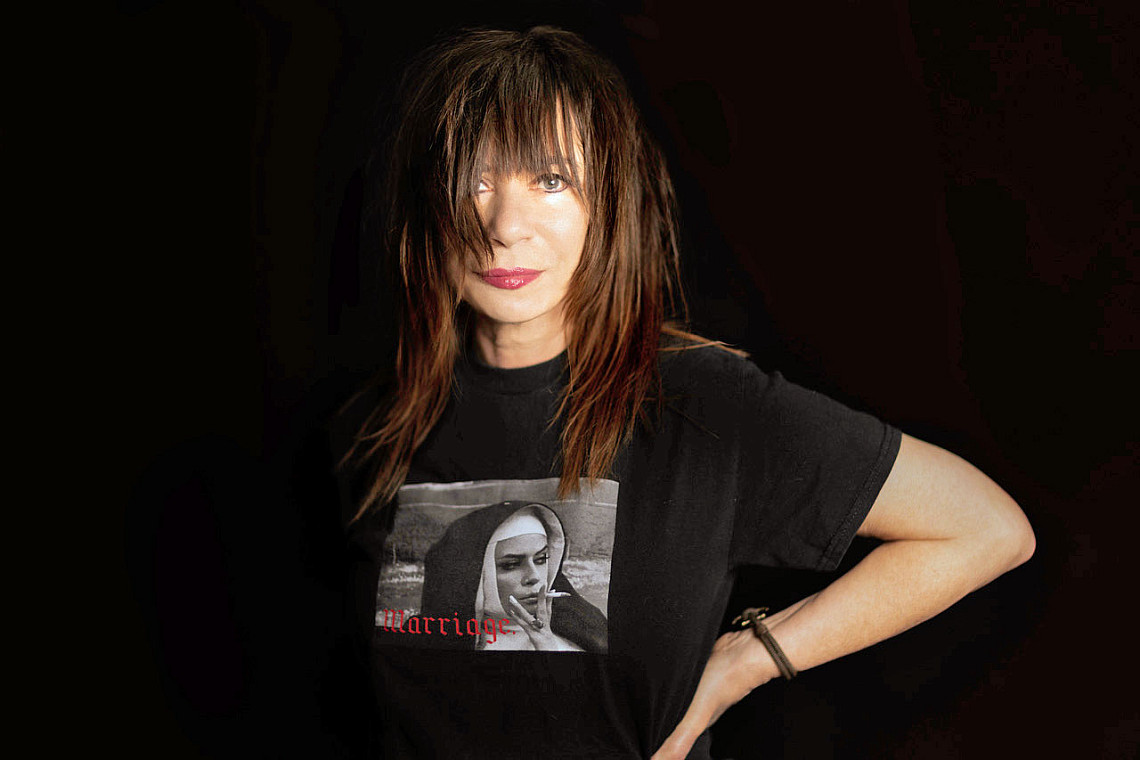
In the late '70s, Adele Bertei fronted The Bloods, the first all-female, openly lesbian band on the New York City punk-rock scene. In the '80s, she made quite a pivot, signing with Geffen Records and turning to dance-pop at the same time Madonna was emerging. Her first single, "Build Me A Bridge," was produced by Thomas Dolby and released in 1983, the same year he dropped "She Blinded Me With Science." Bertei's pop career fizzled out pretty fast - just as well, since, as she explains, it was all a front. She wanted to be Patti Smith, not Paula Abdul.
Bertei did do pretty well as a songwriter, writing a song called "Marseilles" with Dolby, a UK hit called "Just A Mirage" for Jellybean Benitez, and "Do It For Love" for Sheena Easton, which went to #23. She has since become a writer, with her latest book, Twist: An American Girl, telling her story through the eyes of the avatar Maddie Twist. Here, Bertei talks about the book, the New York City punk-rock scene in the '70s, and what she's learned on her incredible journey.
Bertei did do pretty well as a songwriter, writing a song called "Marseilles" with Dolby, a UK hit called "Just A Mirage" for Jellybean Benitez, and "Do It For Love" for Sheena Easton, which went to #23. She has since become a writer, with her latest book, Twist: An American Girl, telling her story through the eyes of the avatar Maddie Twist. Here, Bertei talks about the book, the New York City punk-rock scene in the '70s, and what she's learned on her incredible journey.
Twist: An American Girl
It's the first book in a trilogy. The second book is about Peter Laughner and my relationship with him in Cleveland. He was a huge figure in underground music in Cleveland and was a member of the band Pere Ubu. He died very young, which propelled me into the next memoir, which is called No New York, and I'm working on that right now. That's about the downtown New York scene in the late '70s, early '80s.I've been working on this book for practically 30 years. Of course, not 30 years of steady writing, but in fits and starts because it's such a complex and sometimes very dark story. I had to figure out, what is my way into this story? What's the voice? And I came up with Maddie Twist for a couple of reasons. Number one, having an avatar and a different name allowed me to have a bit of armor, like I was a Trojan going into battle. And it really helped me stay in the moment of what was going on with me. It's written in first-person active, and nothing else is fictitious about the book aside from the fact that there's a lot of magical thinking involved in Maddie Twist's life in order to survive some of the circumstances she's thrown into.
But people talk about genres a lot in literature, and this might be called auto-fiction because I came up with a fictional name. But for me, it's not fiction at all.
It's like going through the war zones of my youth. There were a lot of battlefields. I have different voices for different books, and this one was so personal and so deep that Maddie Twist was the perfect character for it.
The name Maddie Twist is because my mother was referred to as Kitty Twist, and that was based on a Jane Fonda movie called Walk On The Wild Side. And also there were nuns in the reformatory convent I spent some time in who would force me to sing the Oliver songs. I always wanted to sing the Artful Dodger, but they made me do the pitiful waif songs like "Where Is Love?" and "Who Will Buy?" I took advantage of that because it got me some perks that the other girls didn't get.
Oliver Twist is such a famous story about orphans and how kids can fall into corruption very easily when they're abandoned, and that very much happened to me. So that's where the fictional part came in. But the rest of it, the journey happened, that's all for real. Get a detective. I swear.
The Song That Most Inspired Her
Roberta Flack did a version of "Bridge Over Troubled Water," and I remember listening to that when I was probably 17 or 18, and it really opened up the idea of there being some kind of grace that you can reach for, and that there's goodness in people. It gave me faith.I know the idea of God is so particular to each of us. We all have our personal identification or illustrations of what God should be, but for me, that God is music. And I would hear God in the voices of people as I was growing up. For instance, in Blossom Hill, the reformatory, I sang gospel music for the first time. We were allowed to choose either Baptist Sundays or Catholic Sundays, and of course with the music, I'm down with the Baptists.
But I really experienced something incredibly healing about singing, and science is starting to discover this as well. They're starting to work with veterans that are suffering from PTSD with music therapy. And people who suffer from Alzheimer's. If you play them music from when they were teenagers, they light up like a Christmas tree. They remember all the words and they will start to sing. I've never seen anything so incredible. I've done this with my best friend's mother who's suffering from Alzheimer's. She's from Trinidad, so when we put on Calypso music, which is what she grew up with, she just gets up and she'll dance and she'll know the words. It's incredible.
Another song that really affected me as a child was Dionne Warwick singing "Alfie." I was very young, maybe 13, 14. It blew my mind because it's such a song of light, and it starts out existentially and then it ends up concluding in love. It's just an incredible song. I still listen to it and get kind of weepy.
As a kid it's really hard to figure out what you're feeling or analyze your feelings. You don't know what the hell's going on. And music mirrored that for me. Even a song like Gerry & the Pacemakers' "Ferry Cross The Mersey," it's such a tender song of longing for a home, really, because he's talking about England. Songs like that were always a deep mirroring for me of what I couldn't untangle in my own feelings and heart.
Writing Music
I didn't start writing music until I was about 21, and I started writing music with Peter Laughner, the guy from Pere Ubu, and we wrote a few songs. But he died very young and we had always planned to move to New York together because the scene was just bubbling up in New York City. When he died, I had to carry on for the both of us, so I moved to New York and got involved in that scene.The New York City Music Scene In The '70s
Patti Smith was like the pied piper of music and art and poetry. She broke that paradigm of what women singers were supposed to look like or sound like. The Horses LP was extraordinary. It just busted up all gendered expectations and genre'd expectations, and I was so inspired by her.When I got to New York, it was totally dystopian, like a crazy bombed-out city. It looked like Dresden after the Second World War. There were buildings all over that were abandoned and landlords were setting fire to the buildings for insurance money. It was a crazy, crazy scene.
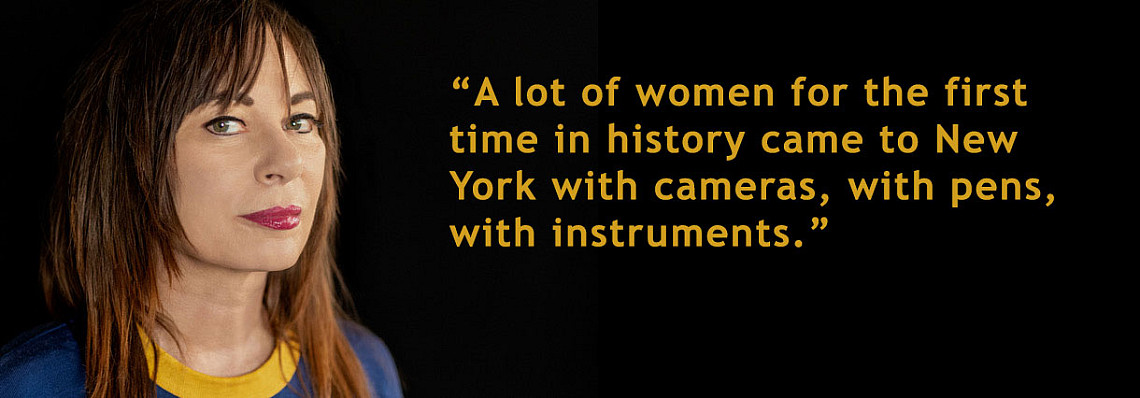
But at the same time, all of these people and a lot of women for the first time in history came to New York with cameras, with pens, with instruments, and everybody was making art in some aspect or another. It blew my mind to see what was going on there. I was so thrilled to meet other artists and be able to survive on very little money. You could get an apartment for $50 a month and make your art, perform a couple of times, and have enough money to just live, which is totally the opposite now for young people. It was a really enchanted time.
This was 1977. New York at the time was basically bankrupt. A lot of people came from Europe, and we all kind of knew each other. Maybe there were 200, 250 people and we were all in a community that launched a kind of a revolution, and a lot of it had to do with the women.
You know, Brian Eno has written something about the comparison of genius to scenius. The way he describes it, genius is a specific person, but scenius is a scene where so many things bubble up and it's really about the community. And for us, it was about the community.
We collaborated with each other. If you were a filmmaker, you would make a film with the musicians you just saw playing at Max's Kansas City or CBGB, and the musicians would raise money so you could make your next installment of the film. It was all very collaborative and very exciting. The energy came from all of us together working off of each other. This was in the East Village and the Lower East Side.
The Definitive Song From The NYC Scene
Well, when I initially got there, we called the music "No New York" or "No Wave" because it was kind of a brutalist dissembling of punk. When you get right down to it, punk is three-chord progressions. It's very pop when you come to the song structures. So, when I arrived in New York, the first person I heard singing - if you'd call it singing - was Lydia Lunch with Teenage Jesus And The Jerks, and the song that I heard that just blew my mind was called "Orphans."The Bloods
What's so interesting is that we were real bad girls. We were like the Rolling Stones - we created havoc wherever we went. We had groupies, we were doing drugs. It was all those tropes that you hear about with the bad boy rock and rollers. We were living that dream, but we were women, and no, no, no, no, you can't do that when you're women. It didn't matter how great our music was, how great our performances. The fact that we were fairly out lesbians, and wild, we were treated like total outcasts in the scene.But people like The Clash recognized the actual essence and talent of the band. We opened for The Clash when they did their stint at Bonds in New York. But the "No New York" scene, where women could do anything they wanted against gender roles, the guys loved it, and it pushed the guys to go further too in terms of risk-taking in art, because here were these women doing all this incredibly risky stuff. So we pushed each other.
And then when I got into the corporate music business, that freedom was completely stripped away from me. It was about control, control, control. You should dress like this, you should talk about this... they really wanted to mold female artists to a certain kind of sexuality that is going to attract male listeners and viewers.
What Went Wrong?
In my case, the A&R man just kept screwing things up. It was just horrible. He took away all of my support systems, my songwriting partner, my manager. It was like, you're gonna do things our way! I failed miserably at that, and I didn't want that.I think the corporate music business still does that to a certain aspect. You don't see anybody like Patti Smith, totally androgynous, out there singing about the things that she would sing about, which were very deep and metaphysical sometimes. They prefer feminine women. And a lot of the women that succeeded in the '80s and early '90s, very strong women like Queen Latifah and Tori Amos, there was an enchanted moment when women were singing truth to power, but then it all disappeared and it got back to that paradigm of the sexualized woman. There are women that break through and I have so much respect for the ones that can, but it's still a very controlling industry.
We'd like to take this opportunity to acknowledge The Go-Gos, who were punk before they were pop. They also started in the '70s, but on the other side of the country, playing the gnarly clubs in and around Los Angeles. By the '80s, they figured out how to write good songs and developed their own musical style that eventually landed them in the Rock and Roll Hall of Fame. Their guitarist, Jane Wiedlin, told us that pop and punk aren't as far apart as people think. "Our favorite band, the band that we always tried to emulate, was The Buzzcocks, who had that great pop song done in a punky style," she said. "It was always trying to sort of straddle the line between pop and punk."
Patti Smith
Patti didn't really break through with a pop hit until "Because The Night," which is something she co-wrote with Bruce Springsteen. So that wasn't what was happening at the time that I got signed. Also, nobody was out of the closet. No one, not even Elton John. Ellen DeGeneres hadn't even come out yet. It was a really scary place to be - to be shoved in a closet and told what to do.So Patti Smith, she became more pop for a minute, and then she reverted back to her wonderful poetic self. But that was a long journey for her. I just couldn't abide by what they wanted me to do.
Amy Winehouse
I look at someone like Amy Winehouse, who to me was just an incredibly phenomenal singer and musician. I was drinking at the time, and when Geffen took everybody that was supporting me away from me, I was drinking harder. And I feel like if I had succeeded at that moment in my life by making compromises with everybody that wanted me to, I would probably have gone the same route as Amy. She had so many people trying to manipulate her, and she was an addict and couldn't get sober even when she wanted to. The people around her knew and kept feeding her what she needed to be this fucked up person so they could end up making the money off of it ultimately. I hate to say it, but that happens.Songs can be predictors of fate in a way. In "Rehab" she talks about how her father thinks it's fine that she keeps getting high, and her father supported that. After she died - this was a year before Covid hit - I read that her father wanted to create an avatar of her. He wanted to put her on tour as a hologram. So, money, money, money, money. A lot of that goes on in the music business.
Drugs And Alcohol In The '70s NYC Scene
I think part of the reason that scene splintered and dissipated is because of drugs. There was a moment in late '77, '78, when heroin started to flood the East Village and the Lower East Side. They were practically giving it away. I had friends that OD'ed during that time that were in their early 20s. It was tragic. And a lot of people I knew were getting addicted to heroin. It was a really bad scene.Recording With Thomas Dolby
When I recorded The Flat Earth with Thomas Dolby in London, we recorded at Eel Pie Studios, Pete Townshend's studio, and it's right on the Thames - the windows faced the river. Tom had a little boat and I would meet him in Hammersmith and we would take the boat up the Thames to the studio. It was one of the most enchanted moments of my recording experience. I loved working with Thomas on that record.Did You Feel Like A Sell-Out Working With Big Names?
I keep thinking I should call my next book You'll Never Punk In This Town Again. But no, I didn't, I couldn't worry about that.In some ways what kept me secluded in my own fear for a long period of my life is thinking about what other people think, being afraid of what other people think in terms of what you're doing publicly. And boy, have I learned that you can't hide who you are because you're afraid somebody might bully you or disparage you publicly.
But no, I didn't think I was selling out. I was really excited to work with these people. I met Whitney Houston - she had heard a demo that I recorded with my friend Tony C, who ended up writing the song "Love Will Save The Day" for Whitney. Jellybean [producer Jellybean Benitez] needed a second voice on the choruses out of the song, so I got to sing on that record and meet her briefly. I didn't get to know her, but I met her when she was with her friend Robin, and it was just at the time when she was really about to take off and become a huge star. She seemed so happy to me and so lovely, and she was with Robin, who for all intents and purposes was her girlfriend. That's another really dark, creepy story of what can happen to a famous person when they're manipulated by so many people and when there's so much money.
Writings And Rememberings
I still have so much to learn about writing. I've always been obsessed with alchemy. Not in the sense of taking metals and turning them into gold, but in the metaphysical sense of taking darkness or sadness or longing from whatever hurts we each possess and somehow transmitting those things into moments of beauty and compassion. That's a big part of my process of writing a memoir.I don't think I would've survived if I had not had books and poetry and songs like life rafts to show me glimmers of hope and goodness and other ways of living. I always reached for those things. I was always curious and reaching for things that would give illumination and comfort.
It took me decades to unravel what happened to me when I was a child. Maybe somebody's gonna read this book and think, Wow, if she can go through that and this is how she did it, maybe I can try being a little braver or taking more risks, or not being afraid to change. I think right now in America we're all in a period of deep, deep fear. We've been bludgeoned by so much, and I'm just hoping that there are more artists and more people that will speak to the idea of not buying into the toxicity that we keep hearing that's being fed to us.
Reach for literature and music. We're a culture where people are not taught to embrace art as children. We're supposed to be doctors and lawyers and make money, make money, make money. Art has become kind of an elitist pursuit, and that bothers me a lot because art should belong to everybody. We should all be making art in some aspect or another. That's the creative spirit.
The Future Of Queer Artistry
I'm so excited about current times because there are lesbians and trans people who are now stepping into the forefront of the industry and are being accepted. Somebody like Brandi Carlile, the talent of this woman... it feels really good to see what's going on with younger people right now.With The Bloods, we wanted to be the female Rolling Stones. There are some videos of us playing in Berlin at a women's music festival in 1981. You can tell we kicked ass musically, but we didn't have a chance because we were queer. Yeah, it was a really, really hard time. So I'm really happy to see that women and gay men and trans people, all of it, are stepping into the forefront and not being ostracized for their sexuality today. I think it's wonderful. They can be whatever they are, and they don't have to brag about it or talk it up. They can just be authentically who they are and that's a wonderful thing.
March 27, 2023
Subscribe to the Songfacts podcast, part of the Pantheon Network
Further Reading:
Interview with Lydia Lunch
Interview with Thomas Dolby
The Punk Photography of Chris Stein
Photos: Natalie Hill
Footnotes:
- 1] Adele's first single - the one produced by Thomas Dolby - is called "Build Me A Bridge" and was released in 1983. There's no video for that one, so we're showing you her next single, "When It's Over." (back)
More Songfacts Podcast