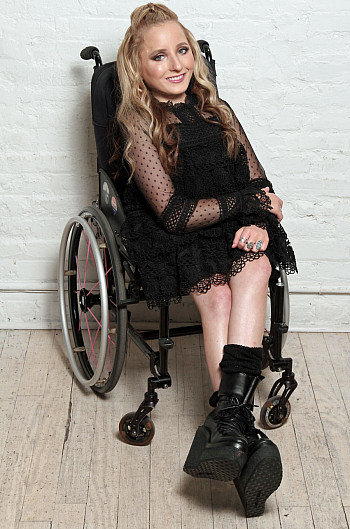
Ali McManus will never sing like Aretha or dance like Britney, but she doesn't have to. Wheelchair-bound and with 30% lung capacity, she's developed an intimate piano, guitar and vocal technique that suits her style.
Born three months premature, Ali developed a rare bone disorder that left her unable to walk at age 7. Eleven surgeries later, she developed into a formidable enough singer/songwriter to attract the attention of producer Jack Douglas, the man who guided Aerosmith through their albums Toys in the Attic and Rocks, and who also worked with John Lennon on Double Fantasy. Douglas produced Ali's first album, Unbreakable, a collection of six songs that deal with some issues typical of a 20-year-old (getting "friendzoned") and others that only a woman who has faced the real prospect of death could deliver.
"Music saved my life," she says. "One song means three minutes of no pain, and I can say things with song that I can't speak in words alone."
Ali McManus: What led me to write this song is that, when being in a wheelchair, I've had to deal with everyone wondering what is wrong with me and staring at me every day. Yes, I did get used to it, and it's totally fine with me. But I wish they would just come up to me and ask me what I have.
One day, while I was on the beach in the Bahamas, I was looking at the ocean, and I started to see all these people walking by, and I saw their reaction. At that moment, it was stronger in my mind, "Have they not seen a chair before?" I'm just sitting in a chair.
As I observed closely, I kind of got bothered by it. Meanwhile, I was stuck in the sand with nowhere to go. I pulled out my phone, and I wrote down what I saw and how I felt.
I would like people to see me as any other person, and not to be afraid to come up and start a conversation with me. I'm not gonna bite. LOL.
Songfacts: How do you go about writing a song?
 Ali: How I go about writing a song is that I usually start with the music first. One of the more rare times that I started with the lyrics first was in the song "Unbreakable." After I get the music progression down on guitar or piano, I start to loop it and usually I will have a topic in mind while listening to the music, and the inspiration comes from there.
Songfacts: What did you learn from working with Jack Douglas?
Ali: I learned about a new level of professionalism that I had not experienced before. Right away, I fell right into it and loved it.
That was one of my first times playing with a band! I had to teach the band my songs, and I got to play guitar on one of my songs, "Rhythm that Rhymes"! I learned that even though he is the producer, he listens to me and my ideas.
Songfacts: What song and artist has been the greatest influence for you?
Ali: The greatest artist that has been a huge influence on me is Ed Sheeran. His imagery of his lyrics and style of playing guitar really affected how I write songs. He's the reason I wanted to get into playing guitar in the first place. I even got the same model guitar as he has!
The song that has the greatest influence on my life has been "The Climb" by Miley Cyrus because my life has been a constant climb. It came out when I was 13, and I was dealing with many medical obstacles in my life, and this song became my anthem.
Songfacts: What are the biggest challenges for you when it comes to creating music?
Ali: With the guitar, I have a challenge of learning new chords because my neck is fused from surgery, and I can't look down at the guitar, like one would when learning new chords. I have to really use my sense of touch and memory.
With singing, I don't really notice that I have any issue, but it is surprising that I can sing like I can with only 30% lung capacity.
Ali: When you go through a near-death experience, and I've been through a few, you look at life differently after - as in the little things you used to care about or get upset about. They don't really seem like big issues any more.
Songfacts: Please tell us about your song "Heart Shattered."
Ali: Well, about two years ago, I really started to like a friend of mine. He found out, and he confronted me. He asked me if I liked him. I wasn't going to say no, because you have only one life.
I got "friendzoned." I was very upset about it at the time. But I also had this piano part sitting around, and I hadn't figured out what topic to write about. Once this happened to me, I wrote this song in like 30 minutes. To this day, I'm very grateful that he did friendzone me. I got a sweet song out of it and a best friend.
February 22, 2018
photo (2): Udo Spreitzenbarth
More Song Writing