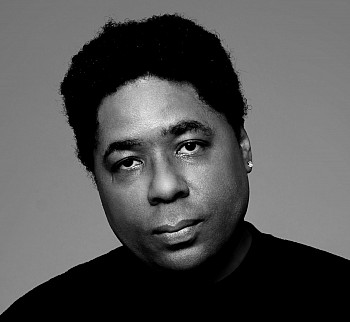
 It's time to rewrite the blues narrative. It didn't start in the Mississippi Delta, and it wasn't primitive or sad.
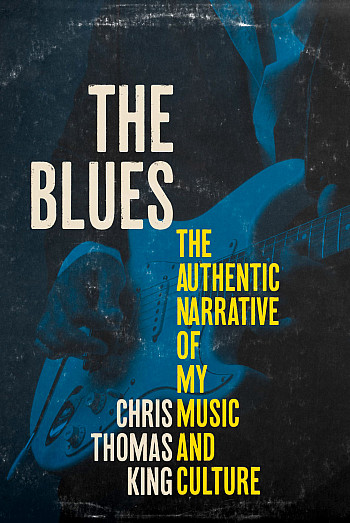
This according to Chris Thomas King, a popular blues musician and author of The Blues: The Authentic Narrative of My Music and Culture, set for publication June 8, 2021. King makes some bold statements in the book - understandable considering he's challenging deeply entrenched assumptions - but backs them up with references to his extensive research. A big takeaway: Blues history was written by white people, notably John and Alan Lomax, to suit an agenda. He writes:
Folklorists such as John and Alan Lomax began with a predetermination of Black inferiority, and then proceeded to screen out any talent or persons that would "taint" their "scientific" data of primitiveness.
So what's the real story? Blues bubbled up in New Orleans, with cosmopolitan musicians like Jelly Roll Morton and King Oliver leading the way. It was the historical gatekeepers - what Thomas calls the "Blues Mafia" - that attributed it to Mississippi sharecroppers.
The full story is rather enlightening and gives context to the way modern Black music is framed, as Thomas found out firsthand when he was marketed as a traditional blues artist and bucked the system by integrating hip-hop. Here, he answers our questions about the history of the blues and the key songs in its development.
Acoustical (1877–1928)
"Jelly Roll Blues" by Jelly Roll Morton. Even though it was first published as sheet music in 1915 and not on disc. Jelly Roll Morton has to be the most important blues artist of the pre-phonograph era.Another is "Crazy Blues" written and produced by Perry Bradford. It's the phonograph that led the gold rush of blues recordings in the 1920s.
I would also include Bessie Smith's recording of "St. Louis Blues" featuring Louis Armstrong. This record set a stylistic vocal and counterpoint mode, sometimes referred to as call and response, that was brand new at the time, but has become ubiquitous in every musical genre.
Electrical Era (1928–1945)
Although he recorded with acoustic guitar, I would have to say the Robert Johnson Texas sessions. Although Robert was virtually unknown until his music was released by Columbia in 1961, it has had a tremendous influence.Magnetic Tape (1945–1980)
There isn't one song. There were hundreds. Beginning with "Good Rockin' Tonight" followed quickly by "The Fat Man," "The Things I Used to Do," and "Tutti Frutti." All recorded by Cosimo Matassa in New Orleans. The rest is history!Digital Recording (1980–present day)
Out of modesty my rendition of "Hard Time Killing Floor Blues," that turned a new generation on, I'll exclude. When I think '80s, Michael Jackson comes to mind. Rhythm and blues everyone should understand is a form of blues as it progressed. However, an impactful song that falls within the myopic popular notion of what blues should be was Stevie Ray's cover of "Texas Flood."Why is the word "blues" used in the titles of so many songs? You don't see that in other genres.
Phonographs were not as popular in sales as sheet music. Sheet music would note that a song is a foxtrot or waltz. Noting "blues" was in that tradition, plus calling anything a blues during the blues craze helped sales.
More importantly, however, blues was a Louisiana Creole word for the defiant risqué music. It represented an authentic expression of their unique culture. It countered the Anglicization of Black Creole culture.
What is the relationship between country music and the blues?
Country began with people like Jimmie Rodgers in blackface covering black blues songs. There wasn't any real difference except the hillbilly's twang. But hillbillies never embraced the Voodoo. Voodoo was the essence of the greatest blues improvisers.
Johnson and Johnson (and Johnson)
Thomas plays Tommy Johnson in the movie O Brother, Where Art Thou?, appearing at a crossroads where, after selling his soul to the Devil so he could play the guitar, the Soggy Bottom Boys (led by George Clooney) pick him up.
Tommy Johnson was a real person, a Mississippi blues musician born in 1896. Like the unrelated Robert Johnson (born 1911), legend has it that he sold his soul to the Devil to procure his talents. In his book, Chris Thomas argues that Robert Johnson's story was ginned up by promoters, and that Tommy Johnson's legend was perpetuated by his older brother LeDell. In any case, the most important Johnson in blues history, according to Thomas, is Lonnie Johnson, who recorded blues on guitar and influenced the next generation, including Robert Johnson (and Bob Dylan).
Thomas plays Tommy Johnson in the movie O Brother, Where Art Thou?, appearing at a crossroads where, after selling his soul to the Devil so he could play the guitar, the Soggy Bottom Boys (led by George Clooney) pick him up.
Tommy Johnson was a real person, a Mississippi blues musician born in 1896. Like the unrelated Robert Johnson (born 1911), legend has it that he sold his soul to the Devil to procure his talents. In his book, Chris Thomas argues that Robert Johnson's story was ginned up by promoters, and that Tommy Johnson's legend was perpetuated by his older brother LeDell. In any case, the most important Johnson in blues history, according to Thomas, is Lonnie Johnson, who recorded blues on guitar and influenced the next generation, including Robert Johnson (and Bob Dylan).
While researching the book nothing new or groundbreaking came up. Mainly, I gained a deeper appreciation of how songs and recordings can go unnoticed for decades then suddenly explode into popular culture.
A shocking and discomfiting section in the book is when you describe how "Ni--er Blues," written and published by white men and recorded in 1916, became a template for appropriated blues. How would the genre have progressed without this kind of interference?
It's hard to imagine. Interference by Europeans and whites is all that Black Americans have known. The problem is, we haven't had the power to control how our cultural expressions are defined.
The fact is, the blues has indeed progressed very differently, both before and after "Ni--er Blues." What I have attempted to do with my book is invite the reader to view and hear the world through my Creole lens. Hopefully, many more people will understand the music is far more colorful than the sad shade of blue they have been miseducated to accept.
 Is there an analog to the "Blues Mafia" in other genres? When you explain how blues musicians are expected to have a hardscrabble upbringing, I thought about how when 50 Cent was introduced, it was all about how he'd been shot nine times, not about his music.
That is very perceptive. I write that Lead Belly was the archetype. I guess 50 was nine times more authentic (savage) than Lead Belly. Sadly, there is a continuum of this sort of thing. The Blues Mafia represents a motley crew of gatekeepers and white cultural brokers. The Blues Mafia represents the existential antagonists to my iconoclastic art.
Who are the three most important musicians in the development of the blues, and why?
Mamie Desdunes and her family started it all. Jelly Roll Morton spread it from coast to coast, and Louis Armstrong trumpeted it the world.
What are your thoughts on how Led Zeppelin borrowed from the blues?
Zeppelin represents capitalism colonizing blues, mining for Gold records. We were barred from partaking in capitalism. We were reduced to miners. We couldn't rent castles and hire million-dollar gear and expert sound engineers for an hour, let alone months. That huge tone took capital and lots of it.
Zeppelin wouldn't be Zeppelin if they had recorded in archaic conditions and with inferior equipment. Don't get me wrong, they still would have sounded pretty good, but not much better than Slim Harpo, Magic Sam, or Buddy Guy. Zeppelin and all those white capitalist blues bands sounded like a million dollars on FM radio. That heavy bombastic sound was drilled into the public with payola and cocaine until they submitted.
How did the hypersexual lyrics found in many blues songs develop?
New Orleans, as loose as it is today, is tame compared to its old Storyville and Basin Street days. To make it plain, blues and sensuality are one.
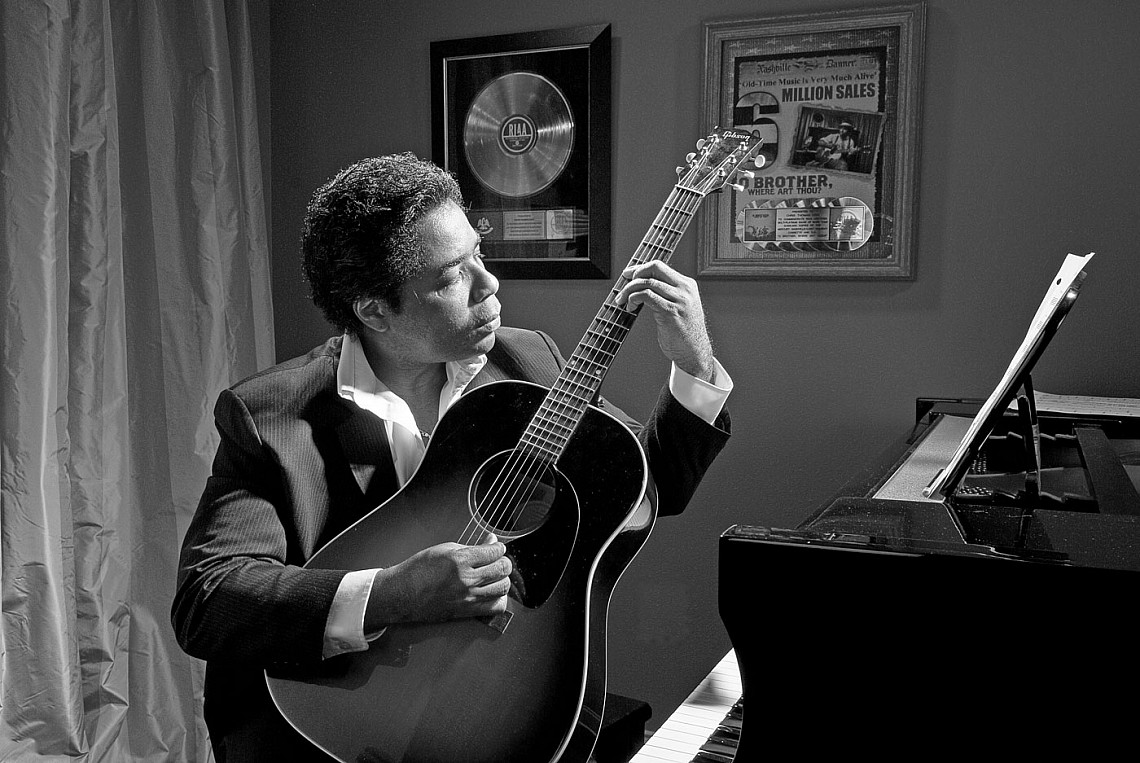 Chris Thomas King composing with guitar and piano at home. In the background are Platinum records awarded to him. Photo by Greg Miles, courtesy of Chris Thomas King Tours, LLC
Chris Thomas King has been nominated for seven Grammy Awards and has won two: Album Of The Year for his contributions to the O Brother, Where Art Thou? soundtrack, and Best Historical Album for Screamin' And Hollerin' The Blues - The Worlds Of Charley Patton.
The Grammys, which appreciates your work, has categories for Best Traditional Blues Album (dominated by B.B. King) and Best Contemporary Blues Album (Keb' Mo', Gary Clark). How do you feel about these distinctions?No, the Grammys doesn't appreciate my work. I don't have any blues Grammys, or any notable blues awards from anywhere! I have won in mainstream categories, and I've won country and bluegrass awards. The myopic Grammys are part of the problem. Black artists of all genres are routinely marginalized. How can the most popular record in the most popular genre (rap) not simply be pop? Very bigoted and stupid.
Please tell us about the song you wrote and recorded that is most important to you.
"Les Bleus Was Born in Louisiana." I wrote a whole book about it.
June 3, 2021
Here's ordering information for The Blues: The Authentic Narrative of My Music
Further reading:
Songs that were adapted from early blues songs
He's So Fine: The Ronnie Mack Story
More Song Writing