Back in 2009, I issued one of my first books - which also happened to be one of my best-known and most successful - entitled Grunge Is Dead: The Oral History of Seattle Rock Music.
Considered by many to be the definitive overview of the Pacific Northwest music scene of the '80s and '90s (check out the reviews on Amazon to back up this bold claim), the book featured well over 100 interviews with members of grunge's "Big 4" (Nirvana, Soundgarden, Pearl Jam, and Alice in Chains), as well as others who were first-hand witnesses and/or contributors to a musical movement that affected the world.
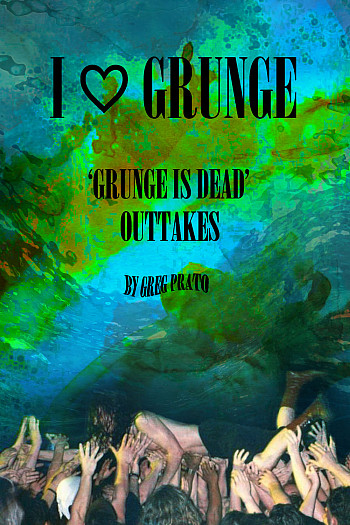
However, with so many interviews conducted, there was much content left on the cutting room floor. Fourteen years later, I have collected the bits that didn't make it during the first go-round - which now comprise I ♡ Grunge: 'Grunge Is Dead' Outtakes.
In addition to offering different viewpoints of grunge's history, new stories and insight are discovered in these nearly forever-forgotten quotes, making I ♡ Grunge the perfect companion read to Grunge Is Dead... and for those who still ♡ grunge.
In this exclusive excerpt, we examine Soundgarden's rise during the early '90s - as told by the people that actually lived it.
Considered by many to be the definitive overview of the Pacific Northwest music scene of the '80s and '90s (check out the reviews on Amazon to back up this bold claim), the book featured well over 100 interviews with members of grunge's "Big 4" (Nirvana, Soundgarden, Pearl Jam, and Alice in Chains), as well as others who were first-hand witnesses and/or contributors to a musical movement that affected the world.
However, with so many interviews conducted, there was much content left on the cutting room floor. Fourteen years later, I have collected the bits that didn't make it during the first go-round - which now comprise I ♡ Grunge: 'Grunge Is Dead' Outtakes.
In addition to offering different viewpoints of grunge's history, new stories and insight are discovered in these nearly forever-forgotten quotes, making I ♡ Grunge the perfect companion read to Grunge Is Dead... and for those who still ♡ grunge.
In this exclusive excerpt, we examine Soundgarden's rise during the early '90s - as told by the people that actually lived it.
 Susan Silver [Soundgarden/Alice in Chains manager, ex-wife of Chris Cornell]: The first time Soundgarden headlined the Moore Theater [in 1990], Ann and Nancy Wilson sent flowers. It was just so indicative of their role here during what became a scene for these other bands. They were so gracious and so supportive. It meant so much to be acknowledged by these women that made rock history. That was really just a beautiful moment.
Ben Rew [Tad roadie]: They were about three or four years older than me, so I looked up to them. They were like the guys that were doing all the smart stuff - while I was still stumbling through, playing crappy punk rock. I was normally pretty intimidated by them. Like, Matt is one of the nicest guys on the planet and I just never knew what to say. There was one show that was up at the Lake Forest Park, some theater they had up north of Seattle - they had Alice in Chains and Soundgarden playing. And Alice in Chains was headlining.
At this show, everyone's there to see Alice in Chains, because remember, once you get out of Seattle and you get up into the masses - which are people who are only fed information through MTV - they're all thinking "Alice in Chains... cute guys that rock." Soundgarden's playing before them and the whole place is empty - there's maybe 40 of us - so they were taking requests. I remember requesting "Little Joe," and Chris was really stoked. He's like, "'Little Joe'? We'll play 'Little Joe'!" That was a pretty awesome show - we were po-going around, and then as soon as they got off stage, this whole slew of Aquanet and freakin' Guns N' Roses t-shirts come running through the place.
Kim Thayil [Soundgarden guitarist]: It wasn't so much that Jason wasn't fitting in, as Soundgarden wasn't fitting in with itself. Chris had brought up Ben. Ultimately, it was Chris' suggestion that we go back and take another look at Ben - and we do some jamming with him and see if he might fit. Because he thought that perhaps Ben's personality and ability might give a creative and emotional spark to the band that we needed - to make us feel like brothers again. Because it's very important that that "collective spirit" be there - it wasn't there after Hiro left, and never came back. So we thought that Ben might aid that situation. And it did - it certainly gave a creative punch and emotional punch.
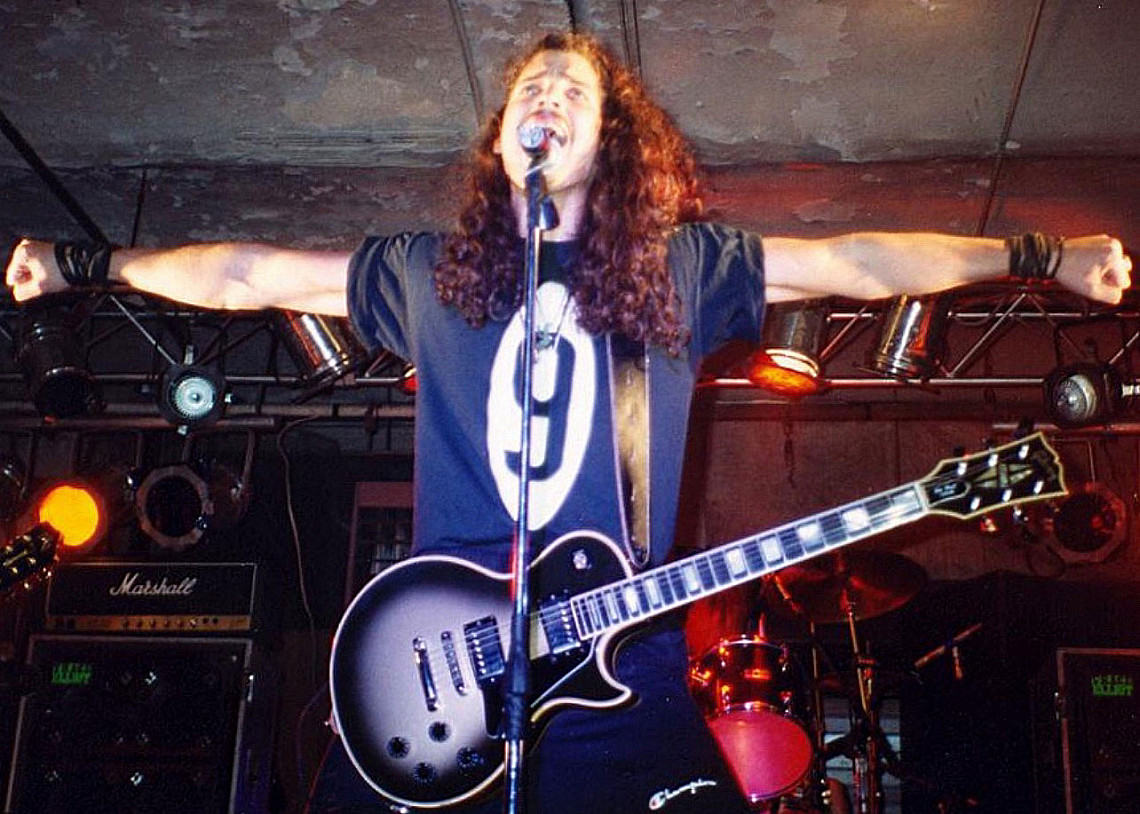 Chris Cornell performing with Soundgarden on October 17, 1991 at Warehouse 429 in New York City at an invite-only performance for the release of Badmotorfinger. In this video of the performance, you'll see him strike the Jesus Christ Pose in the photo at the 4:32 mark. Photo by Steven J. Messina.
Ben Shepherd [Soundgarden bassist]: We rehearsed for a couple of weeks, then we went straight to touring in Europe. The first place I played was in Copenhagen, at the Roskilde Festival. The first time I'd ever seen a D.I. Box. I was like, "Stuart, what's that?" And he goes, "Oh, that's a D.I. Box. That means that we can hear everything you do." I'm like, "Oh fuck!" I was all nervous.
He goes, "By the way, they're broadcasting this over the radio." So we come on stage and the crowd is chanting, "HIRO! HIRO!" I'm like, "Oh, goddamit!" We did this three-week tour, then we came home, then we had another tour all ready to go. So it was like jumping right into the fire, it was awesome. So fucking fun.
It seemed like right after that Danzig tour [in the summer of 1990], we shifted back down into recording and demoing and stuff. It's like how it should be if you're in a band. It was so fun - we invented this game [while recording at Bear Creek Studio in Woodinville, Washington, with producer Terry Date] - it takes a Frisbee and a Nerf ball to play, two man teams. We'd play that all the time when we weren't tracking.
The song "Cold Bitch" - which didn't make it on the record - when we were tracking that, the cellos on it, there was a huge lightning storm going on, just as the cellos started playing. It was totally cool. I think only Kim and I were there that day. It was a cool place - a home away from home. It's way outside the city, and it's totally got history. Everybody from Lionel Ritchie to James Brown has recorded there. It was just a cool old barn turned into a recording studio. Really comfortable. Kim would be outside at night, smoking cigarettes in his van, listening to the Mariners games.
Definitely [1991's Badmotorfinger was the first time Ben was in a pro recording studio]. I was in a band once, when Nirvana was still called Bliss and everybody was still in college. We played at the radio station on the Evergreen campus. And that was like, "Whoa." A real professional thing - real good mics and everything. So, that was the first glimpse I'd ever had of any studio at all. And then it went straight from there to recording at Avast! with Soundgarden [the 1990 Sub Pop single, "Room a Thousand Years Wide" b/w "H.I.V. Baby"], and then from there, to Bear Creek. So, I'd kind of seen a little bit, but not really. This is definitely the first time in a real studio - where people are throwing loot around to do stuff.
Kim Thayil: I remember Terry was put through a lot. He already knew the strong personalities that Chris and I had - as well as Hiro - and Ben had a very strong personality, and was more aggressive in asserting it than Hiro was. All I remember is how much effort it was for Terry to have to juggle the three of us - our wishes and our temperaments.
I think he did a pretty good job of it - although it was certainly draining for him. I could see it. [Laughs] I remember most of the tracking up in Bear Creek, which is a really nice studio with a creek running behind it - a lot of foliage and trees. A nice little field you can hang out at.
I remember Eddie Vedder coming - he was just starting out with Pearl Jam. They were working on their record [Ten] - he would come up and visit us on a few occasions. Just the beauty of the studio at the time. It kind of felt like we were at a resort. It was generally a comfortable situation - at least the tracking process was. A lot more so than Louder Than Love. Louder Than Love seemed a little bit stiff - Badmotorfinger was definitely a lot looser.
Ben Shepherd: What happened to Badmotorfinger, we didn't tour our own tours - we wound up opening for other rock goliaths [including opening shows for Metallica, Guns N' Roses, and Skid Row during late '91/early '92]. We knew it was a good opportunity - because I always approached the band as a fan, too. But I was actually really disgruntled by it, because I wanted us to tour on our own. We did one tour with COC, Monster Magnet, and Sister Double Happiness.
Paul Barker [Ministry bassist]: That tour [Lollapalooza '92, which included the Red Hot Chili Peppers, Ministry, Soundgarden, and Pearl Jam, among others] was really a lot of fun. Primarily because it seemed like a lot of the bands were of the same sentiment at that time, and everybody was really happy the shit was going on. Those festival tours like that - the "traveling circus" - for the band members, how much easier can it get?
There's no soundchecks - you can do whatever you want. You can get there a half an hour before you go onstage, play for an hour, and then split. Basically, you only have to be sober enough to play for that one period of the day, and then the rest of the day, you can do whatever. That's another thing we did on that tour - "I'm going to ride with Soundgarden overnight." We did that with Ice Cube, as well.
Ben Shepherd: I remember being blown away by Bill Rieflin playing with Ministry. Basically, one of my favorite bands was the Blackouts, and they wound up becoming Ministry. That's a record you should find [2004's History in Reverse] - they just released the Blackouts stuff before they moved out of Seattle and became Ministry. It's really cool - they were the coolest band around. Then this band U-Men happened, and then Soundgarden - that was Seattle history. The dark, cool music. The intellectual depth to it.
Bill Rieflin is the king. He broke his hand on that Lollapalooza tour…and then played the next day. With a busted fucking hand - playing Ministry. That tour, it was like watching everyone like you're on a fieldtrip. And I would be standing there, because I'm usually the cockamamie dumbass in the room. But I saw everyone turn giddy and be all having fun. "What the bloody hell is this?"
Kim Thayil: I thought the songs were there [on 1994's Superunknown, co-produced by the band and Michael Beinhorn]. I thought Chris had come up with some strong songs. And we were collaborating on a lot of other ideas. I had a lot of ideas, Matt and Ben had a lot of ideas - Chris had more completed ideas. I was pretty disappointed - there were a lot of ideas that I had that weren't fleshed out with lyrics that could have made the record. Same with Matt and Ben.
There was no shortage of material. Good, strong ideas, that could have probably made another double album. But the most completed material, which certainly gives it weight in terms of strength - because it's ready to go - was stuff that Chris had done, because he was able to marry the music and the lyrics together. It's easier to arrange music when you have lyrics to frame it. There was some "songwriting issues" there - that would probably fail to resolve itself on the next record.
Order I ♡ Grunge: 'Grunge Is Dead' Outtakes at Amazon.
Further Reading:
Interview with Kim Thayil of Soundgarden
Dark Black and Blue: The Soundgarden Story - An Excerpt
Experience Nirvana with Sub Pop Founder Bruce Pavitt
Interview with Jeff Ament of Pearl Jam, Deaf Charlie
Fact of Fiction: Grunge
More Song Writing