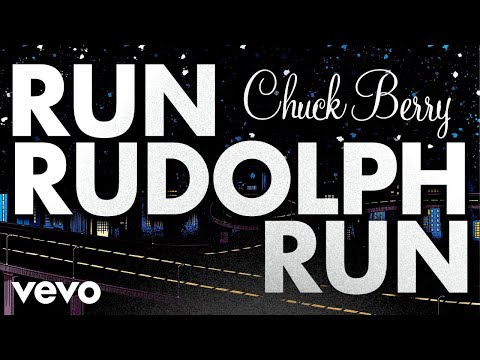
Run Rudolph Run

Album: Berry Christmas (1958)
Charted: 36 10
Play Video

Songfacts®:

  • Chuck Berry based this tale on "Rudolph The Red-Nosed Reindeer," giving Rudolph a bit of an attitude as he delivers the toys. Unlike Santa, however, Rudolph is copyrighted, and Berry had to give the publishing rights to Johnny Marks, who wrote the original Rudolph. Perhaps if Berry had used "Randolph" (another reindeer he mentions), he could have kept the publishing. That's what the makers of the British TV special Robbie the Reindeer did.
  • The song is sometimes known as "Run Run Rudolph," which is how it appears on Lynyrd Skynyrd's cover. Other artists to record the song include Sheryl Crow, Bryan Adams, The Grateful Dead, Jimmy Buffett, Dwight Yoakam, Bon Jovi, Keith Richards and Mark Ambor.
  • "Run Rudolph Run" was used in the 1990 movie Home Alone in one of those pre-9/11 airport scenes where the family rushes to the gate and barely makes their plane (minus Macaulay Culkin). Other films the song has appeared in include Diner, The Santa Clause 2, Cast Away and Jingle All the Way.
  • In the unmistakable intro, Berry sings a warning to Rudolph about another reindeer that's hot on his heels:

    Out of all the reindeers you know you're the mastermind
    Run, run Rudolph, Randolph ain't too far behind
    .

    As we know from Marks' original, the lesser reindeer are Dasher and Dancer and Prancer and Vixen, Comet and Cupid and Donner and Blitzen. So, who is this Randolph character that's creeping up on the most famous reindeer of all? It's possible that Berry was referencing "Randolph The Flat-Nosed Reindeer," a country-novelty tune from 1953 by Homer and Jethro, a duo known for satirizing popular songs. (They had a Top 10 Country hit in 1949 with a version of "Baby It's Cold Outside" featuring June Carter.) In their take on the classic, Santa tries his hand at rhinoplasty when he lops off Randolph's funny-looking snout, and then sews it back on upside down. He probably wasn't too much of a threat to Rudolph because he could never get his flat nose to light up "because his batteries were dead."

    Unlike Berry, Homer and Jethro didn't have to give up the rights to Marks, but they did have to share songwriting credit with him.
  • This song holds the record for the longest amount of time between a song hitting the charts and then breaking into the Top 10. When it was released in December 1958, it went to #69 on the Billboard Hot 100. In 2019, it re-entered the chart at #45, and in January 2021 - 62 years and two weeks after its chart debut - it reached its peak at #10.

    The boost in popularity likely came from an official animated video released by Berry's estate in 2020. It features the Father of Rock 'n Roll on a Christmas adventure, cruising the starry skies in a classic red convertible being pulled by Rudolph and his gang.

Comments: 5

  • Kathi Ybarr from Yuba City , CaTheir seems to be a debate as to who actually wrote this song, was it Chuck Berry (who used a secret co-writer ) or Mr Marks? Truly it was neither.
  • Kathi Ybarr from Yuba City , CaI'm pretty sure the song was actually written by Dial Hall from Kentucky. Stolen and sold by his brother to someone in Nashville . I have an original recording done prior to 1958 when it was released by Mr Berry....
  • Tim from Bovey, MnThe inclusion of "Randolph" as a reindeer in this song still bewilders me. Above I mentioned that I had read chuck ad-libbed "Randolph" in place of Vixen who was in the original lyric -- then it dawned on me, Homer and Jethro recorded "Randolph the Flat Nosed Reindeer" back in 1953. Odd that Chuck would have chosen this obscure name by accident. Also, the Randolph song lists Johnny Marks AND H&J as writers, but since it uses the tune of the original Rudolph, that makes sense. Odd that any sort of licensing would have required Chuck to credit Marks, as the song mentions Rudolph AND Randolph, so he should have credited H&J also following that logic. And I would imagine the name and concept and copyright or trademark of Rudolph belonged to Robert May (creator) or Montgomery Wards as it was their advertising flyer for which Rudolph was created in 1939 -- Marks didn't invent Rudolph, or the story, he just made it into a song. yes, I realize I'm over analyzing a simply holiday song but the details are driving me nuts!
  • Tim from Bovey, MnWikipedia tells the tale a bit differently: "Even though the song was written by Johnny Marks and Marvin Brodie and published by Johnny Marks' publishing company, St. Nicholas Music, the 1958 45 rpm single has the song written by "C. Berry Music & M. Brodie". The thought was to cover up the known Christmas songwriter Johnny Marks from hip R&B DJs and buyers.[citation needed] The song was subsequently officially always listed as written by Johnny Marks and Marvin Brodie and published by St. Nicholas Music (ASCAP). All cover versions of the song show the composers as Johnny Marks and Marvin Brodie and the publisher as St. Nicholas Music." I also read someplace this season that the original Johnny marks lyric was "Vixen ain't too far behind" and Chuck's famous lyric changing/ad libbed style in the studio changed it to "Randolph" as he was recording the tune. We may never know the real story!
  • Steve from Ottawa, OnThere was also a cover of this song on the CD "We Wish You A Metal Christmas", released in Oct, 2008. The song featured Lemmy of Motörhead on bass and vocals, Billy Gibbons of ZZTop on guitar, and Dave Grohl of the Foo Fighters on drums.
see more comments

Editor's Picks

Pam Tillis

Pam TillisSongwriter Interviews

The country sweetheart opines about the demands of touring and talks about writing songs with her famous father.

Rock Stars of Horror

Rock Stars of HorrorMusic Quiz

Rock Stars - especially those in the metal realm - are often enlisted for horror movies. See if you know can match the rocker to the role.

Frankie Valli

Frankie ValliSong Writing

An interview with Frankie Valli, who talks about why his songs - both solo and with The Four Seasons - have endured, and reflects on his time as Rusty Millio on The Sopranos.

Part of Their World: The Stories and Songs of 13 Disney Princesses

Part of Their World: The Stories and Songs of 13 Disney PrincessesSong Writing

From "Some Day My Prince Will Come" to "Let It Go" - how Disney princess songs (and the women who sing them) have evolved.

Kip Winger

Kip WingerSongwriter Interviews

The Winger frontman reveals the Led Zeppelin song he cribbed for "Seventeen," and explains how his passion for orchestra music informs his songwriting.

Stephen Christian of Anberlin

Stephen Christian of AnberlinSongwriter Interviews

The lead singer/lyricist for Anberlin breaks down "Impossible" and covers some tracks from their 2012 album Vital.