Holy Holy

Album: The Man Who Sold The World (reissue) (1971)
Play Video

Songfacts®:

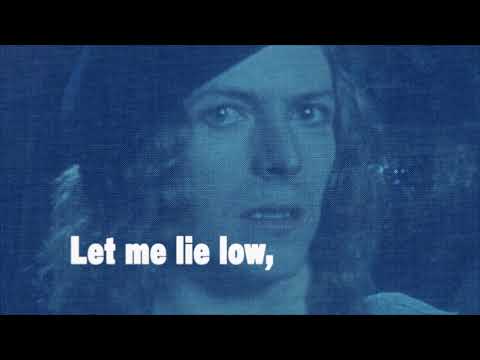
  • "Holy Holy" is difficult to make sense of. On one level, Bowie's asking a woman to bed ("listen, lady, let me lie low"), but on another he's telling someone or something to set him free ("holy holy, hold on to anyone, but just let me be") and on yet another he's proclaiming his desire for wickedness ("I don't want to be angel, just a little bit evil, I feel the devil in me").

    The disassociated lyrical style became a hallmark of Bowie's songwriting; in 1972 he had his commercial breakthrough with the bizarre-even-by-today's standards The Rise and Fall Of Ziggy Stardust And The Spiders From Mars. The thoughts on holiness and wickedness may have something to do with the teachings of "the wickedest man in the world," British occultist Aleister Crowley, whose influence is plainly apparent in "Oh! You Pretty Things," released on Hunky Dory only months after "Holy Holy."
  • On this song, Bowie also used a technique called a "cut up," in which he cut out words from books, magazines, and his own jottings and rearranged them into sentences that provoked feelings or images but often made little rational sense. He got the lyrics for "Moonage Daydream" this way. We don't know if he did that for "Holy Holy," but it seems likely considering the way it combines three distinct and not-obviously connected thoughts into one song.
  • "Holy Holy" is one of Bowie's lesser-known songs even though it was released as a mainstream studio single. Its hazy status is largely due to its strange recording history. Bowie first recorded it in early November 1970, a few months after the release of The Man Who Sold The World, yet he recorded it as a single to promote that album.

    The Man Who Sold The World sold poorly at first. A year after its release, less than 1,400 copies had been purchased in the United States. Bowie and his label, Mercury, thought the album didn't have any songs that worked well on radio, so they decided to do a single-worthy song. "Holy Holy" was Bowie's attempt to fill that gap, but the song was an even bigger commercial flop.

    So the song wasn't originally on The Man Who Sold The World, yet was made for that album, and then it didn't sell nearly enough on its own to find a hook in history. Bowie did another version in 1971 for his next studio album, The Rise and Fall of Ziggy Stardust and the Spiders from Mars, but it wasn't deemed fitting to keep on there. That newer version was used in 1974 as the B-side for the "Diamond Dogs" single. It's not a studio outtake or "rarity" in any usual sense, but the song's convoluted journey kept it under the radar.
  • Bowie wanted to change the name of The Man Who Sold The World to Holy Holy, but the commercial failure of the song persuaded him and his label otherwise.
  • In 1990, Bowie reissued The Man Who Sold The World with "Holy Holy" on the tracklist. The liner notes point to it being the original version, but that version is actually the one that was done for Diamond Dogs. Bowie himself made the call to use the newer version late in the production.
  • In 2015, the German label Parlophone Records Limited released a compilation titled Five Years (1969-1973), which includes the original single version of "Holy Holy."
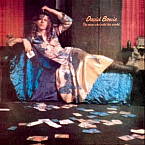
  • Bowie played this song on Granada Television in Britain while wearing the same dress he's pictured in on the cover of the UK pressing of The Man Who Sold the World.

Comments: 1

  • Zabadak from LondonThe music in the film "Jaws", by John Williams, helped contribute to the sense of impending doom in the movie and scared me silly! The intro to the version of "Holy Holy" on the flip of "Diamond Dogs", with its der-DER-der-DER motorik reminded me so much of it that it makes me uneasy to listen even to this day!
see more comments

Editor's Picks

Donnie Iris (Ah! Leah!, The Rapper)

Donnie Iris (Ah! Leah!, The Rapper)Songwriter Interviews

Before "Rap" was a form of music, it was something guys did to pick up girls in nightclubs. Donnie talks about "The Rapper" and reveals the identity of Leah.

David Bowie Leads the Society for Prevention of Cruelty to Long-Haired Men

David Bowie Leads the Society for Prevention of Cruelty to Long-Haired MenSong Writing

Bowie's "activist" days of 1964 led to Ziggy Stardust.

Bob Daisley

Bob DaisleySongwriter Interviews

Bob was the bass player and lyricist for the first two Ozzy Osbourne albums. Here's how he wrote songs like "Crazy Train" and "Mr. Crowley" with Ozzy and Randy Rhoads.

La La Brooks of The Crystals

La La Brooks of The CrystalsSong Writing

The lead singer on "Da Doo Ron Ron" and "Then He Kissed Me," La La explains how and why Phil Spector replaced The Crystals with Darlene Love on "He's A Rebel."

Randy Houser

Randy HouserSongwriter Interviews

The "How Country Feels" singer talks Skynyrd and songwriting.

Laura Nyro

Laura NyroSongwriting Legends

Laura Nyro talks about her complex, emotionally rich songwriting and how she supports women's culture through her art.