Ziggy Stardust is a character Bowie created with the help of his then-wife, Angela. The character's name was inspired by the '60s psychobilly musician, Legendary Stardust Cowboy. Bowie performed under the Stardust persona for about a year. This specific song is about Stardust growing too conceited: "Making love with his ego, Ziggy sucked up into his mind." Stardust's band, The Spiders From Mars, consequently plan to get revenge on the egotistical front man: "So we bitched about his fans, and should we crush his sweet hands?" Bowie said that the song is "about the ultimate rock superstar destroyed by the fanaticism he creates."
Iggy Pop (note the name: zIGGY), Lou Reed, Marc Bolan, Gene Vincent and Jimi Hendrix ("He played it left hand, but made it too far" - Hendrix was left-handed), were all likely influences on the character Ziggy Stardust, but the only musician Bowie admits was a direct influence is Vince Taylor, an English singer who took the "rock star" persona to the extreme, calling himself Mateus and declaring himself the son of God. Taylor was popular in France in the early '60s, and Bowie met him in 1966, after his popularity had faded.
Bowie based the clothes, hair, and makeup of Ziggy Stardust on the Malcom McDowell character in A Clockwork Orange, and on William Burroughs book Wild Boys. Some of the posturing was inspired by Gene Vincent, a rockabilly star who injured his leg in a 1960 car accident that killed Eddie Cochran. When Bowie saw Vincent in concert, he was wearing a leg brace and had to stand with his injured leg behind him; Bowie appropriated this stance, calling it "position number one for the embryonic Ziggy."
"Weird and Gilly" were two of Bowie's band mates in The Spiders From Mars: bassist Trevor Bolder and drummer Woody Woodmansey.
This song and the Ziggy Stardust persona as a whole was a major influence on glam rock bands like T-Rex and Suede. Glam rock was characterized by outrageous costumes, flamboyant stage antics, and sexual ambiguity.
Bowie was very theatrical and a student of acting and mime. He admitted that the Ziggy character was his way of dealing with the mental health issues that plagued his family - he basically went into character so he wouldn't go crazy. "One puts oneself through such psychological damage in trying to avoid the threat of insanity," Bowie said. "As long as I could put those psychological excesses into my music and into my work, I could always be throwing it off." After a while, Ziggy started to scare David, as he was getting engrossed in the persona. He was afraid that the blurring of Stardust and Bowie would lead to madness, and on July 3, 1973, David did his last show as Ziggy at the Hammersmith Odeon in London. The show was made into a movie directed by D.A. Pennebaker called Ziggy Stardust and The Spiders From Mars. It was released on DVD in 2003. For years Bowie would not look at tapes of himself performing as Ziggy Stardust, but when he finally did, he thought they were hilarious.
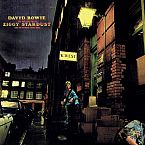
The album cover shows David Bowie (dressed as Ziggy Stardust) standing outside the furriers, K. West, which was located at 23 Heddon Street, London. In March 2012, a plaque honoring Ziggy Stardust was installed where the K. West sign once hung. This plaque is the one of the few in the UK dedicated to a fictional character.
While doing an interview in character as Ziggy Stardust, Bowie admitted he was gay. This gave him a great deal of publicity, even though it was not entirely true. Bowie later married the model Iman.
In a poll by Out.com, The Rise And Fall Of Ziggy Stardust And The Spiders From Mars was voted the gayest album of all time. A panel of "gay experts" including Boy George, Rufus Wainwright and Cyndi Lauper voted in the poll.
Bauhaus recorded a version of this song in 1982 that hit #15 in the UK. The song has also been recorded by Def Leppard, Nina Hagen and Hootie And The Blowfish.
A production error meant a live version of this song was left off some copies of the 3-CD set Bowie At The Beeb. Bowie later made the track available for download to those fans who did not get it on the album.
This never charted because it was not released as a single. Many British acts at the time focused on albums and tried to limit the number of singles they issued.
There is a plaque outside the pub in London where Bowie created the Ziggy Stardust character. Bowie performed there when it was The Three Tuns. It is now called The Rat And Parrot.
The song is ranked #277 on Rolling Stone's list of The 500 Greatest Songs of All Time.
Bowie later said that his Ziggy alter-ego "wouldn't leave me alone for years. That was when it all started to go sour ... My whole personality was affected. It became very dangerous. I really did have doubts about my sanity."