Oh! You Pretty Things

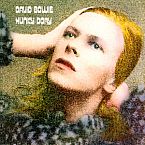
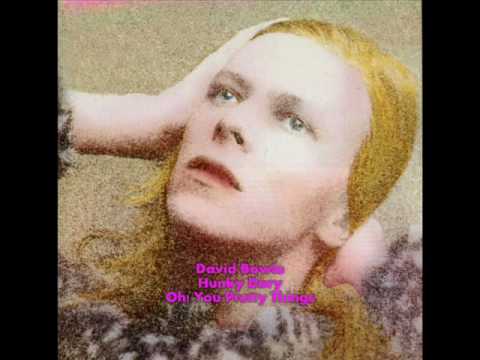
Album: Hunky Dory (1971)
Play Video

Songfacts®:

  • The song came to David Bowie in the early hours of a morning in January 1971. His wife Angie was pregnant at the time with their son, Duncan (originally called Zowie). Explaining the meaning of "Oh! You Pretty Things" in a Hunky Dory track by track made for radio by his label RCA, Bowie said, "The reaction to my wife being pregnant was archetypal daddy - 'Oh he's going to be another Elvis' - and this song is all that plus a dash of science fiction."
  • David Bowie supplied the opening piano line and keyboardist Rick Wakeman, who later became a member of Yes, tinkled the ivories for much of the rest of the song. Wakeman was also credited with performing on the Hunky Dory tracks "Life On Mars?" and "Changes." He recalled to Danny Baker on his BBC Radio 5 Live show in 2017:

    "David wanted it to be very simple but if I remember rightly he kept cocking up the little riff. He did a few bits of it and I did the rest. He did the beginning."
  • Peter Noone covered this song six months prior to the release of the Hunky Dory album. Bowie played the piano on the former Herman's Hermits vocalist's version, which peaked at #12 in the UK. When Noone's recording with producer Mickie Most couldn't match the feel of Bowie's demo, they asked Bowie to show them how it's done.

    In a Songfacts interview, Noone said: "We tried to record it from the demo which was just David on the piano, but the piano player just couldn't get it. We had Herbie Flowers, the world's greatest bass player, and the best people in the studio, the best drummer and everything, but nobody could play the part that David Bowie played because David played it in F sharp. He could only play on black keys. And for normal piano players, that's unusual and difficult. We wanted to record the song in F and nobody could do it.

    Mickie said, 'Let's get Bowie over here.'

    David comes in. Bowie says, 'I can't play it all the way through. I get tired. I'm not a real piano player.'

    So Mickie says, 'Let's record one section and then we'll cut the tape and repeat it three times.'

    David says, 'That sounds like a good idea.'

    So he plays it perfectly once, everybody loves it, it's a great version, then we repeat it. It was one of the first bits-and-pieces type of recordings. David played it great once and we worked around that. We just put the vocals on it and Mickie put some violins on it that night - I don't know why, we didn't need them. But he said, 'I put some violins on it, if you don't like it we'll get rid of it.' But of course they never got rid of anything if they spent money on it."

    "He could only play the song in F#, which became the new key, Noone recalled to Mojo magazine in 2011. "Suddenly with him playing the piano the song came alive. We cut it sort of half-live, I kept the original scratch vocal and they just doubled the high notes. It was mixed in 30 minutes."

    It was Bowie, said Noone, who suggested he change the line "the earth is a bitch" to "the earth is a beast" to ensure the single didn't miss out on radio airplay.
  • David Bowie expert Nicholas Pegg told Q magazine this song began life with the title of "I'd Like a Big Girl With a Couple Of Melons."
  • Peter Noone performed his version on the British TV series Top Of The Pops in 1971. Bowie joined him on piano, making his second appearance on the show.
  • Look out at your children
    See their faces in golden rays
    Don't kid yourself they belong to you
    They're the start of the coming race


    The Coming Race was a 1871 novel by Edward Bulwer-Lytton about a master race that lives underground. It also introduces a concept of energy called "Vril." Though a fictional work, many prominent theosophists, including Rudolf Steiner, contended it was based on occult reality (with "occult" in this sense meaning simply "hidden"). In some circles of theosophical thinkers and occultists in general, the book is still considered to hold esoteric truths.
  • According to the book Bowie: An illustrated Record by Roy Carr and Charles Shaar Murray, this song heralds "the impending obsolescence of the human race in favor of an alliance between arriving aliens and the youth of the present society." All Music Guide on the other hand regards this as more of a Nietzschean lyric "invoking concepts of the 'homo superior.'"

    Uncut magazine June 2008 thought it might be interesting to get Phil May from the 1960s British band The Pretty Things to give his opinion. He told them: "I've always interpreted this song as a fantasy of outsiders taking over. In terms of using our name, I think we were a beacon to him. I've never had a conversation with him about it, but there was 'Pretty Things Are Going to Hell' (from 1999s hours… too. I think the phrase is a euphemism for how he saw our band when he was starting up-somebody shining a light on his situation, when for the rest of his life, he was on his own."

Comments: 3

  • Jacob Kilgore from KoreaRead the book or listen to the audiobook "Childhood's End" by Arthur C. Clark. I always thought there must have been a sci-fi book Bowie read that inspired this song. If there were one, this could be it. Aliens come and herald the next step in the evolution of the human race. Parents must say goodbye to their children.
  • Helio from Rio De Janeiro, BrazilThe Brazilian singer/composer Seu Jorge recorded a version of the song in Portuguese, for the film "The Life Aquatic, with Steve Zissou"
  • Mark from London, EnglandUntil I read otherwise, I always thought this song was inspired by the John Wyndahm novel "The Midwich Cuckoos" (and subesquent films, "Village Of The Damned" and "Children Of The Damned"), about an alien-inspired mutation creating a superior race of kids. Listen to the lyrics with that in mind and you will see what I mean!
see more comments

Editor's Picks

Dean Pitchford

Dean PitchfordSongwriter Interviews

Dean wrote the screenplay and lyrics to all the songs in Footloose. His other hits include "Fame" and "All The Man That I Need."

David Sancious

David SanciousSongwriter Interviews

Keyboard great David Sancious talks about his work with Sting, Seal, Springsteen, Clapton and Aretha, and explains what quantum physics has to do with making music.

Roger McGuinn of The Byrds

Roger McGuinn of The ByrdsSongwriter Interviews

Roger reveals the songwriting formula Clive Davis told him, and if "Eight Miles High" is really about drugs.

Francis Rossi of Status Quo

Francis Rossi of Status QuoSongwriter Interviews

Doubt led to drive for Francis, who still isn't sure why one of Status Quo's biggest hits is so beloved.

Dan Reed

Dan ReedSongwriter Interviews

Dan cracked the Top 40 with "Ritual," then went to India and spent 2 hours with the Dalai Lama.

Jackie DeShannon - "Put a Little Love in Your Heart"

Jackie DeShannon - "Put a Little Love in Your Heart"They're Playing My Song

It wasn't her biggest hit as a songwriter (that would be "Bette Davis Eyes"), but "Put a Little Love in Your Heart" had a family connection for Jackie.