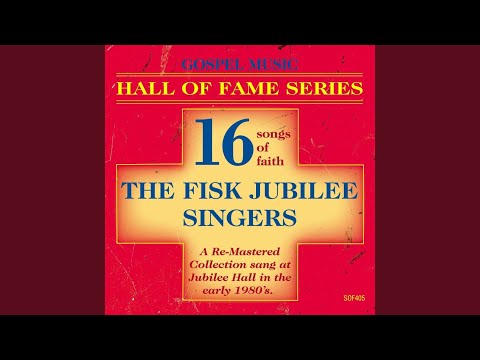
Album: Fisk University Jubilee Singers, Vol. 2 (1871)
Play Video

Songfacts®:

  • Also known as "Steal Away To Jesus," this traditional gospel tune is rooted in African American slavery when people of color would incorporate coded messages in their songs to signal their intentions to flee to freedom. In this case, it's both a faithful spiritual about being liberated from bondage after death and a summons for slaves to steal away towards independence here on earth. The song was popularized after the Civil War when it was picked up by the Fisk University Jubilee Singers.
  • Along with "Swing Low, Sweet Chariot," this is often credited to Wallace Willis, a slave from the old Choctaw Nation region of Oklahoma, who composed several spirituals prior to 1862 as he worked in the fields. When Willis' owner sent him to work at Spencer Academy, a Choctaw boarding school, his "plantation songs" became favorites among the students and faculty, including the superintendent, Rev. Alexander Reid. When Reid attended a fundraising concert by the Fisk University Jubilee Singers in 1871, he learned the ensemble was in need of new material and offered them six of Willis' songs, including "Steal Away," which he transcribed from memory. Shortly after, the African American group popularized the spirituals when they sang them during their tour of the United States and Europe.
  • Nat King Cole covered this on his 1959 album Every Time I Feel The Spirit, a collection of spirituals that was re-issued by Capitol Records in 1966 as Nat King Cole Sings Hymns And Spirituals. His version features accompaniment from the First Church of Deliverance Choir of Chicago, Illinois. The album was arranged by Gordon Jenkins, who frequently worked with the singer and a number of other high-profile artists, including Frank Sinatra, Louis Armstrong, Billie Holiday, Ella Fitzgerald, and Johnny Cash.
  • Nat King Cole also sang this with Mahalia Jackson when the gospel singer appeared on his TV show, The Nat King Cole Show, in 1957. Jackson sang it again in the 1958 movie St. Louis Blues, a biographical film starring Cole as blues musician W.C. Handy.
  • This was also covered by Red Foley, Eartha Kitt, Sam Cooke, Brook Benton, J.D. Sumner, Pat Boone, Bobby Bare, Conway Twitty, Marvin Gaye, and Paula Cole, among others.
  • British composer Michael Tippett arranged a version of the song for his oratorio A Child Of Our Time, which debuted in London in 1944.
  • Despite introducing the song, the Fisk Jubilee Singers were not the first to record it. The first cut came from the Dinwiddie Colored Quartet, who recorded it for the Victor Talking Machine company on October 29, 1902. The Fisk Jubilee Singers, billed as Fisk University Male Quartette, didn't record it until October 21, 1915.

Comments

Be the first to comment...

Editor's Picks

John Waite

John WaiteSongwriter Interviews

"Missing You" was a spontaneous outpouring of emotion triggered by a phone call. John tells that story and explains what MTV meant to his career.

Charlie Daniels

Charlie DanielsSongwriter Interviews

Charlie discusses the songs that made him a Southern Rock icon, and settles the Devil vs. Johnny argument once and for all.

Barry Dean ("Pontoon," "Diamond Rings And Old Barstools")

Barry Dean ("Pontoon," "Diamond Rings And Old Barstools")Songwriter Interviews

A top country songwriter, Barry talks about writing hits for Little Big Town, Tim McGraw and Jason Aldean.

Director Nick Morris ("The Final Countdown")

Director Nick Morris ("The Final Countdown")Song Writing

Nick made some of the biggest videos on MTV, including "The Final Countdown," "Heaven" and "Don't Know What You Got (Till It's Gone)."

John Kay of Steppenwolf

John Kay of SteppenwolfSongwriter Interviews

Steppenwolf frontman John Kay talks about "Magic Carpet Ride," "Born To Be Wild," and what he values more than awards and accolades.

Supertramp founder Roger Hodgson

Supertramp founder Roger HodgsonSongwriter Interviews

Roger tells the stories behind some of his biggest hits, including "Give a Little Bit," "Take the Long Way Home" and "The Logical Song."