Swing Low, Sweet Chariot

Album: Roll Jordan Roll (1847)
Play Video

Songfacts®:

  • There are several differing accounts regarding the origins of this gospel song. Some sources say the origins of the spiritual tune lie in attempts of slaves escaping slavery and finding freedom by means of jumping into a wagon, train or ship to hide and ride away. African-Americans working in the cotton fields would sing this gospel song about a slave escaping by this means, the word "chariot" being used as a euphemism for the means of transport.

    Other sources claim the song was written by a slave, Sara Sheppard, who having contemplated suicide as she and her baby Ella were to be sold off to different owners, recalled the words of an old black "momma." She had told Sara that she and her child would be carried to a far better place by God's chariot. Chariot was the French word for the sledge used to collect cotton in the plantation fields.

    Yet more sources claim Wallace Willis, a Choctaw freedman in the old Indian Territory, composed this spiritual sometime before 1862. He was inspired by the Red River, which reminded him of the Jordan River and of the Prophet Elijah being taken to heaven by a chariot.

    We do know for a fact that in 1871 Alexander Reid, a minister at a Choctaw boarding school attended a performance of The Fisk Jubilee Singers, an African American a cappella ensemble, consisting of students at Fisk University in Nashville, Tennessee. He had heard Willis singing this song years earlier and had transcribed the words and melody. Reid thought this and other songs he had heard Willis singing were better than those he had heard and he sent the music to the Jubilee Singers. The group added it to their repertoire and popularized the song during a tour of the United States and Europe.

    As a footnote, Ella Sheppard, was later re-united with her mother Sara, and became the first pianist of the Fisk University Choir.
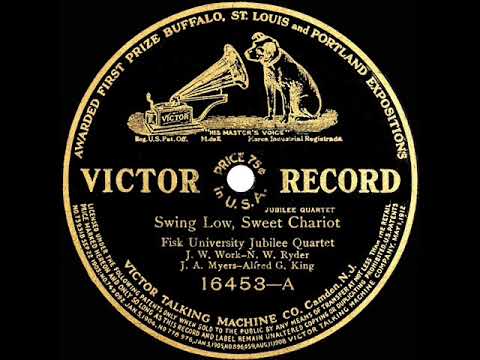
  • In 1909 The Fisk Jubilee Singers made the first recording of the song. African-American composer Henry Thacker Burleigh, who was taught the song by his slave grandfather, arranged the tune in the setting we're familiar with today in 1917.
  • The song enjoyed a resurgence during the 1960s folk revival, when it was performed by a number of artists, notably Joan Baez at the 1969 Woodstock festival. Baez, the last performer on the first day, took the stage around 1 a.m. and sang to a wet, muddy, tired crowd. "It was a humbling moment, in spite of everything," she said. "I'd never sung to a city before."
  • A version by Eric Clapton was a track on his 1975 album, There's One in Every Crowd. Released as a single, it peaked at #19 in the UK.
  • George Clinton's funk group Parliament evoked this song on their 1975 track "Mothership Connection," where they sing:

    Swing down, sweet chariot
    Stop, and let me ride


    In their telling, the chariot represents the Mothership, a space craft that will take them to a place of enlightenment. Clinton commissioned a 20-foot Mothership as a prop that descended to the stage when they performed the song.

    In 1992, Dr. Dre used this "sweet chariot" section of "Mothership Connection" on his song "Let Me Ride."
  • England rugby union fans adopted the song during the last match of the 1988 season after they sung it in tribute to Nigerian-born wing Chris Oti scoring a hat trick of tries. Since then a number of rugby linked recordings have been made of the tune that have hit the UK charts. They include China Black with Ladysmith Black Mambazo, which was England's Rugby squad's World Cup theme song for the 1995 World Cup in South Africa and UB40 / United Colours Of Sound, the official England team song for the 2003 Rugby World Cup 2003 in Australia. Both versions reached #15.

Comments: 1

  • Terry from Valliant, OkIt was supposedly written at the Clear Creek Watermill near Valliant, OK. Local history says it written by a slave that was owned by the Choctaw Indians. The mill began operations in the early 1800's. That's where I learned to swim.
see more comments

Editor's Picks

Jon Anderson of Yes

Jon Anderson of YesSongwriter Interviews

From the lake in "Roundabout" to Sister Bluebird in "Starship Trooper," Jon Anderson talks about how nature and spirituality play into his lyrics for Yes.

Mike Campbell

Mike CampbellSongwriter Interviews

Mike is lead guitarist with Tom Petty & the Heartbreakers, and co-writer of classic songs like "Boys Of Summer," "Refugee" and "The Heart Of The Matter."

Lita Ford

Lita FordSongwriter Interviews

Lita talks about how they wrote songs in The Runaways, and how she feels about her biggest hit being written by somebody else.

The End Of The Rock Era

The End Of The Rock EraSong Writing

There are no more rock stars - the last one died in 1994.

00s Music Quiz 1

00s Music Quiz 1Music Quiz

Do you know the girl singer on Eminem's "Stan"? If so, this quiz is for you.

Lecrae

LecraeSongwriter Interviews

The Christian rapper talks about where his trip to Haiti and his history of addiction fit into his songs.