Knees Up Mother Brown

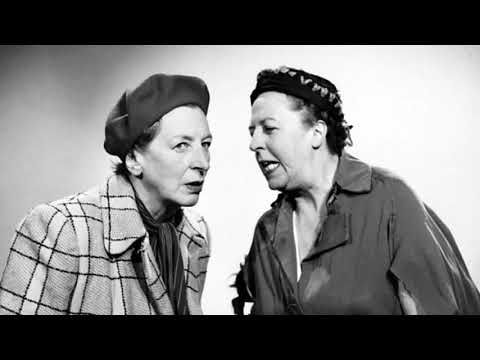
Album: Just Gert and Daisy (1940)
Play Video

Songfacts®:

  • "Knees Up Mother Brown" is a working-class drinking song that emerged from the East End of London in the 1800s. "Mother Brown" had become so popular by the time World War I rolled around that Londoners celebrated the end of the Great War by singing it on Armistice Night, November 11, 1918. One imagines it was belted out with no shortage of enthusiasm, though probably with more vigor than accuracy.
  • Curiously, despite its long history, the song didn't receive an official, standardized version until the late 1930s, when it was published by Harris Weston and Bert Lee, a British songwriting duo. Weston and Lee were also responsible for "Paddy McGinty's Goat," which enjoyed a revival in 1964 thanks to crooner Val Doonican. Weston also co-penned "I'm Henery The VIII, I Am," the signature tune of the great music hall star Harry Champion, later a chart-topper for Herman's Hermits in the 1960s.

    Weston and Lee's version of "Knees Up Mother Brown" became the standard, and the song's cheerful nonsense lyrics were perfect fodder for singalongs, especially in the hands of East End sister comic duo Elsie and Doris Waters, who performed it as their cockney alter-egos, Gert and Daisy.
  • Of course, like any good drinking song, the actual meaning of the lyrics isn't terribly important. What matters is the repetitive, sing-song quality that practically demands participation. A "knees up" is East End slang for a lively party, where the goal is to keep drinking, dancing, and singing until you're quite unable to do any of those things anymore.
  • An interesting, albeit unproven, theory suggests the song might be a cheeky dig at Queen Victoria's famously close relationship with her Scottish ghillie, John Brown. In this context, "knees up" would take on a far more scandalous, not to mention saucy, meaning.
  • Beyond the pubs, "Knees Up Mother Brown" also has a strong association with West Ham United, where it's been sung by supporters since at least the 1950s, a fitting anthem for a football club rooted in Cockney culture and community spirit. So much so that the title has lent itself to an internet forum dedicated to the club.
  • "Knees Up Mother Brown" has made its way into several films and television shows:

    1964: Richard Sherman of Disney fame was inspired to write "Step in Time" for Mary Poppins after watching Walt Disney attempt the "Knees Up Mother Brown" dance, egged on by the head of special effects, a Londoner named Peter Ellenshaw.

    1980: In a an episode of The Muppet Show, Fozzie Bear gives the song his best shot.

    1986 "Knees Up Mother Brown" featured in a scene of the movie Sweet Liberty where Michael Caine recounts meeting Winston Churchill during the war.

Comments

Be the first to comment...

Editor's Picks

Facebook, Bromance and Email - The First Songs To Use New Words

Facebook, Bromance and Email - The First Songs To Use New WordsSong Writing

Where words like "email," "thirsty," "Twitter" and "gangsta" first showed up in songs, and which songs popularized them.

Stand By Me: The Perfect Song-Movie Combination

Stand By Me: The Perfect Song-Movie CombinationSong Writing

In 1986, a Stephen King novella was made into a movie, with a classic song serving as title, soundtrack and tone.

Adele

AdeleFact or Fiction

Despite her reticent personality, Adele's life and music are filled with intrigue. See if you can spot the true tales.

Ian Anderson: "The delight in making music is that you don't have a formula"

Ian Anderson: "The delight in making music is that you don't have a formula"Songwriter Interviews

Ian talks about his 3 or 4 blatant attempts to write a pop song, and also the ones he most connected with, including "Locomotive Breath."

John Lee Hooker

John Lee HookerSongwriter Interviews

Into the vaults for Bruce Pollock's 1984 conversation with the esteemed bluesman. Hooker talks about transforming a Tony Bennett classic and why you don't have to be sad and lonely to write the blues.

Al Jourgensen of Ministry

Al Jourgensen of MinistrySongwriter Interviews

In the name of song explanation, Al talks about scoring heroin for William Burroughs, and that's not even the most shocking story in this one.