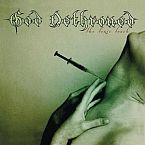
This song might be described as folk ballad meets death metal. Well, a death metal ballad anyway.
Like
Countess Bathory - who has inspired many similar songs - Typhoid Mary was a real person who caused the deaths of innocent people. Unlike the Blood Countess, Typhoid Mary was an innocent harbinger of misery and death - up to a point - and, because she is a far more recent historical figure, a great deal more is known about her.
Mary Mallon was born September 23, 1869 at Cookstown, County Tyrone in what was then Ireland, but which since the Anglo-Irish Treaty of 1921 has been in (British controlled) Northern Ireland. As a teenager she followed in the footsteps of Falmouth Kearney, who arrived in the Promised Land in 1850. During the early Twentieth and entire Nineteenth Centuries, countless Europeans, including Irish, followed the same path. Mary worked as an itinerant cook in the New York area, apparently without incident until 1900, then wherever she worked, outbreaks of typhoid followed.
At this time, the Big Apple was far from the glamorous place it would become in the second half of the Twentieth Century, certainly there was nothing glamorous or salubrious about its slums, where poor immigrants lived in overcrowded and at times unsanitary conditions. This meant that tracing the source of a typhoid outbreak was fraught with difficulties, especially when it was not a stagnant pond or contaminated water tank but an individual who was not only constantly on the move but seemingly immune to the disease.
However, following an outbreak in 1907, civil engineer George Soper identified Mallon as the probable agent when he connected the infection of twenty-two people (including the death of a young girl) to her employment history. Unfortunately, when Soper located her and asked her diplomatically to provide samples for analysis (blood and feces), she reacted badly, and he retreated fearing she would stab him with a carving fork.
Obviously, a person who was potentially a risk to the health of the city had to be tested, if only for elimination purposes, and eventually when reason failed, the police were called in. Mary Mallon was carried off in an ambulance cursing, kicking and screaming to hospital where she was forcibly tested, and when these tests proved positive, she was moved to an isolated cottage on New York's North Border Island.
Her detention caused some controversy, and became a civil liberties issue because she had committed no crime; it appears too either that nobody attempted to explain to this ill-educated working woman that an otherwise healthy person could transmit typhoid, or that if they did, the idea went over her head. Although she was the first healthy carrier of the disease to be confirmed in the United States, others were soon identified.
Mary Mallon was detained until February 1910 when she was released on condition that she never again worked as a cook. She agreed to this, even swearing an affidavit to that effect, but after working briefly as a laundress, she was soon back to cooking, and caused an outbreak at a hospital where she had secured employment under a pseudonym. Two people died as a result of her selfishness and stupidity, and there was little if any sympathy for her second time around. After being sent back to North Brother Island, she would spend the rest of her life in isolation. She helped around the hospital until December 1932 when she was paralyzed by a stroke. She died November 11, 1938.
There is, obviously, a considerable literature surrounding Typhoid Mary, including a 2004 dramatisation
The Most Dangerous Woman In America.