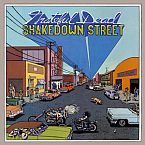
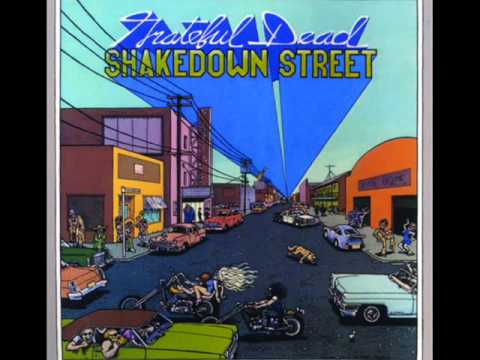
Shakedown Street

Album: Shakedown Street (1978)
Play Video

Songfacts®:

  • "Shakedown Street" is the title track of the 10th Grateful Dead album, their only one produced by Lowell George of Little Feat. It's one of four Dead albums to use the album title as a song title, with the other three being Blues for Allah, Terrapin Station, and Built to Last.
  • Though being one of the Dead's more recognizable songs, its intended meaning is unclear. Even David Dodd, author of The Complete Annotated Grateful Dead Lyrics, is stumped. In his Greatest Stories Ever Told entry for the song over at Dead.net (the Dead's official site), he calls the song one of the Dead's more successful, but otherwise is grasping around in the dark as to what it ultimately means. He does venture the idea that the song is a statement against cynicism, and possibly one meant specifically to "legitimize" disco.

    On the surface, the song's lyrics speak about urban decay overtaking a street that used to be "the heart of the town." There's subtler stuff buried in the words, though. In the first verse, Garcia sings:

    Maybe the dark is in your eyes
    You know you've got such dark eyes

    (Lyricist Robert Hunter's words)

    This seems to be implying that it's not the street that's been beaten down and broken up, but rather the observer. There are other parts that seem sort of accusatory, such as "it's not because you missed on the thing we had to start" and "maybe you had too much too fast."

    One part of the song, in particular, suggests that perhaps it was inspired by a specific encounter with a specific person. This comes in the third verse with the lines:

    Since I'm passing your way today
    (Well, well, well—You never can tell)
    I just stopped in 'cause I want to say
    (Well, well, well—You never can tell)
    I recall your darkness
    when it crackled like a thunder cloud
    don't tell me this town ain't got no heart
    when I can hear it beat out loud


    (Note: In Box of Rain, the collected lyrics of Robert Hunter, the words beat out loud are the only ones in the song italicized for emphasis.)

    It's tempting, of course, to think the song is about the Haight-Ashbury neighborhood in San Francisco, which was a crucial location for the Dead in their early days when that area was the epicenter of the hippie movement. The area had indeed seen some rough times in the late '60s, as the hippie scene degenerated into one of crime, violence, and hard drugs. Still, Hunter's said nothing to confirm or deny this assumption.
  • Within the lyric there are two possible references to other songs.

    The repeated line "you never can tell" harks back to Chuck Berry's "You Never Can Tell."

    The song's second line, "the sunny side of the street is dark," recalls "On the Sunny Side of the Street."
  • Deadheads started calling the vending area outside Dead shows Shakedown Street. This is where all manner of merchandise, legal and illegal, was sold. The term was later used for the vending strip at the Bonnaroo festival.
  • In 2013, the song was featured in The Simpsons episode "Homerland."
  • The song was first performed on August 31, 1978, at the Red Rocks Amphitheatre in Colorado, where it opened the second set. "From the Heart of Me" was also performed for the first time that night.
  • At a performance for the Earthquake Relief Fund after the 1989 Loma Prieta quake hit the Bay Area, the Dead opened (fittingly) with this song.
  • "Shakedown Street" was released as a single, but like most other Dead singles, it failed to chart. The B-side was "France."

Comments

Be the first to comment...

Editor's Picks

Pam Tillis

Pam TillisSongwriter Interviews

The country sweetheart opines about the demands of touring and talks about writing songs with her famous father.

Concert Disasters

Concert DisastersFact or Fiction

Ozzy biting a dove? Alice Cooper causing mayhem with a chicken? Creed so bad they were sued? See if you can spot the real concert mishaps.

Jimmy Webb

Jimmy WebbSongwriter Interviews

Webb talks about his classic songs "By the Time I Get to Phoenix," "Wichita Lineman" and "MacArthur Park."

Julian Lennon

Julian LennonSongwriter Interviews

Julian tells the stories behind his hits "Valotte" and "Too Late for Goodbyes," and fills us in on his many non-musical pursuits. Also: what MTV meant to his career.

Scott Gorham of Thin Lizzy and Black Star Riders

Scott Gorham of Thin Lizzy and Black Star RidersSongwriter Interviews

Writing with Phil Lynott, Scott saw their ill-fated frontman move to a darker place in his life and lyrics.

Amy Lee of Evanescence

Amy Lee of EvanescenceSongwriter Interviews

The Evanescence frontwoman on the songs that have shifted meaning and her foray into kids' music.