A track from the band's first album, "Iron Maiden" quickly became their trademark song and a concert favorite. They would typically close out their sets with it before returning for an encore, a tradition that continued decades later even as the band piled up hits in the UK.
Iron Maiden was formed in 1976, taking their name from a medieval torture device - a specifically shaped iron coffin that resembles a sarcophagus. The door was imbedded with long spikes; it was held vertically so the victim could be placed inside, and the door slammed shut under its own massive weight. The victim was skewered, as well as crushed. Bass player Steve Harris, who started the band, first saw the Maiden in an old film adaptation of The Man In The Iron Mask.
Harris wrote the song after the band already had their name. The lyric refers to the torture device, creating a kind of aural horror movie:
See the blood begin to flow as it falls upon the floor
There is a double meaning to the title. Steve Harris thought "Iron Maiden" could also be a description of a cold-blooded woman (indeed, Margaret Thatcher's nickname was "Iron Maiden," and she appeared on some single covers). The song describes such a damsel who seduces men into her bedroom to show off her "wares" (torture devices) and proceeds to kill them in an Iron Maiden.
Paul Di'Anno was the lead singer on this track. He was Iron Maiden's frontman on their first two albums, and while he was very popular with fans, he made some lifestyle choices that put off his bandmates, and in 1981 he was fired, replaced with Bruce Dickinson, whose air-raid siren voice contrasted with Di'Anno's grittier singing. (Ironically, Bruce tried a grittier style in albums like
No Prayer for the Dying).
It's one of the band's most popular songs, but "Iron Maiden" wasn't released as a single. The two singles from the album were "
Running Free" and "
Sanctuary" - they were issued in the UK and a few other territories, but not in America, where fans tended to buy the albums. Iron Maiden has the distinction of landing 17 Top 10 hits in the UK while never once charting a single in America.
"Iron Maiden" was the first heavy metal song played on MTV. The clip - made up of concert footage - was the 16th video played on MTV's opening day on August 1, 1981, flanked by Rod Stewart's "
Sailing" and REO Speedwagon's "
Keep On Loving You."
The original demo of this song appears on the raw tapes played at the Soundhouse, a metal club in London, when the band was just starting out. The demo was eventually released as an EP called The Soundhouse Tapes in 1979, but the song was re-recorded for their debut album, released a year later.
Maiden mainstay Steve Harris said of this song: "It's quite simple. The bass line is fairly straight forward as is the drumming. But the guitar is over the top with harmony, and the bass is descending behind it. I think this makes it pretty special."
Wil Malone was the producer for the album, although the production was done primarily by the band and the recording engineer. Malone, who had worked with Todd Rundgren and Black Sabbath, was foisted on the band by their record company, and it wasn't a good fit - Steve Harris claimed Malone was disengaged. Their next album was produced by Martin Birch, who worked with the band through their 1992 album Fear Of The Dark.
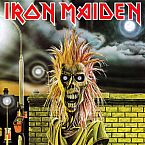
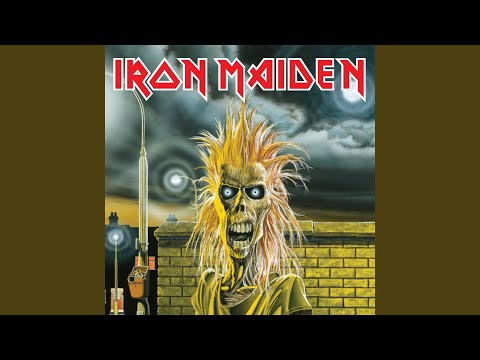
Derek Riggs designed the cover art, which depicts Eddie, a shock-haired, skeletal zombie in an alley. When the album was re-mastered in 1998, a slightly edited version of the cover was used. It was darker, both color-wise (it looks shadier) and emotionally (the zombie looks far less cartoonish and more horrific). Riggs slipped his logo - the symbol features a reflected D and a right-hand R (his initials) - into the cover art. It appears on the second brick from the left, six rows down, on the shadier half of the wall. Also, a wastebasket on a street lamp by the wall reappeared on the cover art for their 1986 album Somewhere in Time, next to Eddie's left leg.
The Iron Maiden album was recorded in December 1979, and released on April 14, 1980. "Iron Maiden" was the last track.
The guitar riff was a heavy influence on Iron Maiden's 1984 song "
Aces High," another concert favorite.
An all-female Los Angeles tribute band called the Iron Maidens formed in 2001 and built a sizable following. They met the band and developed a female Eddie as their mascot.
The heavy metal band Trivium covered this song in 2008. It was included as a bonus track on their
Shogun album.
>>>
Suggestion credit:
Nick - Cairns, Australia