
Ladies Of The Canyon

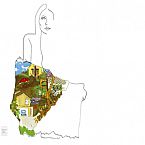
Album: Ladies Of The Canyon (1970)
Play Video

Songfacts®:

  • In "Ladies Of The Canyon," the title track of her third studio album, Joni Mitchell pays tribute to three special women (Trina Robbins, Annie Burden, and Estrella Berosini) from Laurel Canyon, a section of Los Angeles where Mitchell and a number of counterculture luminaries made their home in the '60s and '70s. The tune is a poignant snapshot of the time she spent with each of them in 1968, the year Mitchell bought her house on Lookout Mountain Avenue in Laurel Canyon.
  • The opening verse is about Trina Robbins, a comic book artist and clothing designer who created fashions for stars like Mitchell, Donovan, and Mama Cass. In February 1968, she moved to sunny Los Angeles for a month to escape the frigid winter in New York City, where she owned a boutique in the East Village. She met Mitchell through her friend David Crosby, who produced the singer's debut album, Song To A Seagull, that same year. Mitchell conjures a sartorial image of her Robbins:

    Trina wears her wampum beads
    She fills her drawing book with line
    Sewing lace on widow's weeds
    And filigree on leaf and vine.


    For her entire stay in LA, Robbins wore a string of beads that a woman made for her when she first arrived in town. Love beads, which is how Robbins referred to her necklace, were popular handmade accessories among hippies at the time, and wampum beads are traditional shell beads used by Native American of the Eastern Woodlands tribes. She was also known to carry around a sketchbook to capture ideas and random doodles.

    As for the filigree and lace, Robbins explained to Joni Mitchell.com in 2008: "The filigree is what I drew, the lace on widow's weeds is because I made clothes that often featured antique lace sewn onto velvet mini dresses." Mitchell also mentions Robbins' second-hand coat, "trimmed with antique luxury." Robbins landed the fashionable item through a stroke of luck the previous winter. Business was slow at her boutique, so she took a gig modernizing vintage furs to make extra cash. She explained how the coat in question came into her possession:

    "One day a woman dropped off a fabulous ¾ length skunk fur coat from the '40s, saying she'd be back to discuss what she wanted done to it. I kept it around for at least two months before deciding she wasn’t gonna come back, so I wore it, just the way it was - with shoulders so wide that it looked like a cube. It was a fabulous coat!"
  • The second verse introduces Annie Burden, who was then married to Gary Burden, the artist behind many rock album covers of the '60s and '70s. Gary's profession brought lots of musicians to their doorstep, and Annie made sure they all felt welcome around their dinner table. Mitchell describes Annie's domestic activities and the warmth they bring to the Canyon:

    Annie sits you down to eat, she always makes you welcome in
    Cats and babies round her feet and all are fat and none are thin
    None are thin and all are fat, she may bake some brownies today
    Saying 'you are welcome back,' she is another canyon lady.


    "Many became friends, and nine days out of ten I set extra places around the dinner table. I never thought of myself as part of the scene - until Joni's song framed my role as a homemaker-hostess in the eye of the creative storm. I took it as a great honor to be included in the song, and I still do," Burden told Joni Mitchell.com in a 2008 interview.

    But the memories carry more weight in retrospect. Twenty-year-old Burden was so caught up in family life as a young mother that didn't pay much mind to the newsworthy events of 1968, such as the assassinations of Bobby Kennedy and Martin Luther King Jr., and the beginning of Richard Nixon's presidency.

    "Today, for me, 'Ladies Of The Canyon' evokes a cherished snapshot of innocence but also a somewhat painful perspective on my own naivete," she added.
  • The third verse is about Estrella Berosini, a singer-songwriter who made her second visit to Laurel Canyon in 1968 and palled around with its residents. Mitchell describes Estrella as a "circus girl," because she indeed did grow up in the circus due to her father being a highwire performer.

    Estrella, circus girl
    comes wrapped in songs and gypsy shawls
    Songs like tiny hammers hurled at beveled mirrors in empty halls
    Empty halls and beveled mirrors, sailing seas and climbing banyans.


    Berosini told Joni Mitchell.com that Mitchell bought her a "gypsy shawl" while they were on a shopping trip with David Crosby as their chauffeur. As for the "songs like tiny hammers hurled," the line has a double meaning. First, it refers to the way Berosini plays the guitar left-handed.

    "To say my left hand was strong 'for a girl' is to ignore that it was more like a bionic hand," she explained. "Because it was that strong, I could easily use a technique called the 'hammer on.' This is where your right hand strikes the string, but your left hand fingers keep hammering on the strings as though it doesn't need the right hand at all."

    Second, it alludes to Berosini's "Song Of A Flower," which is about the "long descent of a flower child into oblivion." That tune was partly inspired by Denny Doherty of the Mamas and the Papas, which ties into the next line of Mitchell's song.

    The "empty halls and beveled mirrors" is about Doherty's house at the top of the Canyon, where he was acting out after a breakup with his Mamas And The Papas bandmate Michelle Phillips. "He was not the only 'Flower Child' rapidly declining there," Berosini said. "The beveled mirror was at the top of his staircase leading to the second floor."

    "Sailing seas and climbing banyans" were two of Berosini's favorite pastimes outside of songwriting (a banyan is a type of tree).
  • Released in 1970, Ladies Of The Canyon is Mitchell's third studio album and marked her commercial breakthrough. Bolstered by the single "Big Yellow Taxi," it was her first album to be certified Gold in the US for selling half a million copies (it eventually went Platinum).
  • Annie Lennox recorded this as the B-side to her 1995 single "No More I Love You's."

Comments

Be the first to comment...

Editor's Picks

Gary Brooker of Procol Harum

Gary Brooker of Procol HarumSongwriter Interviews

The lead singer and pianist for Procol Harum, Gary talks about finding the musical ideas to match the words.

Andy McClusky of OMD

Andy McClusky of OMDSongwriter Interviews

Known in America for the hit "If You Leave," OMD is a huge influence on modern electronic music.

Waiting For The Break of Day: Three Classic Songs About All-Nighters

Waiting For The Break of Day: Three Classic Songs About All-NightersSong Writing

These Three famous songs actually describe how they were written - late into the evening.

Donald Fagen

Donald FagenSongwriter Interviews

Fagen talks about how the Steely Dan songwriting strategy has changed over the years, and explains why you don't hear many covers of their songs.

Graham Nash

Graham NashSongwriter Interviews

Graham Nash tells the stories behind some of his famous songs and photos, and is asked about "yacht rock" for the first time.

Michael Sweet of Stryper

Michael Sweet of StryperSongwriter Interviews

Find out how God and glam metal go together from the Stryper frontman.