This lively jazz tune, popularized by Louis Armstrong, evolved out of a traditional Black spiritual that inspired many variations. Originally known by the title "When De Saints Come Marchin' In," the hymn was born as a message of hope for African American slaves who longed for a release from their suffering. Without going into detail about the horrors of the Last Judgment, the traditional lyrics use apocalyptic imagery from the bible's Book of Revelation to signal a jubilant release from bondage. The stars falling from the sky, the moon turning red with blood, the trumpet sound calling, and the horsemen beginning to ride are all references to John's biblical account of the final days. Armstrong's 1938 rendition is a repetition of just the first verse:
Oh, when the saints go marching in
Oh, when the saints go marching in
Oh Lord I want to be in that number
When the saints go marching in
The "Saints" of the title are referring to devout Christian believers rather than the official saints of the Roman church.
The first published version, titled "When The Saints Are Marching In," was issued in June 1896 in Williamsport, Pennsylvania, by James Milton Black and Katharine Purvis. Another variation cropped up in January 1908, copyrighted by Harriet E. Jones and James D. Vaughan as "When The Saints March In For Crowning." The most familiar rendition was published by song collector Edward Boatner in 1916.
Boatner's copyright was first recorded in 1923 by the Paramount Jubilee Singers as "When All The Saints Come Marching In," followed by the Elkins-Payne Jubilee Singers in 1924. By the time Louis Armstrong recorded it with his orchestra on May 13, 1938, it was a staple among bands in his hometown of New Orleans, where it was played by noted jazz leaders like Buddy Bolden and Kid Ory. Armstrong joined Ory's combo in 1919 but was already familiar with the hymn from his reform-school days at New Orleans' Colored Waif's Home; the institution's band (featuring Armstrong on cornet) played it every Sunday to accompany the less-than-saintly boys to church service.
Armstrong, introducing himself as the Reverend Satchmo, opens his unconventional studio sermon with the proclamation: "My text tonight is 'When The Saints Go Marchin' In.' Here comes brother Higginbotham down the aisle with his trombone. Blow it boy!"
While Armstrong sings a repetition of the first verse throughout, J.C. Higginbotham is joined by the rest of the musical congregants, including Shelton Hemphill (second trumpet), Rupert Cole (clarinet/alto sax), Charlie Holmes (alto sax), Bingie Madison (clarinet/tenor sax), Luis Russell (piano), Lee Blair (guitar), Paul Barbarin (drums), and Red Callender (string bass).
Armstrong's jazzed-up version brought the hymn nationwide prominence, but his recording was met with backlash from religious circles who thought combining the sacred with the secular was blasphemous. That didn't stop the tune from becoming a jazz standard that was recorded by a range of artists across genres, including The Delta Rhythm Boys, The Vagabonds, The Weavers, Judy Garland, Bing Crosby, Elvis Presley, Fats Domino, and Jerry Lee Lewis, among others.
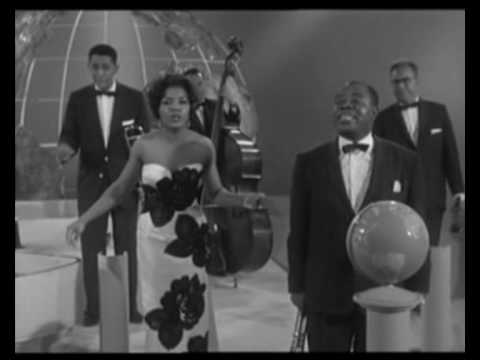
Because of the single's success, Decca exec Jack Kapp had Armstrong record more spirituals in his signature style. He also went on to re-record "When The Saints Go Marching In" several times throughout the rest of his career - including a comedic duet with Danny Kaye for the 1959 film The Five Pennies.
According to his friend Charles Carpenter, Armstrong tried to pitch the idea for a jazzy version of this tune to Okeh Records in 1931 but was denied. The label's A&R man didn't think the masses were ready for the song's "Holy Roller" tempo.
In 1961, Tony Sheridan recorded this in a rock-and-roll arrangement with an unknown backing group: The Beatles.
Woody Guthrie recorded a war-themed offshoot called "When The Yanks Go Marching In" in 1943.
Etta James sang this during the opening ceremony of the 1984 Summer Olympics.
This also gained some prominence in the sports realm. It's a popular song at soccer matches, where fans replace "Saints" with the name of their favorite team. In the US, it became a football anthem when Aaron Neville recorded it in 1983 in honor of the New Orleans Saints, who were named for the jazz standard. Some of the players appeared on the track, contributing the team's "Who Dat?" chant. It also featured New Orleans musicians Carlo Nuccio and Sal and Steve Monistere. Nuccio was the one who brought Neville on board.
"I remember it very well," Neville told The Times-Picayune in 2010. "He asked me if I'd be involved. It's a no-brainer. I had been with the Saints since the late '60s when they used to come see me and my brothers." The Saints knew their way around a football field (arguably - they hadn't had a winning seasons since their inception in 1966) but a recording studio? Not so much.
Nuccio recalled: "It was kind of funny. That first couple of passes, they were really kind of wimpy about it. It led to a minor altercation between me and Dave Waymer, when I said, 'No wonder you guys are losing games.' It got a little testy." Thankfully, they found their groove in the studio and on the field, where their luck began to turn around.
Bo Diddley and Chuck Berry recorded an instrumental version for their 1964 collaborative album, Two Great Guitars.
Bruce Springsteen performed this throughout his Seeger Sessions Band Tour in 2006.
Armstrong's 1938 Decca recording was added to the National Recording Registry of the Library of Congress in 2021.
This was a foundational song for musician brothers Branford and Wynton Marsalis, who grew up playing it together in New Orleans. "As kids in the late 1960s, Wynton and I learned it when I was still playing clarinet; Wynton playing the melody, and me playing the bass notes. It's the first song we played together," Branford explained. "I can't imagine New Orleans' culture without this song. It is an indelible part of our history."
This was used on The Simpsons in the 2018 episode "Lisa Gets The Blues."