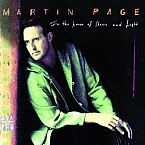
In the House of Stone and Light

Album: In the House of Stone and Light (1995)
Charted: 14
Play Video

Songfacts®:

  • "In the House of Stone and Light" was Martin Page's first single as a solo artist. In the early '80s, he fronted a band called Q-Feel, whose single "Dancing In Heaven (Orbital Be-Bop)" got the attention of Kim Carnes and Earth Wind & Fire, who enlisted Martin to write and perform on some of their tracks. When Elton John's lyricist Bernie Taupin was looking for someone other than Elton to compose music for his songs, he enlisted Page, which resulted in the Starship hit "We Built This City," and the Heart hit "These Dreams."

    Working on Robbie Robertson's 1987 debut solo album, Martin grew more confident in his songwriting, and Robbie encouraged him to start writing lyrics. After co-writing the Go West hits "King Of Wishful Thinking" and "Faithful," he started work on his first solo album, which contained very personal songs.

    Bob Skoro, who had signed Martin to a publishing deal years earlier, was now a vice president at Mercury Records and signed Martin as an artist, which lead to the release of In the House of Stone and Light.
  • It was a trip the Grand Canyon that inspired this song. Page decided to go there after working with Robbie Robertson, who is of Native American heritage. Traveling to the bottom of the Canyon, Martin learned about the Havasupai tribe (referenced in the line "Havasupai Shaman, let me be reborn"), who are natives to the area.

    In our interview with Martin Page, he explained: "The Indians there called the canyon The House of Stone and Light, and I saw that, really, as a reference to my own body and my own soul. I saw the house as my body and building something inside yourself to be strong. I'd worn myself out and really didn't know which direction to take, so as soon as I saw that title, 'In the House of Stone and Light,' I saw it as a spiritual gospel song. I saw it as my house is my body and I've got to pull myself together. I turned it into a treaty - a hymn to myself to say, Keep this together, stay strong, don't get tempted by all the wrong things in life, and let's do some music we really, really believe in."
  • The opening lines, "O Mount Kailas, uncover me. Come my restoration, wash my body clean" are a reference to Mount Kailas in Tibet, a place of great spiritual significance in Buddhist and Hindu lore.

    Page typically writes by putting phonetic placeholder vocals to his music, and in this case, he started his song singing something like "O maryias." Looking for a word that made sense, he looked through some books and discovered Mount Kailas. "That sings well, that's rather Buddhist," Martin told us. "And it's a great place - Mount Kailas is a mountain where people would walk around and strip pieces of clothing off and leave them around the mountain to say, 'I'm stripping some of my past off and some of my sins.'"
  • Growing up in England, Page was influenced by a wide range of music, which helped make him a very versatile songwriter. He says that this song has a distinct reggae feel to it. The beat reminded him of the Paul Simon song "Mother And Child Reunion," or any number of Jimmy Cliff songs.
  • The distinctive bridge section is an example of placeholder lyrics being the best option. Where Martin sings, "ba-ba, ba-da-da-bum," he was planning to insert real words, but decided against it when it became clear that the section sounded great as it was. Martin considers that part "a spiritual jig."
  • Robbie Robertson played guitar on this track, but Page played all the other instruments. Backing vocals were by Brenda Russell and Geoffrey Oryema. Phil Collins played drums on three tracks for the album, but not this one.
  • This song was a #1 Adult Contemporary hit for four weeks, and remains one of the most popular songs of that genre.

    Page had one more chart entry from the album: "Keeper Of The Flame," which made #83 on the Hot 100. He didn't release another album until In the Temple of the Muse in 2008, which was followed by A Temper of Peace in 2012.

Comments: 4

  • Priscilla from CaliforniaSuch a positive spiritual journey it takes you on.
  • Bill from Boston,maI like to relate this song to Christianity which is the only truth.
  • Victoria from NycI grew up in Arizona and despite the first verse explicitly referring to a place of Hindu/Jain/Buddhist spirituality, this song will always be to me about the Grand Canyon. “Havasupai shaman, let me be reborn.” I always tell people when they ask where I’m “from,” that no one is truly from Arizona unless they’re Mexican or Native American. But the power of the canyon is immense, and even if you only went there once, it will stay with you all your life. That’s the kind of emotion he’s talking about in this song.
  • ErikJimmy Copley played drums on this track.
see more comments

Editor's Picks

Bob Daisley

Bob DaisleySongwriter Interviews

Bob was the bass player and lyricist for the first two Ozzy Osbourne albums. Here's how he wrote songs like "Crazy Train" and "Mr. Crowley" with Ozzy and Randy Rhoads.

David Bowie Leads the Society for Prevention of Cruelty to Long-Haired Men

David Bowie Leads the Society for Prevention of Cruelty to Long-Haired MenSong Writing

Bowie's "activist" days of 1964 led to Ziggy Stardust.

Al Jourgensen of Ministry

Al Jourgensen of MinistrySongwriter Interviews

In the name of song explanation, Al talks about scoring heroin for William Burroughs, and that's not even the most shocking story in this one.

Linda Perry

Linda PerrySongwriter Interviews

Songwriting Hall of Famer Linda Perry talks about her songs "What's Up" and "Beautiful," her songwriting process, and her move into film music.

Danny Clinch: The Art of Rock Photography

Danny Clinch: The Art of Rock PhotographySong Writing

One of rock's top photographers talks about artistry in photography, raising funds for a documentary, and enjoying a County Fair with Tom Waits.

Boy Bands

Boy BandsFact or Fiction

From NKOTB to 1D, how well do you know your boy bands?