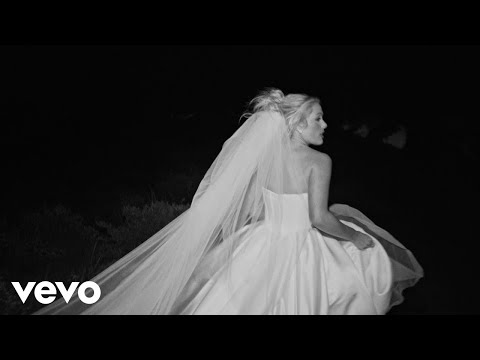
In country music a wedding dress is rarely just a garment. It's a narrative device, usually pressed, pristine, and quietly bracing for emotional impact somewhere between "I do" and "I immediately regret everything." Think of the trembling hesitation in "
Marry Me" or the bittersweet rewrites of forever in "
Speak Now," songs where the aisle doubles as a fault line. Into this long, slightly perilous tradition steps Megan Moroney slow-burn ballad "Wedding Dress."
The premise is Moroney imagining her future wedding day and hoping, prayerfully, and with just a hint of panic, that she won't still be thinking about the ex she still loves. It's heartbreak viewed through a telescope, projecting today's unresolved feelings into tomorrow's supposedly perfect moment. Less "happily ever after" and more "happily ever... pending emotional clearance."
Moroney wrote "Wedding Dress" during a period when she convinced herself she'd already met her future husband, but when they eventually broke up, she realized she had been living in a fantasy. "I think my type has been the problem,"
she told American Songwriter. "I go after potential. I had our future created in my head that wasn't a reality. I think those heartbreaks hurt worse because they weren't real, and you never get to live up to the potential that you created in your head. Once I finally got over it, I was able to write the verses in a way that told the story and explained really complicated emotions. It allowed me to clearly write the story of that feeling."
Moroney was "distraught" over this guy and genuinely feared that even if she married someone else one day, she would still miss him, that it was the kind of heartbreak you can never fully move on from. "There's a little desperation in the lyrics, but I hope it ends up inspiring everyone and lets them know that I did get over it,"
she said as quoted by Whiskey riff, "so if they're going through a heartbreak, they'll get over it too."
Moroney recorded "Wedding Dress" for her third album, Cloud 9. It was one of the first songs she wrote for the project, originally drafted three or four years earlier, with the chorus and bridge making the rounds online long before it was officially released. She told Bobby Bones that at the time, she disliked the verses so much that she refused to put the song out, even as fans kept asking for it. It wasn't until a later writing trip that she felt genuinely past the heartbreak and rewrote the verses in her Notes app as a poem, asking herself, "What would a rational person say here?" Only then did the song finally make sense to her.
Moroney has a long-standing fascination with the number nine, partly because she was born on October 9. That personal connection helped seal Cloud 9 as the album title, and it even influenced tour staging, including designing part of the arena stage thrust in the shape of the number nine.
There is a striking songwriting coincidence Moroney mentioned to Bobby Bones: She discovered she had written the phrase "aisle nine" in the lyrics for "Wedding Dress" years before she ever named the album Cloud 9, with no conscious connection between the two. Her response: "I swear the songwriting stuff is like a God thing."
Moroney wrote the song with Ben Williams and Colin Healy.
Ben Williams is a longtime Moroney collaborator who has been part of her songwriting circle since the early stages of her career, helping to shape the confessional, detail-driven voice that has defined her records from Lucky onward.
Colin Healy is a Nashville songwriter for whom "Wedding Dress" represents a notable breakthrough, his first cut with a major-label artist.
"Wedding Dress" is one of
Cloud 9's slowest, most stripped-back moments, a deliberate contrast to the brassy sass of "
Medicine" or the pointed anger of "
Who Hurt You?"
Kristian Bush's production is understated, leaving space for the lyric to land, with steel guitar providing the emotional texture country ballads of this kind rely on.
Cloud 9 is broadly Moroney's happiest, most upbeat record, and "Wedding Dress" is, by her own description, the most devastating thing on it. That tension - a grief song sitting inside a happiness album - actually reinforces one of Cloud 9's subtler themes: that being above Cloud 9 doesn't mean the old wounds have vanished, just that you've found enough altitude to see them clearly.