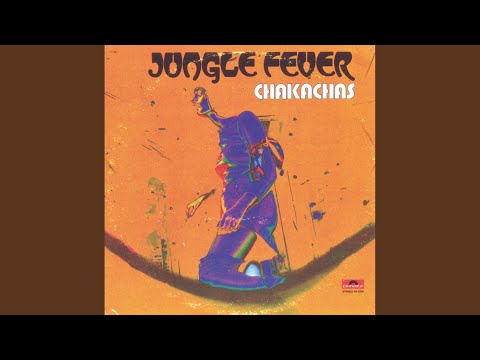
Jungle Fever

Album: Jungle Fever (1972)
Charted: 29 8
Play Video

Songfacts®:

  • You'll need to put the earmuffs on the kids when this one comes on. "Jungle Fever" is a tribal groove with nine breakdowns where a woman moans very suggestively in Spanish. The moaning continues over the music as the song comes to a close, but this time it's accompanied by some grunts from a guy. There's not much doubt what's going on here, but despite the R-rated material, the song was still a pretty big hit, going to #8 in the US, where it got a lot of airplay on R&B radio and went Gold, selling over 500,000 copies of the single. The writer of the song is listed as William Albimoor, sometimes under the name Bill Ador.
  • The Chakachas were a studio group comprised of six middle-aged white guys from Belgium - we'll probably never know who the woman was doing the vocals. The song was released in Belgium and some other countries in Europe on the Polydor label, which concocted a backstory about the group, claiming they were led by a guy named Gaston who painted chickens, and the woman was a congo-playing actress named Kary.

    This ruse was fine until the song was released in the United States, where Polydor needed real people to perform and promote it. That problem was solved by making an arrangement with a New York City group called Bario to become The Chakachas. Bario played Latin rock and had a female singer to perform the grunts and groans in the song, so they were able to pull it off. Bario also had their own catalog, so when they did concerts they could play "Jungle Fever" along with the other Chakachas single - a song called "Stories" - and augment it with their own songs. After "Jungle Fever" abated, Bario planned to revert back to their original name and move on, but they ended up releasing more material as The Chakachas.
  • The Spanish moaning is mostly just exclamations of passion, but there are a few we can translate:

    Ay, ay qué fiebre
    (Oh, oh what a fever)

    Dime, dale, dime
    (Tell me, come on, tell me)

    Suave, suave, suave, suave
    (Soft, soft, soft, soft)
  • "Jungle Fever" shows up in the 1997 movie Boogie Nights in, of course, a sex scene. it's also in the 2004 video game Grand Theft Auto: San Andreas, and in the 2024 movie Blink Twice, directed by Zoë Kravitz.
  • "Jungle Fever" isn't the first popular song with lots of heavy breathing, and it wouldn't be the last. Jane Birkin and Serge Gainsbourg steamed up the windows with their 1969 song "Je T'aime... Moi Non Plus," and in 1975 Donna Summer moaned through her hit "Love To Love You Baby."

Comments

Be the first to comment...

Editor's Picks

Muhammad Ali: His Musical Legacy and the Songs he Inspired

Muhammad Ali: His Musical Legacy and the Songs he InspiredSong Writing

Before he was the champ, Ali released an album called I Am The Greatest!, but his musical influence is best heard in the songs he inspired.

Michael Sweet of Stryper

Michael Sweet of StryperSongwriter Interviews

Find out how God and glam metal go together from the Stryper frontman.

Devo

DevoSongwriter Interviews

Devo founders Mark Mothersbaugh and Jerry Casale take us into their world of subversive performance art. They may be right about the De-Evoloution thing.

Dennis DeYoung

Dennis DeYoungSongwriter Interviews

Dennis DeYoung explains why "Mr. Roboto" is the defining Styx song, and what the "gathering of angels" represents in "Come Sail Away."

Tom Bailey of Thompson Twins

Tom Bailey of Thompson TwinsSongwriter Interviews

Tom stopped performing Thompson Twins songs in 1987, in part because of their personal nature: "Hold Me Now" came after an argument with his bandmate/girlfriend Alannah Currie.

Evolution Of The Prince Symbol

Evolution Of The Prince SymbolSong Writing

The evolution of the symbol that was Prince's name from 1993-2000.