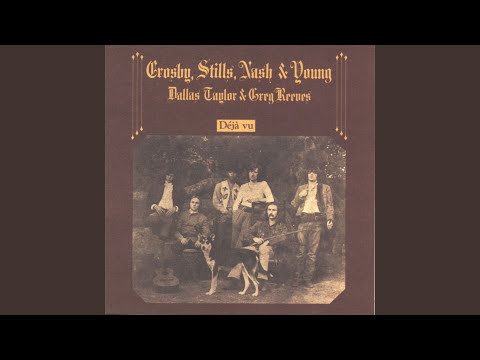
Album: Déjà Vu (1970)
Play Video
  • Four and twenty years ago, I come into this life
    The song of a woman and a man who lived in strife
    He was tired of being poor
    And he wasn't into selling door to door
    And he worked like the devil to be more

    A different kind of poverty now upsets me so
    Night after sleepless night, I walk the floor
    And I want to know- why am I so alone?
    Where is my woman can I bring her home
    Have I driven her away? Is she gone?

    Morning comes to sunrise and I'm driven to my bed.
    I see that it is empty and there's devils in my head
    I embrace the many colored beast
    I grow weary of the torment, can there be no peace?
    And I find myself just wishing that my life would simply cease Lyrics licensed and provided by LyricFind

Comments: 10

  • The "l" LuminatorI believe Mr. Stills was indeed 24 years old when he wrote this song. He was lamenting that his relationship with Judy Collins would soon be a pile of ashes. He was returning home after a night of drinking and substance abuse, perhaps hallucinogens: "I embrace the many colored beasts." He was coming home to an empty bed. The song represents an inventory of his life up until that time.
  • Wendy from Toronto, CanadaThe "many-coloured beast" to me is about different feelings. Green is jealousy and envy. Red is anger. Blue is sadness. Yellow might be feeling weak for not doing more to bring someone (back?) into his life.
  • Michael Amendolara from San Miguel De AllendeI think the "many colored beast" is his pillow. It's a brilliant metaphor! The song is all of a piece and some of the best song writing of the 60's.
  • Original Durangotan from Durango ColoradoStills is pulling someone's leg in the above comments. This is not a song about an old man, but a young man.

    Stills was born on 1945. If this song was written in 1969 or 70 for that matter, Stills would be, you guessed it 24 years old. Or as he put it 4 and 20.

    Thise song is about a (24 year old) who has lost his girlfriend and in in despair over it.

    Also: Many of us born after WW II had fathers who "were tired of being poor." My own Dad "wasn't in to selling door to door" and like many returning Vets "worked like the devil to be more."

    Still's poverty is of his soul.

    Anyone who has lost their lover can identify. I certainly can.
  • Tim from IndianaPetula Clark had a very upbeat "Song of (her) Life" - "4+20" has been the drearier song of my own 59-year life. I absolutely agree with Scottsol that this is about a 24-year-old Stills, still in love with Judy Collins. In his mind, he was probably feeling 84, ready and wishing for death, neither able to live with her, nor without her. I know the ups and downs of this all too well.

    It's interesting to me also, because Stills has all the "signs" of success, and to an "any man" like myself, it would be tempting to say, "why should he be down, he's got it all?" But I know life doesn't work that way - sometimes those with the least are the most content. I try to live that way, downsized from my old stressful job, try to keep my back to the plow, but I still struggle with my own personal failings - I should have done this, or shouldn't have said that type of thing. Ultimately, though, Stephen and I came to the same general conclusion - when we fall, it's best to pick up the pieces and start over again.
  • Dan Schwartz from Bronx, NyI agree that the song is about a 24-year old, not an 84-year old, possibly Stills himself, regardless of what he said later. The singer's father is the one who lived in strife and lifted himself out of being poor and selling door-to-door. The singer never knew literal poverty, so he is more concerned about a different (spiritual or emotional) kind.

    BTW, I initially heard the words right after the title in the opening line as "a-comin' to this life", but I now realize that was not correct. Likewise, I heard the final line as "my life would soon decease" or "soon be ceased", and I know those were wrong too. But I did get the basic meaning, that he was wishing for death.
  • Scottsol from Evanston, IllinoisThe song was written in 1969 and Stills sang it on the Dick Cavett show right after Woodstock when he was, in fact, four and twenty years old. This song, like Suite:Judy Blue Eyes, was inspired by his love for singer Judy Collins. Stills may claim this is about an old man, the lyrics say otherwise.

    While the first stanza mentions his father, the song then shifts to and stays about Stills and Collins.

    “A different kind of poverty now upsets me so”

    “Why am I so alone?
    Where is my woman, can I bring her home?
    Have I driven her away?
    Is she gone?”
  • Pedro from BrazilWhen was the song exactly made? Stills was 25 when it was released, on 1970. If the song was made a little bit earlier, when he was 24, it would be too crazy thinking the song is about Stills himself?
  • Rich from PhillyI’m reading the book that just came out about Crosby, Stills, Nash, and Young and it says that Stills gulped in a moment of emotion between “I” and “embrace the many colored beast” while doing the first take and redid the track to correct it and his bandmates convinced him to keep the original in there as it was raw and real. I always noticed the pause there but never realized why it happened
  • Rebecca from MassachusettsI believe that the 2nd line of 1st verse should read: The son of a woman and a man who lived in strife. [with no g after son] (fixed, thank you - editor)
see more comments

Editor's Picks

Holly Knight ("The Best," "Love Is A Battlefield")

Holly Knight ("The Best," "Love Is A Battlefield")Songwriter Interviews

Holly Knight talks about some of the hit songs she wrote, including "The Warrior," "Never" and "The Best," and explains some songwriting philosophy, including how to think of a bridge.

Marc Campbell - "88 Lines About 44 Women"

Marc Campbell - "88 Lines About 44 Women"They're Playing My Song

The Nails lead singer Marc Campbell talks about those 44 women he sings about over a stock Casio keyboard track. He's married to one of them now - you might be surprised which.

Gentle Giant

Gentle GiantSongwriter Interviews

An interview with Ray and Derek Shulman of the progressive rock band Gentle Giant to discuss counterpoint, polyrhythms, and... Bon Jovi.

Paul Williams

Paul WilliamsSongwriter Interviews

He's a singer and an actor, but as a songwriter Paul helped make Kermit a cultured frog, turned a bank commercial into a huge hit and made love both "exciting and new" and "soft as an easy chair."

Al Kooper

Al KooperSongwriter Interviews

Kooper produced Lynyrd Skynyrd, played with Dylan and the Stones, and formed BS&T.

Edwin McCain

Edwin McCainSongwriter Interviews

"I'll Be" was what Edwin called his "Hail Mary" song. He says it proves "intention of the songwriter is 180 degrees from potential interpretation by an audience."