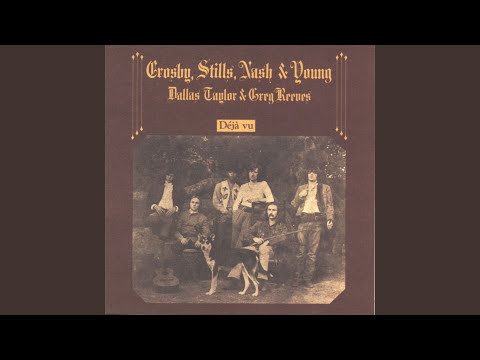
Album: Déjà Vu (1970)
Play Video

Songfacts®:

  • This song was written and sung by Stephen Stills. It tells the sad story of a man who is born into a poor family and finds himself alone in his old age, wishing for death to come. In the CSN boxed set, Stills explained: "It's about an 84-year-old poverty stricken man who started and finished with nothing."
  • Running 2:10, the only instrumentation on this track is Stills' acoustic guitar. He recorded the song in one take and planned to use it on his upcoming debut solo album, but when his bandmates heard it, they implored him to use it on the CSN&Y Déjà Vu album. He recorded the track in one take and planned to have David Crosby and Graham Nash sing harmony parts, but they refused. "They told me they wouldn't touch it," said Stills. "So it always stood alone."
  • The man in this song is 84 years old, but Stills sings that he was born "Four and twenty years ago." Logically, this would mean that he's 24 years old, but there is a bit of poetic license here, as "Sixty-four and twenty years ago" doesn't fit the meter. "Four and Twenty" is a phrase popularized in the children's song "Sing a Song of Sixpence," where four-and-twenty blackbirds are baked in a pie (one of the more disturbing kids' songs).

    "4:20" is also associated with marijuana, but that doesn't apply here. Another close cousin is "four score and seven years ago," the first line of Abraham Lincoln's Gettysburg Address.
  • In David Browne's 2019 book Crosby, Stills, Nash & Young, Nash explains that Stills did indeed record an additional take of the song because he wanted to get rid of the light gulp that occurs between the words "I" and "embrace." Nash and Crosby insisted he keep the original "gulp" version.

    "It was so human, and on such a human song," Nash says in the book. "We convinced Stephen to use the first take."

Comments: 10

  • The "l" LuminatorI believe Mr. Stills was indeed 24 years old when he wrote this song. He was lamenting that his relationship with Judy Collins would soon be a pile of ashes. He was returning home after a night of drinking and substance abuse, perhaps hallucinogens: "I embrace the many colored beasts." He was coming home to an empty bed. The song represents an inventory of his life up until that time.
  • Wendy from Toronto, CanadaThe "many-coloured beast" to me is about different feelings. Green is jealousy and envy. Red is anger. Blue is sadness. Yellow might be feeling weak for not doing more to bring someone (back?) into his life.
  • Michael Amendolara from San Miguel De AllendeI think the "many colored beast" is his pillow. It's a brilliant metaphor! The song is all of a piece and some of the best song writing of the 60's.
  • Original Durangotan from Durango ColoradoStills is pulling someone's leg in the above comments. This is not a song about an old man, but a young man.

    Stills was born on 1945. If this song was written in 1969 or 70 for that matter, Stills would be, you guessed it 24 years old. Or as he put it 4 and 20.

    Thise song is about a (24 year old) who has lost his girlfriend and in in despair over it.

    Also: Many of us born after WW II had fathers who "were tired of being poor." My own Dad "wasn't in to selling door to door" and like many returning Vets "worked like the devil to be more."

    Still's poverty is of his soul.

    Anyone who has lost their lover can identify. I certainly can.
  • Tim from IndianaPetula Clark had a very upbeat "Song of (her) Life" - "4+20" has been the drearier song of my own 59-year life. I absolutely agree with Scottsol that this is about a 24-year-old Stills, still in love with Judy Collins. In his mind, he was probably feeling 84, ready and wishing for death, neither able to live with her, nor without her. I know the ups and downs of this all too well.

    It's interesting to me also, because Stills has all the "signs" of success, and to an "any man" like myself, it would be tempting to say, "why should he be down, he's got it all?" But I know life doesn't work that way - sometimes those with the least are the most content. I try to live that way, downsized from my old stressful job, try to keep my back to the plow, but I still struggle with my own personal failings - I should have done this, or shouldn't have said that type of thing. Ultimately, though, Stephen and I came to the same general conclusion - when we fall, it's best to pick up the pieces and start over again.
  • Dan Schwartz from Bronx, NyI agree that the song is about a 24-year old, not an 84-year old, possibly Stills himself, regardless of what he said later. The singer's father is the one who lived in strife and lifted himself out of being poor and selling door-to-door. The singer never knew literal poverty, so he is more concerned about a different (spiritual or emotional) kind.

    BTW, I initially heard the words right after the title in the opening line as "a-comin' to this life", but I now realize that was not correct. Likewise, I heard the final line as "my life would soon decease" or "soon be ceased", and I know those were wrong too. But I did get the basic meaning, that he was wishing for death.
  • Scottsol from Evanston, IllinoisThe song was written in 1969 and Stills sang it on the Dick Cavett show right after Woodstock when he was, in fact, four and twenty years old. This song, like Suite:Judy Blue Eyes, was inspired by his love for singer Judy Collins. Stills may claim this is about an old man, the lyrics say otherwise.

    While the first stanza mentions his father, the song then shifts to and stays about Stills and Collins.

    “A different kind of poverty now upsets me so”

    “Why am I so alone?
    Where is my woman, can I bring her home?
    Have I driven her away?
    Is she gone?”
  • Pedro from BrazilWhen was the song exactly made? Stills was 25 when it was released, on 1970. If the song was made a little bit earlier, when he was 24, it would be too crazy thinking the song is about Stills himself?
  • Rich from PhillyI’m reading the book that just came out about Crosby, Stills, Nash, and Young and it says that Stills gulped in a moment of emotion between “I” and “embrace the many colored beast” while doing the first take and redid the track to correct it and his bandmates convinced him to keep the original in there as it was raw and real. I always noticed the pause there but never realized why it happened
  • Rebecca from MassachusettsI believe that the 2nd line of 1st verse should read: The son of a woman and a man who lived in strife. [with no g after son] (fixed, thank you - editor)
see more comments

Editor's Picks

Art Alexakis of Everclear

Art Alexakis of EverclearSongwriter Interviews

The lead singer of Everclear, Art is also their primary songwriter.

La La Brooks of The Crystals

La La Brooks of The CrystalsSong Writing

The lead singer on "Da Doo Ron Ron" and "Then He Kissed Me," La La explains how and why Phil Spector replaced The Crystals with Darlene Love on "He's A Rebel."

Trans Soul Rebels: Songs About Transgenderism

Trans Soul Rebels: Songs About TransgenderismSong Writing

A history of songs dealing with transgender issues, featuring Pink Floyd, David Bowie, Morrissey and Green Day.

Lajon Witherspoon of Sevendust

Lajon Witherspoon of SevendustSongwriter Interviews

The Sevendust frontman talks about the group's songwriting process, and how trips to the Murder Bar helped forge their latest album.

Jon Anderson of Yes

Jon Anderson of YesSongwriter Interviews

From the lake in "Roundabout" to Sister Bluebird in "Starship Trooper," Jon Anderson talks about how nature and spirituality play into his lyrics for Yes.

Angelo Moore of Fishbone

Angelo Moore of FishboneSongwriter Interviews

Fishbone has always enjoyed much more acclaim than popularity - Angelo might know why.