Einstein On The Beach (For An Eggman)

Album: Films About Ghosts: The Best Of... (1994)
Charted: 45
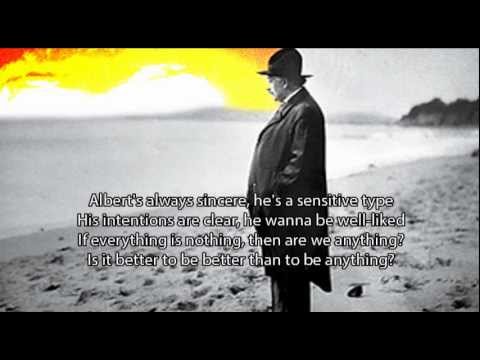
Play Video

Songfacts®:

  • With references to the classic children's poem Humpty Dumpty (the "eggman" in this song), this can be seen as a statement on what we're able to achieve if we accept the possibility of failure (falling off the wall). Counting Crows lead singer Adam Duritz tells us, however, that it's "Just kind of a goofy thing I did."

    He does concede that it might have some meaning, though. "It sort of takes the idea of, what if you're someone who's a brilliant mathematician like Albert Einstein or any of us doing creative work on something that seems so clean and brilliant, and then it turns out to be an atomic bomb," he said. "It's your idea, which is so amazing and graceful in and of itself, but it turns into something not so great."

    Duritz wrote the song with the band's guitarist, Dave Bryson.
  • In Adam's estimation, this song was recorded around 1991 when the band was just starting out, and it was a home recording. He didn't consider the song for their debut album August and Everything After, but when their label, Geffen Records, asked him for a song they could use on their DGC Rarities Volume 1 album, Adam turned it over, figuring that nobody would ever hear it. These "rarities" albums were a way for record companies to make use of the musical detritus that wasn't otherwise released. Rarities Volume 1 also contained songs by Nirvana, Weezer, The Sundays and Teenage Fanclub, but nothing that would interest radio. "Einstein," however, was pegged as a hit and the label sent it to radio stations. The song made #45 on the Billboard Airplay chart and topped the Alternative Songs chart.
  • When this song caught on, it caused Adam Duritz considerable consternation, as he was trying to avoid a Hootie & the Blowfish situation where their songs got played so much that listeners turned on them. To guard against overexposure, Duritz refused to make a video for "Rain King" and cut back on promotion for the album once they saturated the airwaves.
  • The more he talked about this song, but fonder Adam's memories of it grew. "I think it's a great pop song," he said. "I like listening to it every now and then because the harmonies are so good, and the unabashed enthusiasm of my singing on that song is fun for me to hear."

Comments: 6

  • Michael from Pittsburgh, PaEinstein actually wrote a letter to Roosevelt urging the development of the atomic bomb at the request of Szilard. Both men felt, as did many of the scientists eventually recruited to work on the Manhattan Project, that the Germans were probably working on the bomb themselves, and that the Germans were certainly capable of developing it with the scientists and resources they had in Germany. Einstein urged Roosevelt to develop the bomb first so that the Germans could not use it to their advantage in the war. He regretted this letter almost immediately, and came to deeply regret it when it became clear that the Germans had never really tried to develop the bomb in the first place. He was always a passionate pacifist.

    I agree that there's a strong current of anti-nuclear sentiment in this song, at least as I hear it. It's also a great song to just enjoy listening to.
  • Andrés from Montevideo, UruguayI totally agree with you Chris, I totally believe this song is about the effects of atomic bomb and anti-nuke. "The world begins to disappear" that's one of the consecuences of nuclear war, "One more shadow leans against the wall" that refers to what happens in a nuclear explosion, people close to ground zero are evaporated and the only remains are shadows on the wall.
    It's an excelent song.
  • Matthew from Milford, Ma...Eggman?!? Dr. Eggman?
  • Joe from Nome, AkThis is a reference to Plato's Allegory of the Cave in The Republic. The "shadows on the wall" are the most telling of this reference.
  • Chris from Meridian, IdI've always thought there was a pretty strong anti-nuke aspect to this song -- "Albert's vision blooming uncontrolled" -- "One more sun comes sliding down the sky" -- The work of Albert Einstein, of course, was fundamental to the understanding of atomic energy and, vis a vis, the creation of the nuclear bomb. The song seems to imply that Einstein is remorseful about how his discoveries have been used. (Though it's probably unrelated, there's also a post-apocalyptic movie called "On the Beach")
  • Bob from Jackson, MiEinstein on the Beach is also the title of an opera composed by Phillip Glass: http://en.wikipedia.org/wiki/Einstein_on_the_Beach
    http://en.wikipedia.org/wiki/Philip_Glass
see more comments

Editor's Picks

Cheerleaders In Music Videos

Cheerleaders In Music VideosSong Writing

It started with a bouncy MTV classic. Nirvana and MCR made them scary, then Gwen, Avril and Madonna put on the pom poms.

Shaun Morgan of Seether

Shaun Morgan of SeetherSongwriter Interviews

Shaun breaks down the Seether songs, including the one about his brother, the one about Ozzy, and the one that may or may not be about his ex-girlfriend Amy Lee.

Real or Spinal Tap

Real or Spinal TapMusic Quiz

They sang about pink torpedoes and rocking you tonight tonight, but some real lyrics are just as ridiculous. See if you can tell which lyrics are real and which are Spinal Tap in this lyrics quiz.

Ian Anderson of Jethro Tull

Ian Anderson of Jethro TullSongwriter Interviews

The flautist frontman talks about touring with Led Zeppelin, his contribution to "Hotel California", and how he may have done the first MTV Unplugged.

Stan Ridgway

Stan RidgwaySongwriter Interviews

Go beyond the Wall of Voodoo with this cinematic songwriter.

Dar Williams

Dar WilliamsSongwriter Interviews

A popular contemporary folk singer, Williams still remembers the sticky note that changed her life in college.