The Liberty Bell

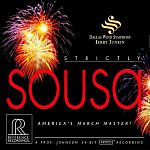
Album: Strictly Sousa (1893)
Play Video

Songfacts®:

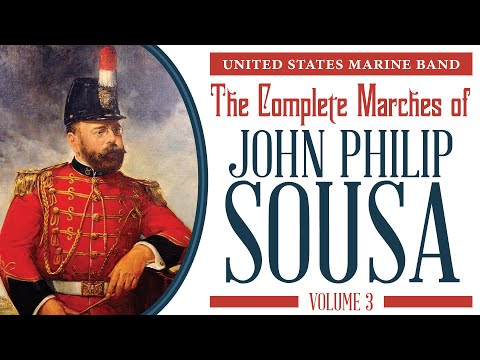
  • John Philip Sousa was an American composer and conductor dubbed "The March King" thanks to his knack for crafting some of the most famous military marches of the late 19th century, including "The Stars And Stripes Forever," "Semper Fidelis," "The Washington Post," and "The Liberty Bell." Sousa composed the latter march for the would-be operetta The Devil's Deputy at the request of actor Francis Wilson, who was adding comic opera to his repertoire. But Wilson wasn't willing to pay Sousa the $1,500 he wanted for the job, so the project was shelved. Sousa was left with an unfinished manuscript for a production that would never come to fruition, but it wasn't entirely useless - it contained a rousing march that just needed the right title. And he found it at the Chicago World's Fair in 1893.

    Sousa and his band manager George Frederick Hinton attended the Columbian Exposition, belatedly celebrating the 400th anniversary of Christopher Columbus' arrival in the New World, and watched a spectacle titled "America," which featured a backdrop of the Liberty Bell. An enduring symbol of American independence ever since it was mounted in the steeple of the Pennsylvania State House in 1752, it struck Hinton as the perfect title for the unnamed march. When Sousa learned his son had just marched in a parade in Philadelphia honoring the return of the Liberty Bell after its national tour, he agreed. That same year, he sold the sheet music for "The Liberty Bell" to the John Church Company for publication. The march was a huge success and earned Sousa over $40,000 in royalties within seven years.
  • According to Marcella Lindh, the first soprano to sing with the Sousa Band, the march was based on a melody she came up with. She happened to be whistling it one day and it caught Sousa's ear. Don't worry, he didn't steal it. She gave him permission to include it in one of his marches and forgot all about it until, years later, she heard a performance of "The Liberty Bell" in Europe and recognized the melody.
  • Sousa didn't become the March King by sticking to the status quo. He revolutionized the American military march by expressing passion through simplicity. Said biographer Paul E. Bierley, author of John Philip Sousa: American Phenomenon: "He believed that a march should have a logical, clean-cut harmonic structure and a straightforward counterpoint which did not detract from the overall theme of the march."

    To stir up a sense of patriotism in the hearts of listeners - enough, Sousa said, to "make a man with a wooden leg want to step out and march" - Sousa imagined himself on the battlefield among "scenes of barbaric splendor" to capture the fervent spirit in his compositions:

    "I picture to myself the glitter of guns and swords, the tread of feet to the drum beat, and all that is grand and glorious in military scenes. How these compositions come I cannot tell. It is an utter mystery to me."
  • Sousa served as director of the United States Marine Band, also known as The President's Own, for 12 years. During his tenure, from 1880 to 1892, the Columbia Phonograph Company made numerous recordings of the band, which brought them international exposure and aided in Sousa's success when he left to pursue his civilian career as a bandleader.

    But if it were up to Sousa, we'd never hear his own band performing his music more than a century later. He believed music was meant to be played and experienced live and was staunchly against the idea of recorded music and mechanical instruments like the self-playing pianola. In fact, he often refused to conduct the band during the times they were recorded. He even wrote an essay for Appleton's Magazine in 1906 titled "The Menace Of Mechanical Music," which dismissed the practice as a "substitute for human skill, intelligence and soul" and foretold the "marked deterioration in American music and musical taste." After all, a recorded piece was frozen in time, eliminating the possibility of improvisation and evolution.

    He was also worried that the popularity of recorded music would hurt musicians' careers, keeping listeners glued to their gramophones instead of seeking out live music. There was also the issue of compensation as composers weren't paid royalties from the manufacturers of mechanical instruments that played sheet music. Sousa brought his concerns about composers' rights to Congress in 1906 and influenced the Copyright Act of 1909.
  • The United States Marine Band performed this at the presidential inaugurations for Bill Clinton, George W. Bush, Barack Obama, and Donald Trump.
  • A 1938 recording by the Band of the Grenadier Guards was used as the theme song to the BBC comedy series Monty Python's Flying Circus from 1969 to 1974. According to legend, Terry Gilliam, the sole American among Brits in the comedy troupe, suggested the march because it was in the public domain and could be used for free. Gilliam, who also created the show's opening titles, introduced Monty Python's irreverent brand of humor by pairing the brassy patriotic theme with surreal cut-out animations, including a giant foot that squashes the sequence with a flatulent splat.
  • This was used in these TV series:

    12 Monkeys ("One Hundred Years" - 2016)
    Preacher ("Pilot" - 2016)
    It's Always Sunny In Philadelphia ("Mac And Dennis Buy A Timeshare" - 2013)
    Last Tango In Halifax ("Episode #1.3" - 2012)
    Sherlock ("The Hounds Of Baskerville" - 2012)
    Pinky And The Brain ("Around The World In 80 Narfs" - 1996)
    Family Ties ("The Other Woman" - 1987)
    Mannix ("The Many Deaths Of Saint Christopher" - 1967)

    And these movies:

    Anytown, USA (2005)
    The Adventures Of Ociee Nash (2002)
    Dummy (2002)
    One Night Stand (1997)
    Appointment With Death (1988)
    Octopussy (1983)
    The Prince And The Showgirl (1957)

Comments

Be the first to comment...

Editor's Picks

Muhammad Ali: His Musical Legacy and the Songs he Inspired

Muhammad Ali: His Musical Legacy and the Songs he InspiredSong Writing

Before he was the champ, Ali released an album called I Am The Greatest!, but his musical influence is best heard in the songs he inspired.

Michael Sweet of Stryper

Michael Sweet of StryperSongwriter Interviews

Find out how God and glam metal go together from the Stryper frontman.

Devo

DevoSongwriter Interviews

Devo founders Mark Mothersbaugh and Jerry Casale take us into their world of subversive performance art. They may be right about the De-Evoloution thing.

Dennis DeYoung

Dennis DeYoungSongwriter Interviews

Dennis DeYoung explains why "Mr. Roboto" is the defining Styx song, and what the "gathering of angels" represents in "Come Sail Away."

Tom Bailey of Thompson Twins

Tom Bailey of Thompson TwinsSongwriter Interviews

Tom stopped performing Thompson Twins songs in 1987, in part because of their personal nature: "Hold Me Now" came after an argument with his bandmate/girlfriend Alannah Currie.

Evolution Of The Prince Symbol

Evolution Of The Prince SymbolSong Writing

The evolution of the symbol that was Prince's name from 1993-2000.