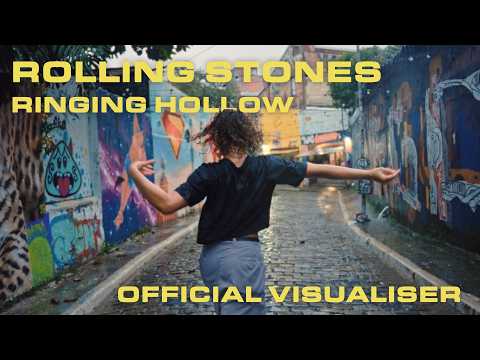
Ringing Hollow

Album: Foreign Tongues (2026)
Play Video

Songfacts®:

  • "Ringing Hollow" is Mick Jagger's tender declaration of love for a country whose ideals still inspire him, accompanied by a growing sense that the reality has fallen short of the promise.

    "It's about America as an idea," Jagger told Mojo magazine. "The American dream is intact for some people, and I'm sure we can find some wonderful immigrant stories that happened in the last 12 months, but we read about the decline of the American Empire."

    Jagger also wondered whether the Iran war might represent America's equivalent of Britain's Suez crisis, the 1956 debacle that exposed the limits of British imperial power. He acknowledged the situations weren't directly comparable but saw questions about imperial overreach and the influence of money in American politics. The sums spent on elections were "absurd," he said, even if they did not necessarily amount to corruption. He concludes that America is no longer quite the place it had been.
  • "Ringing Hollow" initially sounds like a conventional country love song until it becomes clear the object of Mick Jagger's affections is America itself. The song deliberately disguises its subject. "You're cheating the audience by making them think it's about a woman, and then you realize by line four, or maybe later, that it's not about women," Jagger told Apple Music's Zane Lowe. The Statue of Liberty serves as a metaphor, turning what initially appears to be a romantic ballad into a troubled love letter to a nation.
  • Keith Richards liked the track right away, describing it as "a very tender sort of love song to America and what the f--k went wrong." He recalled growing up in the 1950s, when American jukeboxes, cigarettes, and radio stations seemed to represent a world of possibilities. Having radio stations that offered a wide range of music, as opposed to Britain's more limited BBC monopoly, was so appealing that he felt he could "die and go to heaven just to have that." America had seemed marvelous from a distance, he explained, but closer inspection revealed "a few cracks in the bell." Those cracks, he suggested, were worth writing about, too.
  • The title captures the song's central disappointment. Something that rings hollow still makes a noise, but there is little substance behind it. In the chorus, the words "hollow," "deep," and "loud" suggest that America's ideals can still be heard, even as their meaning becomes harder to believe in. The country continues to proclaim its promises; the question is how much of them remain true.
  • Several lyrics lean toward America under Donald Trump's second presidency, including a scoundrel "trying to whip up the crowd" and a king "trying to pick up the crown." The Stones have a long history of objecting to Trump's use of their music, although they have not explicitly identified "Ringing Hollow" as an attack on him.

    In May 2016, the band said it had not authorized Trump's use of "You Can't Always Get What You Want" and demanded that he cease all use immediately. He played it again after his speech at the Republican National Convention in Cleveland that July. Jagger took a swipe at him onstage in summer 2019 and later criticized his position on climate change. In 2020, the band threatened legal action if he continued using their tracks at campaign rallies.

    Asked by The London Sunday Times whether "Ringing Hollow" was an anti-Trump song, Richards declined to give a direct answer. Instead, he called it "a nostalgic love affair with America, and [it being] a bit of a disappointment at the moment."
  • The track continues the Rolling Stones' long-running flirtation with country music. Their country catalog stretches from "Country Honk," the reworking of "Honky Tonk Women" on Let It Bleed (1969), and "Dead Flowers" on Sticky Fingers (1971) to "Sweet Virginia" on Exile on Main St. (1972) and "Far Away Eyes" on Some Girls (1978). "Wild Horses" often enters the same conversation, although its sound sits closer to country-rock or Americana.

    "Keith and I, when we were really young, we both liked country music a lot," Jagger told Conan O'Brien.

    The pair were particularly fond of Hank Williams. They knew they could not simply imitate the musicians they admired, he explained, but they absorbed the style. For "Ringing Hollow," he felt a country arrangement was more appropriate than a straight rock treatment: "It's a love song to America... I didn't want to express it in a rock way. I thought it was better that we did it in a country way."
  • "Ringing Hollow" appears as Track 6 on the Foreign Tongues album, following the rockers "Rough and Twisted" and "In The Stars" and the soul-leaning "Jealous Lover." Its unhurried country arrangement eases the pace and gives the album its most openly reflective political moment. It also fits the record's wider preoccupation with fate, chance, and the state of the world, themes that surface elsewhere on "In the Stars" and "Divine Intervention." Foreign Tongues reached #1 on the UK albums chart and #7 on the US Billboard 200.
  • "Ringing Hollow" is a kind of long-distance love song to America. Mick Jagger approaches the country with affection but is also alert to the tensions and contradictions beneath the surface.

    "I was writing three songs about 'America today,' if you want," Jagger explained to Uncut magazine. "I was in competition with myself. This was the best melodically, but I also liked it because it begins like a love song to a woman. So you're not putting America down, you're showing your affection, but also what you've experienced, and sounding those familiar warning signs in very American ways – that cracks in the Liberty Bell and so on."

Comments

Be the first to comment...

Editor's Picks

Adele

AdeleFact or Fiction

Despite her reticent personality, Adele's life and music are filled with intrigue. See if you can spot the true tales.

Lori McKenna

Lori McKennaSongwriter Interviews

Lori's songs have been recorded by Faith Hill and Sara Evans. She's performed on the CMAs and on Oprah. She also has five kids.

Protest Songs

Protest SongsMusic Quiz

How well do you know your protest songs (including the one that went to #1)?
Hawksley Workman

Hawksley WorkmanSongwriter Interviews

One of Canada's most popular and eclectic performers, Hawksley tells stories about his oldest songs, his plentiful side projects, and the ways that he keeps his songwriting fresh.

Dino Cazares of Fear Factory

Dino Cazares of Fear FactorySongwriter Interviews

The guitarist/songwriter explains how he came up with his signature sound, and deconstructs some classic Fear Factory songs.
Zac Hanson

Zac HansonSongwriter Interviews

Zac tells the story of Hanson's massive hit "MMMbop," and talks about how brotherly bonds effect their music.