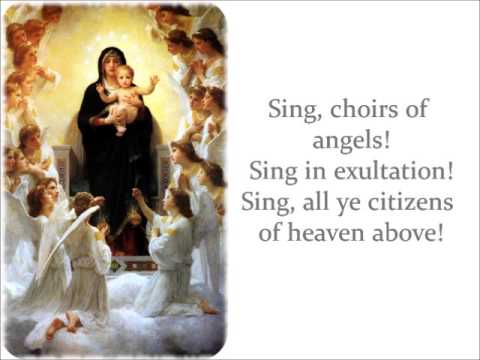
O Come All Ye Faithful

Album: Noel (1853)
Play Video

Songfacts®:

  • This carol is generally attributed to John Wade, a British exile living in France after fleeing the Jacobean rebellion. He earned a living by teaching music and copying plain chant and hymn manuscripts for private use. Around 1741 Wade put the Latin text of "Adeste Fideles" to music and later included it in his 1751 publication of Cantus Diversi.

    There are conflicting theories that Wade wrote the original text of "Adeste Fideles" himself or took the words from an anonymous Latin Hymn, written by monks, possibly as early as the 13th century. The original four verses of the hymn were later extended to a total of eight, (the eighth verse is rarely sung), three of them probably by Abbe Etienne Jean Francois Borderies. It is thought that Abbe Borderies heard the hymn sung while exiled in England during the French Revolution and wrote the three additional stanzas after he returned to France in 1794. In 1853 the familiar English translation first appeared, attributed to the Reverend Frederick Oakeley.
  • Oakeley was ordained into the Church of England in 1828, switching to Roman Catholicism in 1845. He was appointed canon at Westminster Cathedral in 1852 and for many years he worked among the poor of Westminster. Small of stature, lame and short-sighted he did not look like a charismatic person, but his writings, charm and personality meant he exercised a wide influence. He is best remembered for his translation of "Adeste Fideles."
  • "O Come All Ye Faithful" is reputed to be the favorite Christmas carol of President Dwight D. Eisenhower and in its original form of "Adeste Fideles," President Thomas Jefferson.
  • The chant "Why Are We Waiting," which is generally sung by a frustrated gathering of people waiting for somebody to turn up, is sung to the tune of "O Come All Ye Faithful."
  • According to Professor Bennett Zon, the head of the department of music at Durham University in England, John Wade's text of "Adeste Fideles" has "clear references" to Bonnie Prince Charlie. The 18th century prince was the grandson of England's last Catholic monarch, James II and in 1745 he led a rebellion intent on restoring the Catholic House of Stuart to the English throne. Professor Zon claimed in a BBC television program The Truth About Carols that there is far more to this carol than meets the eye. He argued: "Fideles is Faithful Catholic Jacobites. Bethlehem is a common Jacobite cipher for England, and Regem Angelorum is a well-known pun on Angelorum, angels, and Anglorum, English. The meaning of the Christmas carol is clear: 'Come and Behold Him, Born the King of Angels' really means, 'Come and Behold Him, Born the King of the English' - Bonnie Prince Charlie!"
  • Mariah Carey recorded this carol on her second Christmas album, Merry Christmas II You, which was released on November 2, 2010. Her version also features the singer's mother Patricia Carey who is a former opera singer.

    Another popular modern version is by Josh Groban, who recorded the song with the Mormon Tabernacle Choir and released it on his 2007 album Noël.
  • As "Adeste Fideles," Bing Crosby released the only version of this song to chart in the US, reaching #45 in 1960.
  • Dee Snider of Twisted Sister claims that the group's hit "We're Not Gonna Take It" is based on the melody to this song. To prove his point, Twisted Sister did a version of "O Come All Ye Faithful" set to the music of We're Not Gonna Take It on their 2006 album A Twisted Christmas.
  • This was prominently featured in the 1988 Brady Bunch TV movie A Very Brady Christmas. While Mike Brady is trapped in a partially collapsed building, Carol Brady leads the onlookers in a chorus of "O Come All Ye Faithful" until Mike miraculously emerges from the rubble. She also sang the tune in the 1969 episode "The Voice Of Christmas."

Comments: 1

  • Mike from Bradenville, PaTwisted Sister did a great cover of this on their holiday album released in 2006. It's done to the music of their hit We're Not Gonna Take It!
see more comments

Editor's Picks

Mick Jones of Foreigner

Mick Jones of ForeignerSongwriter Interviews

Foreigner's songwriter/guitarist tells the stories behind the songs "Juke Box Hero," "I Want To Know What Love Is," and many more.

Colin Hay

Colin HaySongwriter Interviews

Established as a redoubtable singer-songwriter, the Men At Work frontman explains how religion, sobriety and Jack Nicholson play into his songwriting.

90s Metal

90s MetalFact or Fiction

Test your metal - Priest, Maiden, and Beavis and Butt-head show up in this one.

Psychedelic Lyrics

Psychedelic LyricsMusic Quiz

Whoa man! Do you know which band came up with these cosmic lyrics?

Jim Adkins of Jimmy Eat World

Jim Adkins of Jimmy Eat WorldSongwriter Interviews

Jim talks about the impact of "The Middle" and uses a tree metaphor to describe his songwriting philosophy.

Rob Halford of Judas Priest

Rob Halford of Judas PriestSongwriter Interviews

Rob Halford dives into some of his Judas Priest lyrics, talking about his most personal songs and the message behind "You've Got Another Thing Comin'."